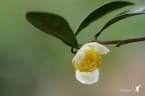
Camellia sinensis assamica
Camellia sinensis assamica
Safety & Hazards
None known
Cultivation Details
Found from the warm temperate zone, through the subtropics and into the tropics of southern Asia, Camellia sinensis originated in an area of monsoon climates and mild winters. The plant has proved very amenable to cultivation and is now grown as far north as 42° North and south to Argentina at 27° South[1]. The var sinensis can tolerate winter temperatures falling occasionally as low as -5 to -10°c, and grows best in the warm temperate to subtropical zone, whilst var assamica is less cold tolerant and is found from the subtropics to tropical areas. Depending on latitude, the plant can be grown at elevations from sea level to 2,300 metres[1]. Whilst a minimum mean annual rainfall of 1,700mm is required for economic production[1], the plant is reported to tolerate an annual precipitation in the range of 700 - 3,500mm[2, 1]. Rainfall should not fall below 50mm per month for any prolonged period[1]. Generally, optimum temperatures for shoot growth are 18 - 30°c, the base temperature, below which shoot growth stops, is about 12.5°c[1]. Prefers a woodland soil but thrives in a warm open well-drained loam if leafmould is added[3, 4, 5]. A calcifuge plant, preferring a pH between 5 and 7[4, 5]. Prefers a pH of 4.5 - 5.6[1]. Prefers the partial shade of a light woodland or a woodland clearing[6, 5]. Tea is generally more productive without shade, but shade trees may be necessary to reduce air temperatures during hot periods, e.g. In Assam and Bangladesh. Shelter belts of trees planted between fields are beneficial in protecting tea against prevailing strong winds[1]. Plants develop a strong taproot and many lateral roots, giving rise to a dense mat of feeding roots in the top 50 - 75cm of the soil[1]. Some lateral roots grow 3 - 4 metres deep[1]. Camellia sinensis assamica is widely cultivated in tropical areas for its leaves which are used to make China tea[3]. The plant is also very ornamental and is sometimes grown in gardens for its flowers[3], Tea is usually distinguished by the Chinese people as small leaf tea (var sinensis) with a more northern distribution and large leaf tea (var assamica) with a more southern distribution. However, there are other varieties of Camellia sinensis and even some other species of Camellia that are used locally as tea[7]. Climatic conditions have a great influence on the quality of the tea, especially on the flavour. Fast shoot growth - for instance at low altitudes, during the best part of the growing season or shortly after the bushes have been pruned back - is detrimental to the quality of tea, particularly the flavour, but induces high production. Nevertheless, high yields and excellent quality tea can be obtained in tropical countries on fertile soils, especially at elevations of 1,200 - 1,800 metres above sea-level. At still higher elevations, the tea will have a well-developed flavour but it will lack strength and yields will be lower[1]. The distinction between green tea and black tea concerns the processing of the leaves whether they are just wilted before drying (green tea) or wilted and then fermented before drying (black tea)[7]. Flowering starts when tea plants are about 4 years old. In the tropics flowering in non-plucked tea occurs year-round[1]. The fragrant flowers are pollinated mainly by insects such as moths and bees[8, 1]. Only cross-pollination gives good fruit set and seed, especially in var. Assamica, which appears to have a system of self-incompatibility. Fruits take 10-12 months to mature; ripe fruits dehisce the seeds by splitting open from the apex into 3 valves[1]. The fragrant flowers are very attractive to insects, particularly moths[8]. Plants are not very self-compatible, self-fertilized flowers produce few seeds and these are of low viability[5]. Both wild and cultivated forms of tea plant (Camellia sinensis) are monoecious, insect-pollinated and self-incompatible[9].
Propagation
Seed - can be sown as soon as it is ripe[10]. Stored seed should be pre-soaked for 24 hours in warm water and the hard covering around the micropyle should be filed down to leave a thin covering[11, 10, 12]. It usually germinates in 1 - 3 months at 23°c[12]. Prick out the seedlings into individual pots when they are large enough to handle and grow them on in light shade. Plant them out into their permanent positions when they are more than 15cm tall. Seedlings take 4 - 12 years before they start to produce seed[2]. There are approximately 500 seeds per kilo[2]. Cuttings of almost ripe wood, 10 - 15cm with a heel, in a shaded frame. High percentage but slow[11]. Cuttings of firm wood, 7 - 10cm with a heel, in a frame[4, 11]. Leaf-bud cuttings in a frame. Cite as: Tropical Plants Database, Ken Fern. tropical.theferns.info. 2026-02-20. <tropical.theferns.info/viewtropical.php?id=Camellia+sinensis+assamica>
Pollinators
Bees
References
- [1]World Agroforesty Centre — http://www.worldagroforestry.org/ ↩︎An excellent online database of a huge range of trees giving very good information on each plant - its uses, ecology, identity, propagation, pests etc.
- [2]Handbook of Energy Crops — Duke. J. · - · 1983 · https://hort.purdue.edu/newcrop/duke_energy/dukeindex.html · ISBN - ↩︎Published only on the Internet, excellent information on a wide range of both temperate and tropical plants.
- [3]RHS Dictionary of Plants plus Supplement. 1956 — F. Chittendon. · Oxford University Press · 1951 · ISBN - ↩︎Comprehensive listing of species and how to grow them. Somewhat outdated, it has been replaced in 1992 by a new dictionary (see [ 200 ]).
- [4]Trees and Shrubs Hardy in Great Britain. Vol 1 - 4 and Supplement. — Bean. W. · Murray · 1981 · ISBN - ↩︎A classic with a wealth of information on the plants, but poor on pictures.
- [5]The New RHS Dictionary of Gardening. 1992. — Huxley. A. · MacMillan Press · 1992 · ISBN 0-333-47494-5 ↩︎Excellent and very comprehensive, though it contains a number of silly mistakes. Readable yet also very detailed.
- [6]The Milder Garden. — Taylor. J. · Dent · 1990 ↩︎A good book on plants that you didn't know could be grown outdoors in Britain.
- [7]Flora of China — Missouri Botanical Garden Press; St. Louis. · 1994 · http://flora.huh.harvard.edu/china/ ↩︎An excellent, comprehensive resource in 25 volumes. In addition to the botanical information the flora also gives basic information on habitat and some uses. An on-line version is also available.
- [8]Gardening on Walls — Grey-Wilson. C. & Matthews. V. · Collins · 1983 · ISBN 0-00-219220-0 ↩︎A nice little book about plants for growing against walls and a small section on plants that can grow in walls.
- [9]Genetic Divergence between Camellia sinensis and Its Wild Relatives Revealed via Genome-Wide SNPs from RAD Sequencin — Hua Yang; Chao-Ling Wei et al · 2016 · ISBN DOI:10.1371/journ ↩︎
- [10]The Reference Manual of Woody Plant Propagation. — Dirr. M. A. and Heuser. M. W. · Athens Ga. Varsity Press · 1987 · ISBN 0942375009 ↩︎A very detailed book on propagating trees. Not for the casual reader.
- [11]Propagation of Trees, Shrubs and Conifers. — Sheat. W. G. · MacMillan and Co · 1948 · ISBN - ↩︎A bit dated but a good book on propagation techniques with specific details for a wide range of plants.
- [12]Growing from Seed. Volume 3. — Bird. R. (Editor) · Thompson and Morgan. · 1989 · ISBN - ↩︎Very readable magazine with lots of information on propagation.
- [13]Tropical and Subtropical Trees - A Worldwide Encyclopaedic Guide. — Barwick. M. · Thames & Hudson, London · 2004 · ISBN 0-500-51181-0 ↩︎A superb book, very concise and well written, giving a wealth of information on 400 or more species including descriptions, habitat, cultivation details and plant uses. A wealth of colour photographs bring each plant vividly to life.
- [14]Cornucopia - A Source Book of Edible Plants. — Facciola. S. · Kampong Publications · 1990 · ISBN 0-9628087-0-9 ↩︎Excellent. Contains a very wide range of conventional and unconventional food plants (including tropical) and where they can be obtained (mainly N. American nurseries but also research institutes and a lot of other nurseries from around the world.
- [15]Encyclopaedia of Herbs and their Uses. — Bown. D. · Dorling Kindersley, London. · 1995 · ISBN 0-7513-020-31 ↩︎A very well presented and informative book on herbs from around the globe. Plenty in it for both the casual reader and the serious student. Just one main quibble is the silly way of having two separate entries for each plant.
- [16]Famine Foods listed in the Chiu-Huang Pen-ts'ao. — Reid. B. E. · Southern Materials Centre; Taipei · 1977 · ISBN - ↩︎A translation of an ancient Chinese book on edible wild foods. Fascinating.
- [17]Medicinal Plants of China — Duke. J. A. and Ayensu. E. S. · Reference Publications, Inc. · 1985 · ISBN 0-917256-20-4 ↩︎Details of over 1,200 medicinal plants of China and brief details of their uses. Often includes an analysis, or at least a list of constituents. Heavy going if you are not into the subject.
- [18]The Encyclopedia of Medicinal Plants — Chevallier. A. · Dorling Kindersley. London · 1996 · ISBN 9-780751-303148 ↩︎An excellent guide to over 500 of the more well known medicinal herbs from around the world.
- [19]Phenolic Antioxidants from Green Tea Produced from Camellia crassicolumna Var. multiplex — Qing Liu; Ying-Jun Zhang; Chong-Ren Yang & Mei Xu · 2009 · ISBN DOI: 10.1021/jf80 ↩︎A research paper.
- [20]A Modern Herbal. — Grieve. · Penguin · 1984 · ISBN 0-14-046-440-9 ↩︎Not so modern (1930's?) but lots of information, mainly temperate plants.
- [21]Atlas of Medicinal Plants. — Kariyone. T. · Nihon Rinshosha; Osaka · 1973 ↩︎A good Japanese herbal.
- [22]Narcotic Plants — Emboden. W. · Studio Vista · 1979 · ISBN 0-289-70864-8 ↩︎A lot of details about the history, chemistry and use of narcotic plants, including hallucinogens, stimulants, inebriants and hypnotics.
- [23]Glossary of Indian Medicinal Plants (Including the Supplement). — Chopra. R. N., Nayar. S. L. and Chopra. I. C. · Council of Scientific and Industrial Research, New Delhi. · 1986 · ISBN - ↩︎Very terse details of medicinal uses of plants with a wide range of references and details of research into the plants chemistry. Not for the casual reader.
- [24]Native American Ethnobotany — Moerman. D. · Timber Press. Oregon. · 1998 · ISBN 0-88192-453-9 ↩︎Very comprehensive but terse guide to the native uses of plants. Excellent bibliography, fully referenced to each plant, giving a pathway to further information. Not for the casual reader.
- [25]Nature's Colors - Dyes from Plants. — Grae. I. · MacMillan Publishing Co. New York. · 1974 · ISBN 0-02-544950-8 ↩︎A very good and readable book on dyeing.
- [26]Vegetable Tannins — Rottsieper. E.H.W. · The Forestal Land, Timber and Railways Co. Ltd. · 1946 · ISBN - ↩︎A fairly detailed treatise on the major sources of vegetable tannins.
- [27]Forest Flora of Chakrata, Dehra Dun and Saharanpur. — Gupta. B. L. · Forest Research Institute Press · 1945 · ISBN - ↩︎A good flora for the middle Himalayan forests, sparsly illustrated. Not really for the casual reader.
- [28]Chinese Materia Medica. — Stuart. Rev. G. A. · Taipei. Southern Materials Centre · 1911 · ISBN - ↩︎A translation of an ancient Chinese herbal. Fascinating.
- [29]IUCN Red List of Threatened Species — http://www.iucnredlist.org/ ↩︎A list of plants under threat and facing possible extinction, usually with brief details of the threats and information on habitat.
- [30]Trends in New Crops and New Uses — Jules Janick and Anna Whipkey (Editors) · ASHS Press; Virginia USA · 2002 · https://hort.purdue.edu/newcrop/ncnu02/v5-toc.html · ISBN 0-970756-5-5 ↩︎This book, the fifth of a series, is based on the symposium entitled New Crops and New Uses: Strength in Diversity held Nov. 8 to 11, 2001 in Atlanta, Georgia. It can be downloaded from the Internet
- [PFAF]Plants for a Future — pfaf.org ↩︎