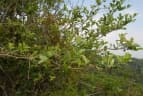
Camellia oleifera
Camellia oleifera
Safety & Hazards
None known
Cultivation Details
This species is not hardy in the colder areas of the country, it tolerates temperatures down to between -5 and -10°c[1]. It succeeds on a wall at Kew and outdoors in milder areas[2]. Camellia oleifera is said to be the hardiest Chinese species in the genus and has the farthest northerly distribution[3]. Prefers a woodland soil but thrives in a warm open well-drained loam if leafmould is added and is tolerant of clay soils[4, 2, 1, 5]. A calcifuge plant, preferring a pH between 5 and 7[2, 1]. Prefers the partial shade of a light woodland, but becomes more tolerant of full sun as it grows[1]. The species prefers warm conditions and requires sunlight[6]. It grows on gentle slopes of mountains and hills[6]. Established plants can tolerate some drought[5]. Prefers a wet summer and a cool but not very frosty dry winter[1]. Plants are not very self-compatible, self-fertilized flowers produce few seeds and these are of low viability[1]. This species has been cultivated for many centuries in China for the oil in its seed[7, 8]. This species is extensively cultivated as an oil seed. Because of its long cultivation in China, it is often difficult to know if particular collections are wild, cultivated, or escaped. For this reason the original wild distribution is uncertain although it is possibly in the region of S Qin Ling to the Huai He valley[3]. A very ornamental plant, some named forms have been developed for their ornamental value. A slow-growing plant[5].
Propagation
Seed - can be sown as soon as it is ripe in a greenhouse[9]. Stored seed should be pre-soaked for 24 hours in warm water and the hard covering around the micropyle should be filed down to leave a thin covering[10, 9, 11]. It usually germinates in 1 - 3 months at 23°c[11]. Prick out the seedlings into individual pots when they are large enough to handle and grow them on in light shade in the greenhouse for at least their first winter. Plant them out into their permanent positions when they are more than 15cm tall and give them some protection from winter cold for their first year or three outdoors[PFAF]. Cuttings of almost ripe wood, 10 - 15cm with a heel, mid summer to early autumn in a shaded frame. High percentage but slow[10]. Cuttings of firm wood, 7 - 10cm with a heel, end of early summer in a frame[2, 10]. Keep in a cool greenhouse for the first year[2]. Leaf-bud cuttings, mid summer in a frame. Cite as: Temperate Plants Database, Ken Fern. temperate.theferns.info. 2026-02-20. <temperate.theferns.info/plant/Camellia+oleifera>
Pollinators
Bees
References
- [1]The New RHS Dictionary of Gardening. 1992. — Huxley. A. · MacMillan Press · 1992 · ISBN 0-333-47494-5 ↩︎Excellent and very comprehensive, though it contains a number of silly mistakes. Readable yet also very detailed.
- [2]Trees and Shrubs Hardy in Great Britain. Vol 1 - 4 and Supplement. — Bean. W. · Murray · 1981 · ISBN - ↩︎A classic with a wealth of information on the plants, but poor on pictures.
- [3]Flora of China — Missouri Botanical Garden Press; St. Louis. · 1994 · http://flora.huh.harvard.edu/china/ ↩︎An excellent, comprehensive resource in 25 volumes. In addition to the botanical information the flora also gives basic information on habitat and some uses. An on-line version is also available.
- [4]RHS Dictionary of Plants plus Supplement. 1956 — F. Chittendon. · Oxford University Press · 1951 · ISBN - ↩︎Comprehensive listing of species and how to grow them. Somewhat outdated, it has been replaced in 1992 by a new dictionary (see [ 200 ]).
- [5]Southern Trees Fact Sheets — Gilman E.F. · University of Florida, IFAS Extension · http://edis.ifas.ufl.edu/department_envhort-trees ↩︎A series of fact sheets on trees that can be grown in Florida. They can be downloaded from the Internet
- [6]IUCN Red List of Threatened Species — http://www.iucnredlist.org/ ↩︎A list of plants under threat and facing possible extinction, usually with brief details of the threats and information on habitat.
- [7]Plantae Wilsonae. Vol 1 - 3 — Wilson. E. H. · University Press; Cambridge. · 1911 - 1917 · http://www.biodiversitylibrary.org ↩︎Details of the palnts collected by the plant collector E. H. Wilson on his travels in China. Gives some habitats. Not for the casual reader. It can be downloaded from the internet.
- [8]Gardening on Walls — Grey-Wilson. C. & Matthews. V. · Collins · 1983 · ISBN 0-00-219220-0 ↩︎A nice little book about plants for growing against walls and a small section on plants that can grow in walls.
- [9]The Reference Manual of Woody Plant Propagation. — Dirr. M. A. and Heuser. M. W. · Athens Ga. Varsity Press · 1987 · ISBN 0942375009 ↩︎A very detailed book on propagating trees. Not for the casual reader.
- [10]Propagation of Trees, Shrubs and Conifers. — Sheat. W. G. · MacMillan and Co · 1948 · ISBN - ↩︎A bit dated but a good book on propagation techniques with specific details for a wide range of plants.
- [11]Growing from Seed. Volume 3. — Bird. R. (Editor) · Thompson and Morgan. · 1989 · ISBN - ↩︎Very readable magazine with lots of information on propagation.
- [12]Sturtevant's Edible Plants of the World. — Hedrick. U. P. · Dover Publications · 1972 · ISBN 0-486-20459-6 ↩︎Lots of entries, quite a lot of information in most entries and references.
- [13]Trends in New Crops and New Uses — Jules Janick and Anna Whipkey (Editors) · ASHS Press; Virginia USA · 2002 · https://hort.purdue.edu/newcrop/ncnu02/v5-toc.html · ISBN 0-970756-5-5 ↩︎This book, the fifth of a series, is based on the symposium entitled New Crops and New Uses: Strength in Diversity held Nov. 8 to 11, 2001 in Atlanta, Georgia. It can be downloaded from the Internet
- [14]Mansfeld's Database of Agricultural and Horticultural Plants — http://mansfeld.ipk-gatersleben.de/pls/htmldb_pgrc/f?p=185:3:4292127278597336 ↩︎Terse details of a huge range of useful plants.
- [15]Medicinal Plants of China — Duke. J. A. and Ayensu. E. S. · Reference Publications, Inc. · 1985 · ISBN 0-917256-20-4 ↩︎Details of over 1,200 medicinal plants of China and brief details of their uses. Often includes an analysis, or at least a list of constituents. Heavy going if you are not into the subject.
- [16]Atlas of Medicinal Plants. — Kariyone. T. · Nihon Rinshosha; Osaka · 1973 ↩︎A good Japanese herbal.
- [17]The Milder Garden. — Taylor. J. · Dent · 1990 ↩︎A good book on plants that you didn't know could be grown outdoors in Britain.
- [18]Chinese Materia Medica. — Stuart. Rev. G. A. · Taipei. Southern Materials Centre · 1911 · ISBN - ↩︎A translation of an ancient Chinese herbal. Fascinating.
- [19]Nature's Colors - Dyes from Plants. — Grae. I. · MacMillan Publishing Co. New York. · 1974 · ISBN 0-02-544950-8 ↩︎A very good and readable book on dyeing.
- [PFAF]Plants for a Future — pfaf.org ↩︎