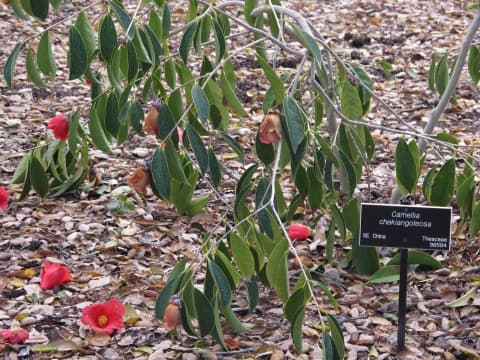
Camellia chekiangoleosa
Camellia chekiangoleosa
Safety & Hazards
None known
Cultivation Details
Camellia species are found mainly in the warm temperate to subtropical regions of southern China, and most species experience mild winters with few frosts plus wet summers[1]. This species is said to be fairly hardy[2] and able to tolerate occasional temperatures falling to around -10°c. Species in this genus generally prefer a peaty, more or less lime-free soil with a pH in the range 5 - 7, but most will grow well in an open loam to which ample leaf-mould has been added, so long as it is well-drained and lime-free. Most species are understorey plants in forests (preferably oak or pine) and prefer a warm, sheltered position with moderate shade; at least at the hottest time of day[3, 1]. Requires a position sheltered from strong winds[1]. Plants are not very self-compatible, self-fertilized flowers produce few seeds and these are of low viability[1]. This species is a valuable oil crop and is cultivated for its oil in Chekiang, China[4]. The plant is closely related to Camellia japonica[1], and is gown as an ornamental[2].
Propagation
Seed - can be sown as soon as it is ripe in a greenhouse[5]. Stored seed should be pre-soaked for 24 hours in warm water and the hard covering around the micropyle should be filed down to leave a thin covering[6, 5, 7]. It usually germinates in 1 - 3 months at 23°c[7]. Prick out the seedlings into individual pots when they are large enough to handle and grow them on in light shade in the greenhouse for at least their first winter. Plant them out into their permanent positions when they are more than 15cm tall and give them some protection from winter cold for their first year or three outdoors[PFAF]. Cuttings of almost ripe wood, 10 - 15cm with a heel, mid summer to early autumn in a shaded frame. High percentage but slow[6]. Cuttings of firm wood, 7 - 10cm with a heel, end of early summer in a frame[3, 6]. Keep in a cool greenhouse for the first year[3]. Leaf-bud cuttings, mid summer in a frame. Cite as: Temperate Plants Database, Ken Fern. temperate.theferns.info. 2026-02-20. <temperate.theferns.info/plant/Camellia+chekiangoleosa>
Pollinators
Bees
References
- [1]The New RHS Dictionary of Gardening. 1992. — Huxley. A. · MacMillan Press · 1992 · ISBN 0-333-47494-5 ↩︎Excellent and very comprehensive, though it contains a number of silly mistakes. Readable yet also very detailed.
- [2]New Trees — Grimshaw J.; Bayton R.; Wilks H. · Kew Publishing; London · 2009 · ISBN 1842461737 ↩︎Provides comprehensive botanical descriptions and horticultural commentary on over 800 tree species that have been introduced to cultivation in recent decades.
- [3]Trees and Shrubs Hardy in Great Britain. Vol 1 - 4 and Supplement. — Bean. W. · Murray · 1981 · ISBN - ↩︎A classic with a wealth of information on the plants, but poor on pictures.
- [4]Flora of China — Missouri Botanical Garden Press; St. Louis. · 1994 · http://flora.huh.harvard.edu/china/ ↩︎An excellent, comprehensive resource in 25 volumes. In addition to the botanical information the flora also gives basic information on habitat and some uses. An on-line version is also available.
- [5]The Reference Manual of Woody Plant Propagation. — Dirr. M. A. and Heuser. M. W. · Athens Ga. Varsity Press · 1987 · ISBN 0942375009 ↩︎A very detailed book on propagating trees. Not for the casual reader.
- [6]Propagation of Trees, Shrubs and Conifers. — Sheat. W. G. · MacMillan and Co · 1948 · ISBN - ↩︎A bit dated but a good book on propagation techniques with specific details for a wide range of plants.
- [7]Growing from Seed. Volume 3. — Bird. R. (Editor) · Thompson and Morgan. · 1989 · ISBN - ↩︎Very readable magazine with lots of information on propagation.
- [8]Yunnan Camellias of China. — Kunming Inst. of Botany. ↩︎Lots of information and good photos.
- [9]Plants for Human Consumption. — Kunkel. G. · Koeltz Scientific Books · 1984 · ISBN 3874292169 ↩︎An excellent book for the dedicated. A comprehensive listing of Latin names with a brief list of edible parts.
- [10]Mansfeld's Database of Agricultural and Horticultural Plants — http://mansfeld.ipk-gatersleben.de/pls/htmldb_pgrc/f?p=185:3:4292127278597336 ↩︎Terse details of a huge range of useful plants.
- [11]Atlas of Medicinal Plants. — Kariyone. T. · Nihon Rinshosha; Osaka · 1973 ↩︎A good Japanese herbal.
- [12]RHS Dictionary of Plants plus Supplement. 1956 — F. Chittendon. · Oxford University Press · 1951 · ISBN - ↩︎Comprehensive listing of species and how to grow them. Somewhat outdated, it has been replaced in 1992 by a new dictionary (see [ 200 ]).
- [13]The Milder Garden. — Taylor. J. · Dent · 1990 ↩︎A good book on plants that you didn't know could be grown outdoors in Britain.
- [14]Chinese Materia Medica. — Stuart. Rev. G. A. · Taipei. Southern Materials Centre · 1911 · ISBN - ↩︎A translation of an ancient Chinese herbal. Fascinating.
- [15]IUCN Red List of Threatened Species — http://www.iucnredlist.org/ ↩︎A list of plants under threat and facing possible extinction, usually with brief details of the threats and information on habitat.
- [16]Trends in New Crops and New Uses — Jules Janick and Anna Whipkey (Editors) · ASHS Press; Virginia USA · 2002 · https://hort.purdue.edu/newcrop/ncnu02/v5-toc.html · ISBN 0-970756-5-5 ↩︎This book, the fifth of a series, is based on the symposium entitled New Crops and New Uses: Strength in Diversity held Nov. 8 to 11, 2001 in Atlanta, Georgia. It can be downloaded from the Internet
- [17]Medicinal Plants of China — Duke. J. A. and Ayensu. E. S. · Reference Publications, Inc. · 1985 · ISBN 0-917256-20-4 ↩︎Details of over 1,200 medicinal plants of China and brief details of their uses. Often includes an analysis, or at least a list of constituents. Heavy going if you are not into the subject.
- [PFAF]Plants for a Future — pfaf.org ↩︎