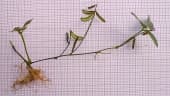
Calopogonium mucunoides
Calopogonium mucunoides
Safety & Hazards
None known
Cultivation Details
Calopogonium mucunoides is a plant of the hot humid tropics, where it succeeds at elevations from sea level to 2,000 metres, though it is best adapted to elevations of 300 - 1,500 metres[1]. It grows best in areas where the annual rainfall exceeds 1,250 mm and daily temperatures range from 24 - 32°c, tolerating 18 - 36°c[1, 2]. Plants are not tolerant of frost[1]. Vigorous growth occurs on soils of all textures, though it prefers a clay soil[1, 2]. Succeeds in very acid soils, preferring a pH in the range 4.5 - 5[1, 2]. Requires a sunny position - growth declines markedly if the plant is shaded[1]. Plants are tolerant of seasonal inundation of the soil and are also moderately drought-tolerant, but they may die out if the dry season is prolonged[1, 2]. The plant can become a localised weed in humid-tropical environments. It has invaded tropical ecosystems in northern Australia and is listed as a weed in the Philippines, Malaysia and Indonesia[2]. Calopo grows rapidly and is able to cover the soil in 3 - 6 months after sowing and even sooner on newly cleared, fertile land. It forms a dense entangled sward in 4 - 5 months after sowing, but the plants are short-lived and may only persist for 1 - 2 years[1]. When grown as a cover crop in plantation crops in a mixture with tropical kudzu and centro, calopo is the first to become established but also the first to be shaded out. Long-term persistence is through recruitment of new plants from seedlings. The root system is dense and rather shallow, its deepest roots reaching a depth of about 50 cm[1]. Flowering in calopo is initiated by short days. It is self-pollinated and seeds freely[1]. This species has a symbiotic relationship with certain soil bacteria, these bacteria form nodules on the roots and fix atmospheric nitrogen. Some of this nitrogen is utilized by the growing plant but some can also be used by other plants growing nearby[3].
Propagation
Calopo is usually propagated by seed, sown at 1-3 kg/ha. Seed is normally drilled in rows when sown into new plantations or broadcast in stands to be used for forage production. After seed is broadcast, the seed-bed may be rolled to improve establishment. As calopo nodulates promiscuously with native rhizobia, seeds are usually not inoculated. If inoculum is applied, then cowpea strains such as the Australian CB 756 are used[1]. Newly harvested seed usually has more than 75% hard seed. Mechanical scarification, soaking in concentrated sulphuric acid for 30 minutes, or soaking in hot water (75°C) for 3 minutes is recommended to enhance germination[1]. Although calopo stems root at the nodes when in contact with moist soil the establishment of stem cuttings inserted directly into soil is generally poor. Use of pre and post-emergence herbicides or hand weeding promotes the establishment of calopo. with 1-3 kg/ha of calopo in a total mixture of 10- 15 kg/ha of legume seed. When sown for forage production, calopo has been successfully used in mixtures with stoloniferous grasses, such as molasses grass (Melinis minutiflora Beauv.) and Rhodes grass (Chloris gayana Kunth), and with tussock grasses such as setaria (Setaria sphacelata (Schumacher) Stapf & Hubbard ex M.B. Moss). Good results have been obtained from oversowing it into existing stands of pangola grass (Digitaria eriantha Steud.) which have been harrowed[1]. Cite as: Tropical Plants Database, Ken Fern. tropical.theferns.info. 2026-02-20. <tropical.theferns.info/viewtropical.php?id=Calopogonium+mucunoides>
Pollinators
Insects
References
- [1]Plant Resources of Southeast Asia — http://proseanet.org/ ↩︎Lots of information on the uses of the plants of SE Asia.
- [2]Tropical Forages — http://www.tropicalforages.info/key/Forages/Media/Html/index.htm ↩︎Mainly focussed on forage plants, the site gives a lot of information on the plant, with a good botanical description, details of cultivation, plant uses and a good selection of photographs.
- [3]Grassland Species - Profiles — http://www.fao.org/ag/AGP/AGPC/doc/Gbase/Default.htm ↩︎Terse information on over 650 species of plants that grow in grassland, including trees, shrubs and perennial plants as well as grasses. Gives a brief description of the plant, its range and habitat and some of its uses.
- [4]The Leguminosae; A Source Book of Characteristics, Uses and Nodulation — Allen O.N.; Allen E.K. · University of Wisconsin · 1981 · ISBN 0-333-32221-5 ↩︎An amazing and comprehensive work, giving a brief guide to the many genera of the family Fabaceae and also the principle uses of the genus.
- [5]Flora of Guatemala — Standley P.C. & J. A. Steyermark · 1946 - 1976 · http://www.archive.org/ ↩︎A superb reference, though somewhat dated. Gives lots of plant uses as well as information on plant habit and habitat. The entire flora (13 volumes) can now be downloaded from http://www.archive.org/