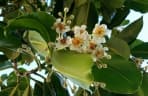
Calophyllum inophyllum
Calophyllum inophyllum
Safety & Hazards
Toxic compounds may be present in mature fruits[1].
Cultivation Details
Alexandrian laurel is a plant of semi-arid to moist tropical coastal areas, where it is found at elevations up to 200 metres[2], though planted specimens have thrived inland at elevations as high as 1,200 metres[1]. It grows best in areas where annual daytime temperatures are within the range 28 - 35°c, but can tolerate 10 - 42°c[2]. It can be killed by temperatures of -1°c or lower[2]. It prefers a mean annual rainfall in the range 2,000 - 4,000mm, but tolerates 750 - 5,000mm[2]. Requires a sunny position[2]. Plants are often found in pronouncedly xerophytic conditions due to the exposed situation, brackish groundwater and salt-laden winds[1]. Prefers a pH in the range 5.5 - 7, tolerating 5 - 8[2]. Under natural conditions in tropical Asia, seedlings reach a height of 40 - 50cm in 6 months after germination. Growth of young trees is discontinuous and branching is rhythmic. The bole and branches are orthotropic, although the orthotropy of the bole is weaker than in other Calophyllum species, often resulting in a procumbent bole, especially in trees growing on beaches. However, Calophyllum inophyllum is sometimes an erect tree of closed forest. Older trees show sympodial growth[1]. Young trees start fruiting after about 10 years[1]. They often flower and produce fruit all year round[3]. The fruits are mainly dispersed by water and can often be found washed up on beaches[1]. When the outer layer of the fruit has rotted away, fruits float easily and can be dispersed by sea currents[1]. However, fruits are also dispersed by fruit bats. A mature tree may yield 50 kg of dry fruits and 18 kg of seed oil[1]. Trees are sensitive to fire[1].
Propagation
Seed - sow in a shaded position in a nursery seedbed. Removal of the endocarp significantly reduces the germination period to about 22 days, it also increases the germination rate and improves seedling growth and development[4]. Natural regeneration usually occurs near the mother tree and provides young plants that can be transplanted to other places. Cite as: Tropical Plants Database, Ken Fern. tropical.theferns.info. 2026-02-20. <tropical.theferns.info/viewtropical.php?id=Calophyllum+inophyllum>
Pollinators
Insects
References
- [1]Protabase - Plant Resources of Tropical Africa. — http://www.prota.org ↩︎An excellent on-line database with detailed information on over 3,200 species of useful plants of Africa.
- [2]Ecocrop — http://ecocrop.fao.org/ecocrop/srv/en/home ↩︎Basic information on a wide range of useful plants, plus details of environmental needs where available.
- [3]Medicinal Plants in Papua New Guinea — World Health Organisation · 2009 · ISBN 978-92-9061-249-0 ↩︎Traditional medicinal uses of 126 species from Papua New Guinea, including information on modern research into the plants.
- [4]World Agroforesty Centre — http://www.worldagroforestry.org/ ↩︎An excellent online database of a huge range of trees giving very good information on each plant - its uses, ecology, identity, propagation, pests etc.
- [5]The New RHS Dictionary of Gardening. 1992. — Huxley. A. · MacMillan Press · 1992 · ISBN 0-333-47494-5 ↩︎Excellent and very comprehensive, though it contains a number of silly mistakes. Readable yet also very detailed.
- [6]Agroforestry in the Pacific Islands: Systems for Sustainability — W.C. Clarke and R.R. Thaman (Editors) · United Nations University Press, Tokyo · 1993 · http://www.unu.edu/unupress/unupbooks/80824e/80824E00.htm#Contents · ISBN 92-808-0824-9 ↩︎The guide includes information on 100 species of plants for Agroforestry. It is also available on the web at the address given above.
- [7]Journal of the Arnold Arboretum Vol. 55 — Harvard University. · 1974 · http://www.biodiversitylibrary.org ↩︎Various articles on plants, including a revision of the genus Acronychia. It can be downloaded from the Internet.
- [8]IUCN Red List of Threatened Species — http://www.iucnredlist.org/ ↩︎A list of plants under threat and facing possible extinction, usually with brief details of the threats and information on habitat.
- [9]Flora of China — Missouri Botanical Garden Press; St. Louis. · 1994 · http://flora.huh.harvard.edu/china/ ↩︎An excellent, comprehensive resource in 25 volumes. In addition to the botanical information the flora also gives basic information on habitat and some uses. An on-line version is also available.
- [10]Tropix 7 — CIRAD · http://tropix.cirad.fr/en ↩︎An on-line guide to the timbers of 245 species of trees.
- [PFAF]Plants for a Future — pfaf.org ↩︎