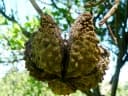
Calodendrum capense
Calodendrum capense
Safety & Hazards
None known
Cultivation Details
Cape chestnut is a plant of the tropics and sub tropics, succeeding at altitudes from sea level to 2,200 metres[1]. It grows best in areas where annual daytime temperatures are within the range 20 - 30°c, but can tolerate 15 - 45°c[2]. Plants are able to withstand considerable frost, tolerating temperatures as low as -5°c[1]. Well-established trees, growing in favourable tree or bush groups, can survive up to 8°c of frost[1]. They can also grow in areas with bitterly cold winters, but will not flower regularly there[1]. It prefers a mean annual rainfall in the range 800 - 1,500mm, but tolerates 600 - 2,000mm[2]. Plants succeed in full sun or light shade[1]. Thrives in deep, fertile and moist forest soils, grows on black cotton soils and is able to tolerate drier sites[1]. Prefers a slightly acid soil[3]. Established plants are drought tolerant[1]. Prefers a pH in the range 5.5 - 7, tolerating 5 - 7.5[2]. A slow growing tree[3]. Trees start flowering when 6 - 8 years old, the flowers being attractive to bees and butterflies[1]. Plants can take up to 14 years to flower[3]. Cape chestnut is a slow growing tree in most conditions[1]. It coppices while young, and pollarding is a suitable practice[1]. In warm areas with high rainfall, the growth rate can be up to 850 mm/year[1]. Trees grown from seed will flower after 6 - 7 years, and those grown from cuttings after 4 years[1].
Propagation
Seed - best sown as soon as ripe, old seed germinates erratically[1]. Trees are easily cultivated from seed. Fresh seed can be sown in deep seedling trays filled with river sand and normally germinate in 10-40 days, with a germination rate of 80-90%[1]. Young plants transplant easily[4]. Seeds can be stored for up to a year if kept insect-free[1]. Cuttings made from half-grown shoots, but they must be treated with a root-stimulating hormone[1]. Cite as: Tropical Plants Database, Ken Fern. tropical.theferns.info. 2026-02-20. <tropical.theferns.info/viewtropical.php?id=Calodendrum+capense>
Pollinators
Bees, Butterflies
References
- [1]World Agroforesty Centre — http://www.worldagroforestry.org/ ↩︎An excellent online database of a huge range of trees giving very good information on each plant - its uses, ecology, identity, propagation, pests etc.
- [2]Ecocrop — http://ecocrop.fao.org/ecocrop/srv/en/home ↩︎Basic information on a wide range of useful plants, plus details of environmental needs where available.
- [3]Tropical and Subtropical Trees - A Worldwide Encyclopaedic Guide. — Barwick. M. · Thames & Hudson, London · 2004 · ISBN 0-500-51181-0 ↩︎A superb book, very concise and well written, giving a wealth of information on 400 or more species including descriptions, habitat, cultivation details and plant uses. A wealth of colour photographs bring each plant vividly to life.
- [4]Protabase - Plant Resources of Tropical Africa. — http://www.prota.org ↩︎An excellent on-line database with detailed information on over 3,200 species of useful plants of Africa.
- [5]Flora Zambesiaca — http://apps.kew.org/efloras/fz/intro.html ↩︎An excellent online flora of plants from the Zambezi River basin. It lists a number of the plant uses as well as the habitats and botanical descriptions of the plants.
- [6]Dictionary of Economic Plants. — Uphof. J. C. Th. · Weinheim · 1959 · ISBN - ↩︎An excellent and very comprehensive guide but it only gives very short descriptions of the uses without any details of how to utilize the plants. Not for the casual reader.