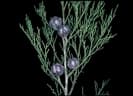
Callitris endlicheri
Callitris endlicheri
Safety & Hazards
None known
Cultivation Details
Callitris endlicheri is found in warm temperate to tropical regions of eastern Australia, usually growing in areas with low rainfall, generally around 350 - 800mm per year. It is not very frost hardy, tolerating occasional, short-lived temperatures down to around -7°c, and can only be grown outdoors in areas with mild winters, generally growing well in Mediterranean climates such as southern Europe, northern Africa and California[1, 2]. Requires a sunny position, growing well in sandy, well-drained soils[1]. Grows well near the coast[1]. Tolerant of acid soils and, when established, of drought[1, 3]. Intolerant of saline soils[3]. Plants are highly flammable and so should not be planted near buildings in areas prone to bush fires[1]. Plants are adapted to growing in regions subject to periodic bush fires - the seed is usually only released after a fire, germinating rapidly to re-occupy the site[1]. A fairly slow-growing tree[3].
Propagation
Seed - does not require stratification, germinating at any time of the year if it becomes moist[1]. Sow in early spring in a greenhouse. When large enough to handle, prick the seedlings out into individual pots and grow them on in the greenhouse for at least their first winter, planting them out into their permanent positions in late spring or early summer, after the last expected frosts. Cite as: Temperate Plants Database, Ken Fern. temperate.theferns.info. 2026-02-20. <temperate.theferns.info/plant/Callitris+endlicheri>
Pollinators
Wind
References
- [1]The New RHS Dictionary of Gardening. 1992. — Huxley. A. · MacMillan Press · 1992 · ISBN 0-333-47494-5 ↩︎Excellent and very comprehensive, though it contains a number of silly mistakes. Readable yet also very detailed.
- [2]The Gymnosperm Database — http://www.conifers.org/index.htm ↩︎A vast amount of information on conifers and families of gymnosperms.
- [3]Florabank Fact Sheets — http://www.florabank.org.au/lucid/key/Species%20Navigator/Media/Html/index.htm#D ↩︎An excellent on-line publication. At present their are 132 species in the list, giving lots of information on growing and using the plants, plus information on their climatic tolerances, distribution maps and photographs.
- [4]Flora of Australia — http://www.anbg.gov.au/abrs/abif/flora/ ↩︎The full information from the Flora of Australia - on-line. An excellent resource.
- [5]IUCN Red List of Threatened Species — http://www.iucnredlist.org/ ↩︎A list of plants under threat and facing possible extinction, usually with brief details of the threats and information on habitat.
- [6]Flora of Victoria. — Ewart. A. J. · University Press; Melbourne · 1930 ↩︎A flora of eastern Australia, it is rather short on information that is useful to the plant project.
- [7]Australian Medicinal Plants. — Lassak. E. V. and McCarthy. T. · New Holland Publishers · 2001 · ISBN 1876334703 ↩︎A very good and readable guide to the subject.
- [8]Native Tastes of Australia — http://tasteaustralia.biz/ ↩︎A website with detailed information on around 50 species of native Australian food plants, including recipes.
- [9]RHS Dictionary of Plants plus Supplement. 1956 — F. Chittendon. · Oxford University Press · 1951 · ISBN - ↩︎Comprehensive listing of species and how to grow them. Somewhat outdated, it has been replaced in 1992 by a new dictionary (see [ 200 ]).
- [10]Useful Wild Plants in Australia. — Cribb. A. B. and J. W. · William Collins Pty Ltd. Sidney · 1981 · ISBN 0-00-216441-8 ↩︎A very readable book.