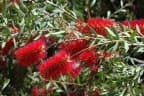
Callistemon citrinus
Callistemon citrinus
Safety & Hazards
None known
Cultivation Details
Callistemon citrinus is found mainly in the warm temperate to subtropical areas of eastern Australia, just reaching into the tropics. Plants are said to tolerate occasional temperatures falling as low as -7°c in Australian gardens[1], with a report that it has tolerated occasional short-lived lows down to about -10°c in Britain[2]. Small-leaved forms of the plant are hardier than the type and can tolerate temperatures down to about -10°c[3]. The cultivar 'Splendens' is said to be particularly good in temperate areas and is possibly more hardy than the type[4]. Succeeds in any soil, tolerating both water-logging and drought[3]. Requires a fertile well-drained moisture retentive soil in full sun[5]. Succeeds in a hot position in dry soils. Accepts very wet conditions in Australian gardens[1]. Prefers an acid soil, not doing very well on chalk[6]. Succeeds in exposed positions by the sea[7]. Plants are very tolerant of pruning, even old plants will regenerate if pruned back hard into the old wood[PFAF]. Hybridizes freely with other members of this genus[5]. The leaves vary considerably in shape and are lemon scented[6, 2]. The leaves, when pressed, emit a refreshing scent of lemon[8]. Plants can flower twice a year if they receive sufficient water[7]. The woody seed capsules remain closed on the branches for years, usually opening after a forest fire when there is ample open ground for them to germinate in[7]. Plants in this genus are notably resistant to honey fungus[5].
Propagation
Seed - surface sow in late winter in a shaded part of the greenhouse[9]. Cover with paper and stand the pots in a few centimetres of water until germination takes place[5]. Remove from the water tray as soon as the seed germinates. Seedlings are prone to damp off and must be watered with care and kept well ventilated[5]. When large enough to handle, prick the seedlings out into individual pots and grow them on in the greenhouse for at least their first winter, planting them out into their permanent positions in late spring or early summer, after the last expected frosts. Cuttings of half-ripe wood,7 - 10cm with a heel, mid summer in a frame. Poor results[9]. Cite as: Temperate Plants Database, Ken Fern. temperate.theferns.info. 2026-02-20. <temperate.theferns.info/plant/Callistemon+citrinus>
Pollinators
Birds
References
- [1]Australian Native Plants. — Wrigley. J. W. and Fagg. M. · Collins. (Australia) · 1988 · ISBN 0-7322-0021-0 ↩︎A lovely book, written in order to encourage Australian gardeners to grow their native plants. A little bit of information for the plant project.
- [2]Shrubs. — Phillips. R. & Rix. M. · Pan Books · 1989 · ISBN 0-330-30258-2 ↩︎Excellent photographs and a terse description of 1,900 species and cultivars.
- [3]Conservatory and Indoor Plants Volumes 1 & 2 — Phillips. R. & Rix. M. · Pan Books, London. · 1998 · ISBN 0-330-37376-5 ↩︎Excellent photos of over 1,100 species and cultivars with habits and cultivation details plus a few plant uses. Many species are too tender for outdoors in Britain though there are many that can be grown outside.
- [4]Climbers and Wall Shrubs. — Davis. B. · Viking. · 1990 · ISBN 0-670-82929-3 ↩︎Contains information on 2,000 species and cultivars, giving details of cultivation requirements. The text is terse but informative.
- [5]The New RHS Dictionary of Gardening. 1992. — Huxley. A. · MacMillan Press · 1992 · ISBN 0-333-47494-5 ↩︎Excellent and very comprehensive, though it contains a number of silly mistakes. Readable yet also very detailed.
- [6]Ornamental Shrubs, Climbers and Bamboos. — Thomas. G. S. · Murray · 1992 · ISBN 0-7195-5043-2 ↩︎Contains a wide range of plants with a brief description, mainly of their ornamental value but also usually of cultivation details and varieties.
- [7]Growing Native Plants — Australian National Botanic Gardens · http://www.anbg.gov.au/gnp/ ↩︎A series of articles giving details of cultivation and matters of general interest (including a few plant uses) on over 250 Australian plants.
- [8]Scented Flora of the World. — Genders. R. · Robert Hale. London. · 1994 · ISBN 0-7090-5440-8 ↩︎An excellent, comprehensive book on scented plants giving a few other plant uses and brief cultivation details. There are no illustrations.
- [9]Propagation of Trees, Shrubs and Conifers. — Sheat. W. G. · MacMillan and Co · 1948 · ISBN - ↩︎A bit dated but a good book on propagation techniques with specific details for a wide range of plants.
- [10]Trees and Shrubs Hardy in Great Britain. Vol 1 - 4 and Supplement. — Bean. W. · Murray · 1981 · ISBN - ↩︎A classic with a wealth of information on the plants, but poor on pictures.
- [11]Flora of New South Wales — http://plantnet.rbgsyd.nsw.gov.au/floraonline.htm ↩︎An on-line resource giving a brief botanical description of all the native plants of New South Wales, their habitat and range, together with diagrams and photographs of the plants.
- [12]Tropical Ornamentals; A Guide — Whistler. W. Arthur. · Timber Press Inc. Oregon. · 2000 · ISBN 0-88192-448-2 ↩︎An excellent little guide to some of the more commonly cultivated ornamental plants of the Tropics, often giving some information on the plants other uses.
- [13]Wild Food in Australia. — Cribb. A. B. and J. W. · Fontana · 1976 · ISBN 0-00-634436-4 ↩︎A very good pocket guide.
- [14]Nature's Colors - Dyes from Plants. — Grae. I. · MacMillan Publishing Co. New York. · 1974 · ISBN 0-02-544950-8 ↩︎A very good and readable book on dyeing.
- [15]Flora of Victoria. — Ewart. A. J. · University Press; Melbourne · 1930 ↩︎A flora of eastern Australia, it is rather short on information that is useful to the plant project.
- [16]Plants and People of Nepal — Manandhar. N. P. · Timber Press. Oregon. · 2002 · ISBN 0-88192-527-6 ↩︎Excellent book, covering over 1,500 species of useful plants from Nepal together with information on the geography and peoples of Nepal. Good descriptions of the plants with terse notes on their uses.
- [PFAF]Plants for a Future — pfaf.org ↩︎