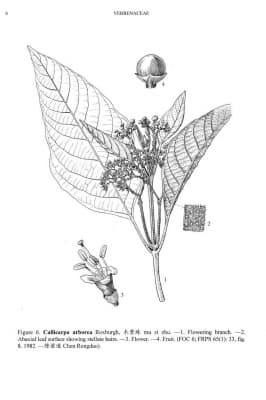
Callicarpa arborea
Callicarpa arborea
Safety & Hazards
None known
Cultivation Details
Species in this genus generally require a sunny position or light dappled shade[1, 2]. Prefers a highly fertile well-drained loamy soil[1, 2]. Requires cross-pollination for good fruit production[3]. Plants in this genus are notably resistant to honey fungus[2]. A fast-growing tree[4].
Propagation
Seed - sow in a nursery seedbed and only just cover the seed[5]. Germination usually takes place within 1 - 3 months at 18°c[5]. When large enough to handle, prick the seedlings out into individual pots and grow them on until large enough to plant out Cuttings of half-ripe wood 10cm long in a frame. High percentage[6]. Cuttings of mature wood of the current season's growth with a heel[6, 2]. Cite as: Tropical Plants Database, Ken Fern. tropical.theferns.info. 2026-02-20. <tropical.theferns.info/viewtropical.php?id=Callicarpa+arborea>
Pollinators
Data unavailable
References
- [1]Trees and Shrubs Hardy in Great Britain. Vol 1 - 4 and Supplement. — Bean. W. · Murray · 1981 · ISBN - ↩︎A classic with a wealth of information on the plants, but poor on pictures.
- [2]The New RHS Dictionary of Gardening. 1992. — Huxley. A. · MacMillan Press · 1992 · ISBN 0-333-47494-5 ↩︎Excellent and very comprehensive, though it contains a number of silly mistakes. Readable yet also very detailed.
- [3]Ornamental Shrubs, Climbers and Bamboos. — Thomas. G. S. · Murray · 1992 · ISBN 0-7195-5043-2 ↩︎Contains a wide range of plants with a brief description, mainly of their ornamental value but also usually of cultivation details and varieties.
- [4]Forest Restoration Planting in Northern Thailand — Pakkad G.; Elliott S.; Anusarnsunthorn V. Et al · Food and Agriculture Organization of the United Nations; Bangkok · 2002 · http://www.fao.org/ ↩︎A report on reforestation in northern Thailand by using specific pioneer species. It can be downloaded from the Internet.
- [5]Growing from Seed. Volume 3. — Bird. R. (Editor) · Thompson and Morgan. · 1989 · ISBN - ↩︎Very readable magazine with lots of information on propagation.
- [6]Propagation of Trees, Shrubs and Conifers. — Sheat. W. G. · MacMillan and Co · 1948 · ISBN - ↩︎A bit dated but a good book on propagation techniques with specific details for a wide range of plants.
- [7]Plants and People of Nepal — Manandhar. N. P. · Timber Press. Oregon. · 2002 · ISBN 0-88192-527-6 ↩︎Excellent book, covering over 1,500 species of useful plants from Nepal together with information on the geography and peoples of Nepal. Good descriptions of the plants with terse notes on their uses.
- [8]Medicinal Plants of Asia and the Pacific — Wiart C. · CRC Press, Taylor & Francis Group; Florida. · 2006 · ISBN 0-8493-7245-3 ↩︎An excellent look at a range of plants, in particular focussing on the active principles that could be responsible for the medical activities.
- [9]Flora of China — Missouri Botanical Garden Press; St. Louis. · 1994 · http://flora.huh.harvard.edu/china/ ↩︎An excellent, comprehensive resource in 25 volumes. In addition to the botanical information the flora also gives basic information on habitat and some uses. An on-line version is also available.
- [10]A Dictionary of Plants Used by Man. — Usher. G. · Constable · 1974 · ISBN 0094579202 ↩︎Forget the sexist title, this is one of the best books on the subject. Lists a very extensive range of useful plants from around the world with very brief details of the uses. Not for the casual reader.
- [11]The Gardens' Bulletin Vol. 6 — Singapore Botanic Gardens; Singapore · 1930 ↩︎A botanical journal - this edition contains a list of the medicinal uses of plants in the region.
- [12]The medicinal uses of Callicarpa L. in traditional Chinese medicine: An ethnopharmacological, phytochemical and phar — Yanhua Tu, Lianna Sun, Meili Guo, Wansheng Chen · Elsevier · 2013 ↩︎A review of the Chinese species of Callicarpa used in medicine