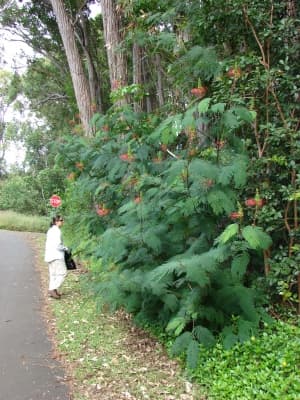
Calliandra calothyrsus
Calliandra calothyrsus
Safety & Hazards
None known
Cultivation Details
A plant of moderate elevations in the humid and subhumid tropics[1]. It can succeed at elevations up to 1,800 metres, but does best at 250 - 800 metres[1]. It grows best in areas where annual daytime temperatures are within the range 22 - 30°c, but can tolerate 18 - 34°c[2]. It prefers a mean annual rainfall in the range 2,000 - 4,000mm, but tolerates 700 - 5,000mm[2]. It can tolerate a 3 - 6 month dry period[1]. Prefers a position in full sun[2]. Grows well on a wide range of soil types but prefers light textured, slightly acidic soils[1]. It can tolerate infertile and compacted or poorly aerated soils but does not tolerate waterlogged and alkaline soils[1]. Plants will die of oxygen starvation within two weeks if the soil is waterlogged[1]. Prefers a pH in the range 5 - 6, tolerating 4.5 - 7.5[2]. The tree is drought hardy, it fixes nitrogen and regenerates rapidly. It is so hardy and reproduces so easily that it may become a weed of sorts and may be difficult to keep in check[2]. Seedlings grow very quickly, they can be 2.5 - 3.5 metres tall within 6 months and 3 - 5 metres within the first year[2]. Flowering may start in the first year, but good fruit set does not start until the second[1]. Fruits ripen 3 months after anthesis[1]. The plants will often flower all year round[3]. When grown for fuel, wood yields have been reported in the order of 15 - 40 tonnes per hectare just one year after planting, with annual coppice harvests continuing for 10 - 20 years[1, 2]. Annual wood production potential is 5 - 65 m3/ha[2]. The rootstock is very vigorous and will resprout readily when coppiced[1]. Yields are extremely good - just 6 months after being cut at 50cm from the ground new growth 3 metre high has been formed[1]. Returns from charcoal production are higher than fuel wood because the wood is a quick burner[1]. The plant can produce 14 tonnes per hectare of charcoal annually[1]. This species has a symbiotic relationship with certain soil bacteria, these bacteria form nodules on the roots and fix atmospheric nitrogen. Some of this nitrogen is utilized by the growing plant but some can also be used by other plants growing nearby[4].
Propagation
Seed - the seed has a hard coat and requires pre-treatment by scarification. This can be carried out by carefully abrading some of the seed coat (being careful not to damage the embryo) to allow the ingress of water. A simpler method is to immerse the seed in a small amount of almost boiling water (which cools down quickly enough so that it does not kill the seed) and then soak it for 12 - 24 hours in warm water before sowing. Seed germination occurs after 4 days and continues for 21 days with most seed germinating between 10 - 25 days from sowing[1]. Seedlings grow away very quickly and can be 2.5 metres or more tall within 6 months[2]. Seed viability can be maintained for several years in hermetic storage at 3°c with 6-10% moisture content[1]. The plant can also be propagated from stem cuttings[1]. Cite as: Tropical Plants Database, Ken Fern. tropical.theferns.info. 2026-02-20. <tropical.theferns.info/viewtropical.php?id=Calliandra+calothyrsus>
Pollinators
Insects, Bats
References
- [1]World Agroforesty Centre — http://www.worldagroforestry.org/ ↩︎An excellent online database of a huge range of trees giving very good information on each plant - its uses, ecology, identity, propagation, pests etc.
- [2]Ecocrop — http://ecocrop.fao.org/ecocrop/srv/en/home ↩︎Basic information on a wide range of useful plants, plus details of environmental needs where available.
- [3]Trees Commonly Cultivated in SE Asia — Jensen. M. · FAO Regional Office, Bangkok. · 1999 · ISBN 974-89377-5-5 ↩︎
- [4]The New RHS Dictionary of Gardening. 1992. — Huxley. A. · MacMillan Press · 1992 · ISBN 0-333-47494-5 ↩︎Excellent and very comprehensive, though it contains a number of silly mistakes. Readable yet also very detailed.
- [5]Flora of Guatemala — Standley P.C. & J. A. Steyermark · 1946 - 1976 · http://www.archive.org/ ↩︎A superb reference, though somewhat dated. Gives lots of plant uses as well as information on plant habit and habitat. The entire flora (13 volumes) can now be downloaded from http://www.archive.org/
- [6]The Leguminosae; A Source Book of Characteristics, Uses and Nodulation — Allen O.N.; Allen E.K. · University of Wisconsin · 1981 · ISBN 0-333-32221-5 ↩︎An amazing and comprehensive work, giving a brief guide to the many genera of the family Fabaceae and also the principle uses of the genus.