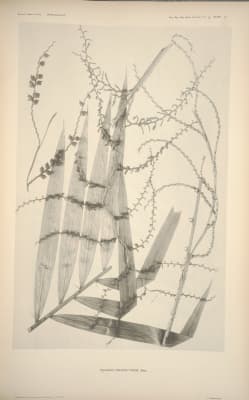
Calamus pseudotenuis
Calamus pseudotenuis
Safety & Hazards
None known
Cultivation Details
Most species in this genus are more or less vigorous climbing plants in rainforests. Leaves of young plants are normally damaged if exposed to too much light, though leaves of older plants will usually tolerate full sun. In general, plants are likely to grow best with their roots in the shade but with enough gap in the canopy to encourage their stems to grow up towards the light. They are also likely to grow best in a humus-rich soil[PFAF]. Many of the species require fairly moist conditions for good growth, in fact several of them grow in wet soils or in areas with seasonal inundation - where we have the information it will be included under the plant’s habitat. Overhead shade should be manipulated at about 6-monthly intervals for the first 2 - 3 years of a young plant’s life to ensure they receive sufficient light to grow vigorously. About 40 - 50% light penetration is generally considered to be ideal for promoting stem growth. Little care is needed once the seedlings are established. It is important, however, to weed the area surrounding the seedlings occasionally until the plants are more than 2 metres tall. A dioecious species, both male and female forms need to be grown if fruit and seed are required.
Propagation
Seed - it has a fairly short viability and is best sown as soon as it is ripe. Cite as: Tropical Plants Database, Ken Fern. tropical.theferns.info. 2026-02-20. <tropical.theferns.info/viewtropical.php?id=Calamus+pseudotenuis>
Pollinators
Data unavailable
References
- [1]Flowers of India — http://www.flowersofindia.net/ ↩︎A wed site of native Indian plants, plus cultivated and naturalized species. It has good quality photos and terse details on more than 3,000 species and cultivars.
- [2]Annals of the Royal Botanical Garden, Calcutta Vol. XI and Appendix — Dr Odoardo Beccari · Royal Botanic Garden, Calcutta · 1908 ↩︎This volume of the journal is dedicated entirely to a monograph of the genus Calamus, which remains an important treatment over 100 years later.
- [3]Mansfeld's Database of Agricultural and Horticultural Plants — http://mansfeld.ipk-gatersleben.de/pls/htmldb_pgrc/f?p=185:3:4292127278597336 ↩︎Terse details of a huge range of useful plants.
- [4]Speciality Rattans of the ASEAN — A. C. Baja-Lapis · National Herbarium, Nederland. · 2009 · http://www.ingentaconnect.com/content/nhn/blumea ↩︎A description of the uses and agricultural practices for 11 selected species of rattan.
- [PFAF]Plants for a Future — pfaf.org ↩︎