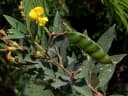
Cajanus cajan
Cajanus cajan
Safety & Hazards
None known
Cultivation Details
Grows well in lowland tropical areas up to an elevation of 1,500 metres, though some forms can still do well up to 2,000 metres[1]. Plants generally prefer a rainfall in the region of 500 - 1,000mm per year, though there are some cultivars that are adapted to wet, humid tropics so long as the soil is well drained[1]. A temperature range of 20 - 30°c is preferred, but under optimal cultural conditions good yields can be obtained with temperatures up to 35°c[1]. Grows best in a sunny position[2]. Succeeds in a wide range of soils that are well-drained[1]. Plants produce deep tap roots, they can succeed in poor soils and are extremely drought resistant once established[3, 1]. Dislikes very acid soils, growing best in a pH range of 5.5 - 6.5[1]. A short-lived, woody plant, dying after 1 - 5 years[4]. Harvesting of dwarf varieties can commence 5 months after sowing (8 - 12 months for taller varieties) and continue for several months[1]. A relatively low-yielding crop, yields of up to 5 tonnes per hectare of pods, or 1 tonne of seeds can be achieved[1, 4]. In perennial crops, 2 - 10 tonnes per hectare a year of woody stalks can be harvested for fuel[4]. There are two main forms of this plant, and many named varieties of each[5, 1, 6]. Var. Flavus DC. Is a moderate height plant that is early maturing, it is often grown as an annual in India[1]. The green pods normally contain 3 seeds[1]. Var. Bicolor DC. Is a taller plant that is later to mature and is usually grown as a perennial[1]. The dark coloured pods contain 4 - 5 seeds[1]. Short-duration dwarf cultivars are usually daylength neutral, but the taller growing cultivars are usually short-day plants that will not readily flower if day length is 12 hours or more[1]. A good companion plant, it is often grown in association with other crops[1]. This species has a symbiotic relationship with certain soil bacteria, these bacteria form nodules on the roots and fix atmospheric nitrogen. Some of this nitrogen is utilized by the growing plant but some can also be used by other plants growing nearby[7].
Propagation
Seed - sow in situ during the wet season, placing the seed 2 - 3 cm deep in the soil[1]. Two seeds are often planted per station, thinning to the best plant[1]. The seeds germinate at temperatures of 19 - 43°c, but most rapidly at 20 - 30°c. Emergence is complete 2 - 3 weeks after sowing. Vegetative development starts slowly, but after 2 - 3 months growth accelerates[8]. Cite as: Tropical Plants Database, Ken Fern. tropical.theferns.info. 2026-02-19. <tropical.theferns.info/viewtropical.php?id=Cajanus+cajan>
Pollinators
Self, Bees, Insects
References
- [1]Vegetables in the Tropics — Tindall. H. D. · MacMillan, Oxford. · 1983 · ISBN 0-333-24268-8 ↩︎An excellent, in-depth look at the main vegetable crops that can be grown in the Tropics, plus many less well-known plants.
- [2]Trees Commonly Cultivated in SE Asia — Jensen. M. · FAO Regional Office, Bangkok. · 1999 · ISBN 974-89377-5-5 ↩︎
- [3]Edible Leaves of the Tropics — Martin. F. W.; Ruberte. R. M. & Meitzner. L. S. · Echo. USA. · 1998 · ISBN 0-9653360-1-8 ↩︎A terse guide, giving reasonable detail on the more common leaf crops and brief information on a wide range of lesser known plants.
- [4]Digital Compendium of Forestry Species of Cambodia — www.digitalspecies.blogspot.com; Phnom Penh · 2008 · http://www.digitalspecies.blogspot.com ↩︎A very detailed booklet, produced in PDF format on the internet, giving information on around 100 species of trees.
- [5]Dictionary of Economic Plants. — Uphof. J. C. Th. · Weinheim · 1959 · ISBN - ↩︎An excellent and very comprehensive guide but it only gives very short descriptions of the uses without any details of how to utilize the plants. Not for the casual reader.
- [6]Cornucopia II — Facciola. S. · Kampong Publications, California. · 1998 · ISBN 0-9628087-2-5 ↩︎The second edition of an excellent guide to the edible uses of plants, though it does not give any details of cultivation etc.
- [7]The New RHS Dictionary of Gardening. 1992. — Huxley. A. · MacMillan Press · 1992 · ISBN 0-333-47494-5 ↩︎Excellent and very comprehensive, though it contains a number of silly mistakes. Readable yet also very detailed.
- [8]Protabase - Plant Resources of Tropical Africa. — http://www.prota.org ↩︎An excellent on-line database with detailed information on over 3,200 species of useful plants of Africa.
- [9]African Flowering Plants Database — Conservatoire et Jardin Botaniques. · http://www.ville-ge.ch/musinfo/bd/cjb/africa/recherche.php ↩︎Contains information on over 150,000 plant names (including synonyms) giving a description and habitat, plus a distribution map.
- [10]The Leguminosae; A Source Book of Characteristics, Uses and Nodulation — Allen O.N.; Allen E.K. · University of Wisconsin · 1981 · ISBN 0-333-32221-5 ↩︎An amazing and comprehensive work, giving a brief guide to the many genera of the family Fabaceae and also the principle uses of the genus.
- [11]Plants and People of Nepal — Manandhar. N. P. · Timber Press. Oregon. · 2002 · ISBN 0-88192-527-6 ↩︎Excellent book, covering over 1,500 species of useful plants from Nepal together with information on the geography and peoples of Nepal. Good descriptions of the plants with terse notes on their uses.
- [12]Medicinal Plants of the Guianas — DeFilipps, R. A.; Maina, S. L.; & Crepin, J. · Smithsonian Museum · http://botany.si.edu/bdg/medicinal/index.html ↩︎A down-loadable PDF document of a book in pre-publication awaiting illustration. An excellent, if rather terse, guide to the traditional medicinal uses of the plants of the region
- [13]World Agroforesty Centre — http://www.worldagroforestry.org/ ↩︎An excellent online database of a huge range of trees giving very good information on each plant - its uses, ecology, identity, propagation, pests etc.