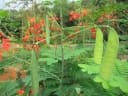
Caesalpinia pulcherrima
Caesalpinia pulcherrima
Safety & Hazards
None known
Cultivation Details
An evergreen plant in the tropics, in cooler but frost-free areas it is more likely to become deciduous whislt in areas with occasional frosts it can survive as a perennial plant, dying down to ground level in the cold season but regrowing with the warmer weather. Succeeds in any moderately fertile, well-drained soil[1]. Requires a position in full sun[1]. Established plants are moderately drought tolerant[2]. Widely grown as an ornamental, it has escaped from cultivation and become naturalized in some areas[3, 4]. Plants can commence flowering when only 8 months old[2], and then, in warm climates, can flower all year round[5, 6]. Plants in this genus are notably resistant to honey fungus[1]. This species has a symbiotic relationship with certain soil bacteria, these bacteria form nodules on the roots and fix atmospheric nitrogen. Some of this nitrogen is utilized by the growing plant but some can also be used by other plants growing nearby[1].
Propagation
Seed - pre-soak for 12 - 24 hours in warm water prior to sowing. When large enough to handle, prick the seedlings out into individual pots and grow them on until large enough to plant out. Softwood cuttings in sand in a frame[1]. Cite as: Tropical Plants Database, Ken Fern. tropical.theferns.info. 2026-02-19. <tropical.theferns.info/viewtropical.php?id=Caesalpinia+pulcherrima>
Pollinators
Butterflies
References
- [1]The New RHS Dictionary of Gardening. 1992. — Huxley. A. · MacMillan Press · 1992 · ISBN 0-333-47494-5 ↩︎Excellent and very comprehensive, though it contains a number of silly mistakes. Readable yet also very detailed.
- [2]The Leguminosae; A Source Book of Characteristics, Uses and Nodulation — Allen O.N.; Allen E.K. · University of Wisconsin · 1981 · ISBN 0-333-32221-5 ↩︎An amazing and comprehensive work, giving a brief guide to the many genera of the family Fabaceae and also the principle uses of the genus.
- [3]Pacific Island Ecosystems at Risk — http://www.hear.org/pier/scientificnames/index.html ↩︎A very good website detailing weed species that have been introduced into the Pacific Islands.
- [4]Medicinal Plants of the Philippines — Bureau of Plant Industry, Philippines. · http://www.bpi.da.gov.ph/Publications/mp/mplants.html ↩︎An Internet site from the Philippines Department of Agriculture, giving information in a readable way on the medicinal uses of many plants in their area.
- [5]Flowers of India — http://www.flowersofindia.net/ ↩︎A wed site of native Indian plants, plus cultivated and naturalized species. It has good quality photos and terse details on more than 3,000 species and cultivars.
- [6]The Useful Plants of the Island of Guam — Safford W.E. · Smithsonian Institute; Washington. · 1905 · http://www.biodiversitylibrary.org/ ↩︎A very comprehensive, if rather dated, guide to the plants of Guam. It can be downloaded from the Internet.
- [7]Plant Resources of Southeast Asia — http://proseanet.org/ ↩︎Lots of information on the uses of the plants of SE Asia.
- [8]Flora of Barro Colorado Island — Croat. Thomas B. · Stanford University Press · 1978 · http://biogeodb.stri.si.edu/bioinformatics/croat/home · ISBN 0-8047-0950-5 ↩︎A very good flora of an area in Panama. Written some years ago, so some of the names have been changed. The book is out of print, but the whole flora is now available on the web.
- [9]Woods of Northeastern Peru — Williams L. · Field Museum Press; Chicago. · 1936 · http://www.biodiversitylibrary.org/ ↩︎Gives information on the properties of the wood of well over 1,000 species of woody plants from northeastern Peru. Can be downloaded from the Internet.
- [10]Cornucopia II — Facciola. S. · Kampong Publications, California. · 1998 · ISBN 0-9628087-2-5 ↩︎The second edition of an excellent guide to the edible uses of plants, though it does not give any details of cultivation etc.
- [11]Rio Mayo Plants - A study of the flora and vegetation of the valley of the Rio Mayo, Sonora — Gentry H.S. · Carnegie Institution of Washington; Washington DC · 1942 ↩︎One of my favourite authors on native plants, often including their uses. This is an excellent example with lots of information, even though the book is 80 years old.
- [12]Medicinal Plants of the Guianas — DeFilipps, R. A.; Maina, S. L.; & Crepin, J. · Smithsonian Museum · http://botany.si.edu/bdg/medicinal/index.html ↩︎A down-loadable PDF document of a book in pre-publication awaiting illustration. An excellent, if rather terse, guide to the traditional medicinal uses of the plants of the region
- [13]Dominica Botanic Gardens — http://www.da-academy.org/trees_shrubs.html ↩︎An on-line resource, providing top quality pictures and some basic information on various plants being grown at the Botanic Gardens, often including uses and habitat.