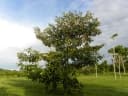
Byrsonima crassifolia
Byrsonima crassifolia
Safety & Hazards
The leaves and stems, if put in water, can stupefy fish[1]. This possibly means they contain saponins[PFAF]. Although poisonous, saponins are poorly absorbed by the human body and so most pass through without harm. Saponins are quite bitter and can be found in many common foods such as some beans. They can be removed by carefully leaching in running water. Thorough cooking, and perhaps changing the cooking water once, will also normally remove most of them. However, it is not advisable to eat large quantities of food that contain saponins. Saponins are much more toxic to some creatures, such as fish, and hunting tribes have traditionally put large quantities of them in streams, lakes etc in order to stupefy or kill the fish[PFAF].
Cultivation Details
Trees succeed in tropical and subtropical climates up to elevations of 1,000 metres[1]. They are tolerant of a wide range of environments, from humid tropical lowlands to semi-desert regions[1]. The tree is often found on rocky ground. It grows well on sandy and alkaline-sandy soils[1]. Although it succeeds in poor soils, better yields are achieved when a good supply of organic matter is added. Grows best in a fertile, well-drained soil[2]. Established plants are highly drought tolerant[1, 2]. Plants are very tolerant of salt laden winds[2]. Very often, when the forest is cleared this tree is left and allowed to grow in a state of semi-wild cultivation[1]. A fire-resistant tree[1]. A very variable species with a wide distribution in tropical America[2]. It has sometimes been recognised as more than one species[2].
Propagation
Seed - best sown as soon as it is ripe in a partially shaded position in a nursery seedbed. A germination rate of less than 30% can be expected, with the seed sprouting within 25 - 35 days[3]. Cite as: Tropical Plants Database, Ken Fern. tropical.theferns.info. 2026-02-19. <tropical.theferns.info/viewtropical.php?id=Byrsonima+crassifolia>
Pollinators
Bees
References
- [1]World Agroforesty Centre — http://www.worldagroforestry.org/ ↩︎An excellent online database of a huge range of trees giving very good information on each plant - its uses, ecology, identity, propagation, pests etc.
- [2]Tropical and Subtropical Trees - A Worldwide Encyclopaedic Guide. — Barwick. M. · Thames & Hudson, London · 2004 · ISBN 0-500-51181-0 ↩︎A superb book, very concise and well written, giving a wealth of information on 400 or more species including descriptions, habitat, cultivation details and plant uses. A wealth of colour photographs bring each plant vividly to life.
- [3]Brazilian Trees. Volume 3. — Lorenzi. H. · Instituto Plantarum De Estudos Da Flora; Brazil. · 2009 · ISBN 85-86714-34-4 ↩︎Information on 350 species of Brazilian trees. Stunning photographs of each species, brief details on the plant, its uses and how to grow it from seed. A superb work, with the minor irritation that the translation from Portuguese is not of the best.
- [4]Cornucopia II — Facciola. S. · Kampong Publications, California. · 1998 · ISBN 0-9628087-2-5 ↩︎The second edition of an excellent guide to the edible uses of plants, though it does not give any details of cultivation etc.
- [5]Dictionary of Economic Plants. — Uphof. J. C. Th. · Weinheim · 1959 · ISBN - ↩︎An excellent and very comprehensive guide but it only gives very short descriptions of the uses without any details of how to utilize the plants. Not for the casual reader.
- [6]A Century of Trees of Panama. — Pittier H. Mell C.D. · http://www.biodiversitylibrary.org ↩︎A work that was very difficult to get published according to the correspondence contained at the start!. A treatment of 100 different species with descriptions and details of uses. It can be downloaded from the Internet.
- [7]Medicinal Plants of the Guianas — DeFilipps, R. A.; Maina, S. L.; & Crepin, J. · Smithsonian Museum · http://botany.si.edu/bdg/medicinal/index.html ↩︎A down-loadable PDF document of a book in pre-publication awaiting illustration. An excellent, if rather terse, guide to the traditional medicinal uses of the plants of the region
- [PFAF]Plants for a Future — pfaf.org ↩︎