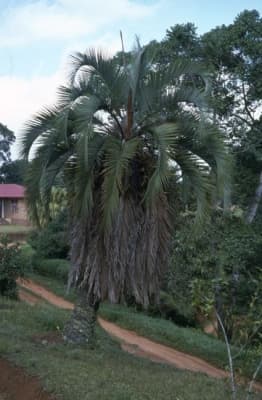
Butia eriospatha
Butia eriospatha
Safety & Hazards
None known
Cultivation Details
A plant of moderate elevations in the subtropics, found at elevations between 700 - 1,200 metres[1, 2]. It grows in areas where it experiences frosts and temperatures as low as -4°c[1]. Requires a position in full sun[3]. A slow-growing plant[4].
Propagation
Seed - takes a few weeks, to several months, to germinate[3]. Seed - best sown as soon as it is ripe in a partially shaded position in a nursery seedbed or in individual containers. A low germination rate can be expected, with the seed sprouting within 90 - 180 days[4]. Plant out into deep pots or the open ground either as soon as root growth is noticed or as soon as top growth appears. Cite as: Tropical Plants Database, Ken Fern. tropical.theferns.info. 2026-02-19. <tropical.theferns.info/viewtropical.php?id=Butia+eriospatha>
Pollinators
Data unavailable
References
- [1]Palm and Cycad Societies of Australia. — http://www.pacsoa.org.au/ ↩︎Contains at least a little information on the majority of palm and cycad species, plus a wealth of photographs. A first class website.
- [2]IUCN Red List of Threatened Species — http://www.iucnredlist.org/ ↩︎A list of plants under threat and facing possible extinction, usually with brief details of the threats and information on habitat.
- [3]Trade Winds Fruit — http://www.tradewindsfruit.com/index.htm ↩︎The on-line catalogue of a company selling seeds. Gives descriptions, photos and uses of a very wide range of fruit and other food-producing plants plus ornamentals.
- [4]Brazilian Trees. Volume 1. 4th Edition. — Lorenzi. H. · Instituto Plantarum De Estudos Da Flora; Brazil. · 2002 · ISBN 85-86714-17-8 ↩︎Information on 350 species of Brazilian trees. Stunning photographs of each species, brief details on the plant, its uses and how to grow it from seed. A superb work, with the minor irritation that the translation from Portuguese is not of the best.
- [5]Brazilian Fruits and Cultivated Exotics — Lorenzi. H.; Bacher. L.; Lacerda. M.; Sartori. S. · Instituto Plantarum De Estudos Da Flora LTDA; Brazil. · 2000 · ISBN 85-867174-24-0 ↩︎A superb book, giving information on several hundred fruit species. Each entry has a brief description of the plant and its uses, accompanied by one to many excellent quality photographs of the fruits.
- [6]Mansfeld's Database of Agricultural and Horticultural Plants — http://mansfeld.ipk-gatersleben.de/pls/htmldb_pgrc/f?p=185:3:4292127278597336 ↩︎Terse details of a huge range of useful plants.
- [7]Field Guide to the Palms of the Americas — Henderson A.; Galeano G.; Bernal R. · Princeton University Press; Princeton, New Jersey. · 1995 · ISBN 0-691-08537-4 ↩︎An excellent book, giving basic information on all the 550 species of palms native to the Americas that were known in 1995. Comprehensive information on the plants range and habitat, brief description, some uses and almost 250 photos.