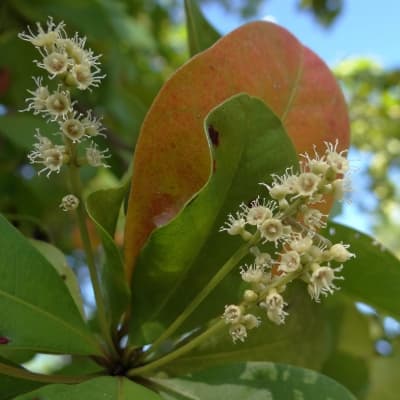
Bucida buceras
Bucida buceras
Safety & Hazards
None known
Cultivation Details
A tree of mainly low elevations in the tropics, where it is often found near the coast and at elevations up to 450 metres. It grows best in areas where the mean annual temperatures are within the range 24 - 28°c and the mean annual rainfall is in the range 750 - 2,000mm[1]. Prefers a position in full sun[2]. Grows best in a rich, moist, well-drained soil, though it can be grown in almost any type of soil[2]. It has a high tolerance to saline soils, growing well in sea-side locations[2]. Tolerant of air pollution[1]. Although the branches are heavy, the plant is very wind tolerant and able to withstand hurricanes[2]. Established plans are drought tolerant[2]. The tree coppices until it reaches saw log size (around 30cm in diameter)[1]. The tree needs somewhat careful siting because it exudes a dark, sticky substance that drips down onto and coats anything underneath[1].
Propagation
Seed - Cite as: Tropical Plants Database, Ken Fern. tropical.theferns.info. 2026-02-19. <tropical.theferns.info/viewtropical.php?id=Bucida+buceras>
Pollinators
Bees
References
- [1]World Agroforesty Centre — http://www.worldagroforestry.org/ ↩︎An excellent online database of a huge range of trees giving very good information on each plant - its uses, ecology, identity, propagation, pests etc.
- [2]Dominica Botanic Gardens — http://www.da-academy.org/trees_shrubs.html ↩︎An on-line resource, providing top quality pictures and some basic information on various plants being grown at the Botanic Gardens, often including uses and habitat.
- [3]Tropical Timbers of the World. Ag. Handbook No. 607. — Chudnoff. Martin. · USDA Forest Service. Wisconsin. · 1984 ↩︎Terse details on the properties of the wood of almost 400 species of trees from the Tropics.
- [4]Common Trees of Puerto Rico and the Virgin Islands — Little E.L.; Wadsworth F.H. · USDA, Forest Service; Washington. · 1964 ↩︎Contains detailed information, and usually an illustration, on 250 tree species, including both native and exotic species.
- [5]Manual of the Trees of N. America. — Sargent. C. S. · Dover Publications Inc. New York. · 1965 · http://www.biodiversitylibrary.org/ · ISBN 0-486-20278-X ↩︎Two volumes, a comprehensive listing of N. American trees though a bit out of date now. Good details on habitats, some details on plant uses. Not really for the casual reader. It can be downloaded from the internet.
- [6]South American Timbers: the Properties, Uses and Characteristics of 190 Species. — Bolza. E. & Christensen. F.J. · Commonwealth Scientific and Industrial Research Organization · 1979 · ISBN 0 643 02582 0 ↩︎A very useful guide.
- [7]Medicinal Plants of the Guianas — DeFilipps, R. A.; Maina, S. L.; & Crepin, J. · Smithsonian Museum · http://botany.si.edu/bdg/medicinal/index.html ↩︎A down-loadable PDF document of a book in pre-publication awaiting illustration. An excellent, if rather terse, guide to the traditional medicinal uses of the plants of the region