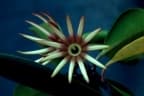
Bruguiera gymnorhiza
Bruguiera gymnorhiza
Safety & Hazards
None known
Cultivation Details
A plant of tropical and subtropical, moist to rainforest life zones, where it always grows near the coast at elevations up to 50 metres. It grows best in areas where annual daytime temperatures are within the range 20 - 26°c, but can tolerate 15 - 30°c[1]. It can be killed by temperatures of °c or lower[1]. It prefers a mean annual rainfall in the range 1,500 - 6,000mm, but tolerates 1,000 - 8,000mm[1]. Plants grow best on brackish or saline silts of depositing shores and marshes[2]. The tree has proved to be able to grow, flower, fruit and even regenerate in artificial fresh water swamps[2]. It can stand any amount of shade[2]. Prefers a pH in the range 7 - 8, tolerating 6.5 - 8.5[1]. Although it is a mangrove, it is sensitive to high salt concentrations, dying out when concentrations of sodium chloride exceed 3%[2]. Black mangrove marks the climax vegetation of littoral forests (mangroves), before the transition to land forest. It is a shade tolerant species that is able to establish itself even in pure stands of Rhizophora species. It takes 40 years for trees to attain 16cm in bole diameter[3]. Plants do not respond well to lopping or coppicing[3]. It flowers abundantly in the rainy season[2]. Seedlings can remain alive, floating in the water, for 5 - 6 months, which possibly explains the large area of natural distribution[2]. Planting is usually not needed because natural regeneration is so successful. Regeneration after felling, however, is usually scant or even absent[2]. The natural and artificial regeneration has never been extensively investigated[2].
Propagation
Seed germinates whilst still attached to the tree[3]. Seedlings can be collected either from the trees or from the ground, they are equally viable[2]. They can be planted in a nursery, and transferred to the field 3 - 4 months later[2]. Seedlings develop best where the tidal range is only about 0.35 metres and the salinity is 1 - 2.5%[2]. Cite as: Tropical Plants Database, Ken Fern. tropical.theferns.info. 2026-02-19. <tropical.theferns.info/viewtropical.php?id=Bruguiera+gymnorhiza>
Pollinators
Data unavailable
References
- [1]Ecocrop — http://ecocrop.fao.org/ecocrop/srv/en/home ↩︎Basic information on a wide range of useful plants, plus details of environmental needs where available.
- [2]World Agroforesty Centre — http://www.worldagroforestry.org/ ↩︎An excellent online database of a huge range of trees giving very good information on each plant - its uses, ecology, identity, propagation, pests etc.
- [3]Protabase - Plant Resources of Tropical Africa. — http://www.prota.org ↩︎An excellent on-line database with detailed information on over 3,200 species of useful plants of Africa.
- [4]Agroforestry in the Pacific Islands: Systems for Sustainability — W.C. Clarke and R.R. Thaman (Editors) · United Nations University Press, Tokyo · 1993 · http://www.unu.edu/unupress/unupbooks/80824e/80824E00.htm#Contents · ISBN 92-808-0824-9 ↩︎The guide includes information on 100 species of plants for Agroforestry. It is also available on the web at the address given above.
- [5]IUCN Red List of Threatened Species — http://www.iucnredlist.org/ ↩︎A list of plants under threat and facing possible extinction, usually with brief details of the threats and information on habitat.
- [6]Hedges and Screens. — Shepherd. F.W. · Royal Horticultural Society. · 1974 · ISBN 0900629649 ↩︎A small but informative booklet giving details of all the hedging plants being grown in the R.H.S. gardens at Wisley in Surrey.