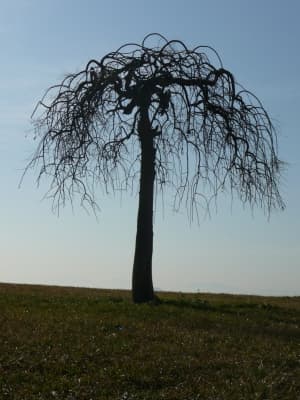
Broussonetia papyrifera
Broussonetia papyrifera
Safety & Hazards
None known
Cultivation Details
Broussonetia papyrifera is a very adaptable tree. It is found growing in tropical climates at elevations from sea level to about 2,000 metres, but its range also extends well into the temperate zone where mature plants can withstand temperatures down to about -10°c[1]. It grows best in areas where annual daytime temperatures are within the range 15 - 28°c, but can tolerate 500 - 3,000°c[1]. It prefers a mean annual rainfall in the range 800 - 2,500mm, but tolerates 500 - 3,000mm[1]. Easily cultivated in a warm sunny position in any soil of reasonable quality[2]. A drought resistant species once established[3], thriving on poor sandy or gravelly soils[4, 5]. Another report says that it does not thrive on poor soils[6]. Prefers a pH in the range 5 - 7.5, tolerating 4.5 - 8[1]. The plant is tolerant to urban pollution (including airborne sulphur dioxide), moisture-sapping wind in hot and dry regions, and nitrogen loading near fertilizer factories[4, 7]. A fast-growing tree according to one report[8]. Annual height increases of up to 2.6 metres have been recorded for young trees on good sites in the tropics, with an increase in bole diameter of 6 - 25mm[7]. Trees are coppiced on a regular basis in order to provide young, long, clean shoots from which to strip the bark[9]. With a 10-year rotation for pulp and paper production, annual yields of 8 - 12 tonnes per hectare can be expected in low rainfall areas and 21 - 30 tonnes in high rainfall areas[7]. The leaves on the same tree can vary widely in shape and size[PFAF]. A dioecious species. Both male and female plants must be grown if seed is required.
Propagation
Seed - no pre-treatment is required. Sown in the autumn or spring in a greenhouse, germination usually takes place within 1 - 3 months at 15°c[10]. When large enough to handle, prick the seedlings out into individual pots and grow them on in the greenhouse for at least their first winter, planting them out into their permanent positions in late spring or early summer, after the last expected frosts. Cuttings of half-ripe wood, 8 - 12cm long with a heel, mid summer in a frame. High percentage[2, 11]. Cuttings of mature wood of the current season's growth, late autumn in a frame[4]. Root cuttings in winter[4]. Layering in spring[4]. Cite as: Temperate Plants Database, Ken Fern. temperate.theferns.info. 2026-02-20. <temperate.theferns.info/plant/Broussonetia+papyrifera>
Pollinators
Insect, Wind
References
- [1]Ecocrop — http://ecocrop.fao.org/ecocrop/srv/en/home ↩︎Basic information on a wide range of useful plants, plus details of environmental needs where available.
- [2]Trees and Shrubs Hardy in Great Britain. Vol 1 - 4 and Supplement. — Bean. W. · Murray · 1981 · ISBN - ↩︎A classic with a wealth of information on the plants, but poor on pictures.
- [3]Trees of Central Texas. — Vines. R. A. · University of Texas Press · 1987 · ISBN 0-292-78958-3 ↩︎A good concise guide, it gives details of habitats and some of the uses of trees growing in Texas.
- [4]The New RHS Dictionary of Gardening. 1992. — Huxley. A. · MacMillan Press · 1992 · ISBN 0-333-47494-5 ↩︎Excellent and very comprehensive, though it contains a number of silly mistakes. Readable yet also very detailed.
- [5]The Complete Trees of N. America. Field Guide and Natural History. — Elias. T. · Van Nostrand Reinhold Co. · 1980 · ISBN 0442238622 ↩︎A very good concise guide. Gives habitats, good descriptions, maps showing distribution and a few of the uses. It also includes the many shrubs that occasionally reach tree proportions.
- [6]A Manual of Indian Timbers. — Gamble. J. S. · Bishen Singh Mahendra Pal Singh · 1972 · ISBN - ↩︎First written in the 19th century, but still a classic, giving a lot of information on the uses and habitats of Indian trees. Not for the casual reader.
- [7]World Agroforesty Centre — http://www.worldagroforestry.org/ ↩︎An excellent online database of a huge range of trees giving very good information on each plant - its uses, ecology, identity, propagation, pests etc.
- [8]Trees of North Texas — Vines. R.A. · University of Texas Press. · 1982 · ISBN 0292780206 ↩︎A readable guide to the area, it contains descriptions of the plants and their habitats with quite a bit of information on plant uses.
- [9]Tropical and Subtropical Trees - A Worldwide Encyclopaedic Guide. — Barwick. M. · Thames & Hudson, London · 2004 · ISBN 0-500-51181-0 ↩︎A superb book, very concise and well written, giving a wealth of information on 400 or more species including descriptions, habitat, cultivation details and plant uses. A wealth of colour photographs bring each plant vividly to life.
- [10]Growing from Seed. Volume 3. — Bird. R. (Editor) · Thompson and Morgan. · 1989 · ISBN - ↩︎Very readable magazine with lots of information on propagation.
- [11]Propagation of Trees, Shrubs and Conifers. — Sheat. W. G. · MacMillan and Co · 1948 · ISBN - ↩︎A bit dated but a good book on propagation techniques with specific details for a wide range of plants.
- [12]Trees of Laos and Vietnam - A Field Guide to 100 species. — Hoang Van Sam; Khamseng Nanthavong; Kessler P.J.A. · Blumea · 2004 ↩︎A detailed guide, with excellent line-drawings, to 100 of the more important trees of Laos and Vietnam. A very good work, giving lots of information about each plant. Originally published in the journal Blumea, it is available as a PDF on the Interne
- [13]Invasive Species Compendium — http://www.cabi.org ↩︎An immense resource - in depth information on over 900 species of invasive plants (it also has information on animals, fungi etc).
- [14]Agroforestry in the Pacific Islands: Systems for Sustainability — W.C. Clarke and R.R. Thaman (Editors) · United Nations University Press, Tokyo · 1993 · http://www.unu.edu/unupress/unupbooks/80824e/80824E00.htm#Contents · ISBN 92-808-0824-9 ↩︎The guide includes information on 100 species of plants for Agroforestry. It is also available on the web at the address given above.
- [15]A Modern Herbal. — Grieve. · Penguin · 1984 · ISBN 0-14-046-440-9 ↩︎Not so modern (1930's?) but lots of information, mainly temperate plants.
- [16]IUCN Red List of Threatened Species — http://www.iucnredlist.org/ ↩︎A list of plants under threat and facing possible extinction, usually with brief details of the threats and information on habitat.
- [17]Plantae Wilsonae. Vol 1 - 3 — Wilson. E. H. · University Press; Cambridge. · 1911 - 1917 · http://www.biodiversitylibrary.org ↩︎Details of the palnts collected by the plant collector E. H. Wilson on his travels in China. Gives some habitats. Not for the casual reader. It can be downloaded from the internet.
- [18]Sturtevant's Edible Plants of the World. — Hedrick. U. P. · Dover Publications · 1972 · ISBN 0-486-20459-6 ↩︎Lots of entries, quite a lot of information in most entries and references.
- [19]Tanaka's Cyclopedia of Edible Plants of the World. — Tanaka. T. & Nakao S. · Keigaku Publishing; Tokyo · 1976 · ISBN - ↩︎The most comprehensive list of edible plants I've come across. Only the briefest entry for each species, though, and some of the entries are more than a little dubious. Not for the casual reader.
- [20]Plants for Human Consumption. — Kunkel. G. · Koeltz Scientific Books · 1984 · ISBN 3874292169 ↩︎An excellent book for the dedicated. A comprehensive listing of Latin names with a brief list of edible parts.
- [21]Famine Foods listed in the Chiu-Huang Pen-ts'ao. — Reid. B. E. · Southern Materials Centre; Taipei · 1977 · ISBN - ↩︎A translation of an ancient Chinese book on edible wild foods. Fascinating.
- [22]Chinese Materia Medica. — Stuart. Rev. G. A. · Taipei. Southern Materials Centre · 1911 · ISBN - ↩︎A translation of an ancient Chinese herbal. Fascinating.
- [23]Medicinal Plants of China — Duke. J. A. and Ayensu. E. S. · Reference Publications, Inc. · 1985 · ISBN 0-917256-20-4 ↩︎Details of over 1,200 medicinal plants of China and brief details of their uses. Often includes an analysis, or at least a list of constituents. Heavy going if you are not into the subject.
- [24]Dictionary of Economic Plants. — Uphof. J. C. Th. · Weinheim · 1959 · ISBN - ↩︎An excellent and very comprehensive guide but it only gives very short descriptions of the uses without any details of how to utilize the plants. Not for the casual reader.
- [25]A Dictionary of Plants Used by Man. — Usher. G. · Constable · 1974 · ISBN 0094579202 ↩︎Forget the sexist title, this is one of the best books on the subject. Lists a very extensive range of useful plants from around the world with very brief details of the uses. Not for the casual reader.
- [26]The Plant Wealth of Iraq. — Chakravarty. H. L. ↩︎It is surprising how many of these plants can be grown in Britain. A very readable book on the useful plants of Iraq.
- [27]Economic Botany. — Hill. A. F. · The Maple Press · 1952 · ISBN - ↩︎Not very comprehensive, but it is quite readable and goes into some detail about the plants it does cover.
- [28]Plant Fibres for Papermaking. — Bell. L. A. · Liliaceae Press · 1988 · ISBN - ↩︎A good practical section on how to make paper on a small scale plus details of about 75 species (quite a few of them tropical) that can be used.
- [29]Forest Flora of Chakrata, Dehra Dun and Saharanpur. — Gupta. B. L. · Forest Research Institute Press · 1945 · ISBN - ↩︎A good flora for the middle Himalayan forests, sparsly illustrated. Not really for the casual reader.
- [30]Flora of China — Missouri Botanical Garden Press; St. Louis. · 1994 · http://flora.huh.harvard.edu/china/ ↩︎An excellent, comprehensive resource in 25 volumes. In addition to the botanical information the flora also gives basic information on habitat and some uses. An on-line version is also available.
- [31]Ethnobotanical Studies of Useful Trees of District Kotli, Azad Jammu and Kashmir — Muhammad Ajaib & Zaheer-Ud-Din Khan · 2014 · ISBN 2313-206X ↩︎
- [PFAF]Plants for a Future — pfaf.org ↩︎