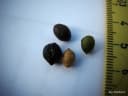
Bridelia micrantha
Bridelia micrantha
Safety & Hazards
None known
Cultivation Details
Succeeding in a wide variety of climates from the tropics to the subtropics, it can be found at elevations ranging from 300 - 2,200 metres[1]. It grows best in areas where the mean annual temperature is in the range 18 - 28°c and the mean annual rainfall is between 800 - 2,500mm[1]. It is naturally distributed from the Sudan in the north to the eastern Cape in South Africa. It can withstand light frost[1]. Grows on a variety of soils, from sandy to regular clay loams[1]. Plants are not drought resistant[1]. Coast goldleaf grows fast on good sites; it is one of the fastest growing indigenous trees of South Africa, with a growth rate of up to 2 metres per year[1]. Pollarding and coppicing are practised. Coppice shoots are produced after the trees are felled. Root suckers are produced if the roots are wounded, for example by trampling animals or during cultivation[1]. Ripe fruits are very popular with many of the fruit-eating birds, making this plant a must for the bird garden[1]. Coast goldleaf has an aggressive root system and cannot be planted close to buildings or paved areas[1].
Propagation
Seed - pre-treatment is not necessary, but only fresh seed should be used. The fruit pulp contains a growth inhibitor that must be removed - a suitable pre-treatment technique is to soak the seeds in cold water for 24 hours after removing the pulp[1]. The seed can be sown in situ or in a nursery. Sow the seed in a mixture of river sand and compost (2:1) and keep it moist[1]. Germination is good and uniform, up to 90-100% after 20-25 days[1]. Seedlings and young plants transplant easily; they can be transplanted into nursery bags when they reach the 2-leaf stage[1]. The oily seed has short viability and does not store[1]. Root suckers. Cite as: Tropical Plants Database, Ken Fern. tropical.theferns.info. 2026-02-19. <tropical.theferns.info/viewtropical.php?id=Bridelia+micrantha>
Pollinators
Data unavailable
References
- [1]World Agroforesty Centre — http://www.worldagroforestry.org/ ↩︎An excellent online database of a huge range of trees giving very good information on each plant - its uses, ecology, identity, propagation, pests etc.
- [2]Flora Zambesiaca — http://apps.kew.org/efloras/fz/intro.html ↩︎An excellent online flora of plants from the Zambezi River basin. It lists a number of the plant uses as well as the habitats and botanical descriptions of the plants.
- [3]Dictionary of Economic Plants. — Uphof. J. C. Th. · Weinheim · 1959 · ISBN - ↩︎An excellent and very comprehensive guide but it only gives very short descriptions of the uses without any details of how to utilize the plants. Not for the casual reader.