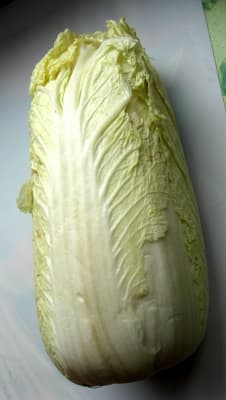
Brassica rapa pekinensis
Brassica rapa pekinensis
Safety & Hazards
The oil contained in the seed of some varieties of this species can be rich in erucic acid which is toxic. However, modern cultivars have been selected which are almost free of erucic acid.
Cultivation Details
Chinese cabbage is not fully winter hardy in much of the temperate zone, though mature plants withstand light frosts to about -3°c[1, 2]. Plants prefer coolish weather during their growing season, a temperature range of 13 - 20°c is ideal[2]. Succeeds in a well-drained fertile preferably alkaline soil[3, 4, 5]. Succeeds in acid and alkaline soils[6, 5]. Prefers a pH in the range 6.5 to 7[2]. Tolerates a pH in the range 4.3 to 6.8. Prefers a heavy soil[3] and grows badly in sandy ones[5]. Prefers full sun[5, 2] and a sheltered position[2]. Likes some shade[3]. Drought resistant according to one report[1], whilst another says that the plants are shallow-rooted and have very little resistance to drought[2]. They require about 5 gallons of water from sowing to maturity[2]. It looks like a large cos lettuce or cabbage and has a crisp, watery texture with a mustard-like taste[7]. There are many named varieties[8, 2]. Those forms with loose heads were developed for areas with hotter summers, whilst compact-headed forms were developed for cooler areas[2]. The loose-headed forms are less prone to bolt, are more resistant to cold and are more disease-resistant[2]. An annual to biennial species, the plant is normally grown as an annual[2]. Plants take from 55 - 100 days from sowing to maturity, depending on variety, the loose-headed forms are usually 2 - 3 weeks faster than compact-headed forms[2]. Plants do not like root disturbance so should not be transplanted unless grown in individual pots[2]. Plants are highly resistant to fungus attacks and the cabbage moth[1], they are also slow to bolt in hot weather[1]. Some cultivars are more resistant to bolting when sown in spring than other forms[2]. There is some evidence that interplanting this species with dill and garlic can lessen the attacks of caterpillars[2]. A good bee plant[9].
Propagation
Seed - it can be sown from late May to September in situ[2]. The spring sown crops often run to seed very quickly but 'barrel' types can be sown at this time. If seedlings are germinated at a temperature of 18 - 20°c and then grown on at this temperature for their first few weeks, they are then less likely to bolt[2]. Seed usually germinates within 3 - 4 days[2]. A late summer sowing under protection can provide leaves in the winter[2]. Seedlings can be transplanted when about 3 - 4 weeks old[2]. Cite as: Temperate Plants Database, Ken Fern. temperate.theferns.info. 2026-02-20. <temperate.theferns.info/plant/Brassica+rapa+pekinensis>
Pollinators
Bees
References
- [1]Wonder Crops. 1987. — Natural Food Institute, ↩︎Fascinating reading, this is an annual publication. Some reports do seem somewhat exaggerated though.
- [2]Oriental Vegetables — Larkcom J. · John Murray · 1991 · ISBN 0-7195-4781-4 ↩︎Well written and very informative.
- [3]New Vegetable Growers Handbook. — Simons. · Penguin · 1977 · ISBN 0-14-046-050-0 ↩︎A good guide to growing vegetables in temperate areas, not entirely organic.
- [4]Salads all the Year Round. — Larkcom. J. · Hamlyn · 1980 ↩︎A good and comprehensive guide to temperate salad plants, with full organic details of cultivation.
- [5]The New RHS Dictionary of Gardening. 1992. — Huxley. A. · MacMillan Press · 1992 · ISBN 0-333-47494-5 ↩︎Excellent and very comprehensive, though it contains a number of silly mistakes. Readable yet also very detailed.
- [6]The Milder Garden. — Taylor. J. · Dent · 1990 ↩︎A good book on plants that you didn't know could be grown outdoors in Britain.
- [7]Vegetables — Phillips. R. & Rix. M. · Macmillan Reference Books, London. · 1995 · ISBN 0 333 62640 0 ↩︎Excellent and easily read book with good information and an excellent collection of photos of vegetables from around the world, including many unusual species.
- [8]The Garden. Volume 112. — RHS. · Royal Horticultural Society · 1987 · ISBN - ↩︎Snippets of information from the magazine of the RHS. In particular, there are articles on plants that are resistant to honey fungus, oriental vegetables, Cimicifuga spp, Passiflora species and Cucurbits.
- [9]Garden Plants Valuable to Bees. — International Bee Research Association. · International Bee Research Association. · 1981 · ISBN - ↩︎The title says it all.
- [10]Flora of China — Missouri Botanical Garden Press; St. Louis. · 1994 · http://flora.huh.harvard.edu/china/ ↩︎An excellent, comprehensive resource in 25 volumes. In addition to the botanical information the flora also gives basic information on habitat and some uses. An on-line version is also available.
- [11]Oriental Herbs and Vegetables, Vol 39 No. 2. — Brooklyn Botanic Garden · Brooklyn Botanic Garden · 1986 · ISBN - ↩︎A small booklet packed with information.
- [12]Economic Botany. — Hill. A. F. · The Maple Press · 1952 · ISBN - ↩︎Not very comprehensive, but it is quite readable and goes into some detail about the plants it does cover.
- [13]Medicinal Plants of China — Duke. J. A. and Ayensu. E. S. · Reference Publications, Inc. · 1985 · ISBN 0-917256-20-4 ↩︎Details of over 1,200 medicinal plants of China and brief details of their uses. Often includes an analysis, or at least a list of constituents. Heavy going if you are not into the subject.
- [14]Growing from Seed. Volume 1. — Rice. G. (Editor) · Thompson and Morgan. · 1987 · ISBN - ↩︎Very readable magazine with lots of information on propagation.