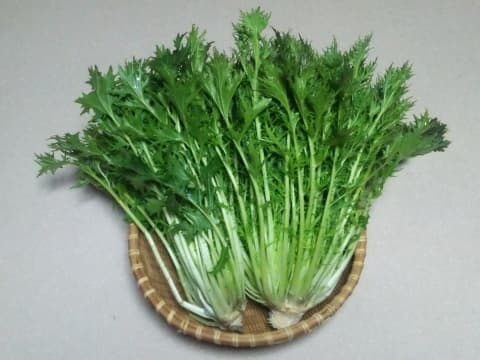
Brassica rapa nipposinica
Brassica rapa nipposinica
Safety & Hazards
The oil contained in the seed of some varieties of this species can be rich in erucic acid which is toxic. However, modern cultivars have been selected which are almost free of erucic acid.
Cultivation Details
Fairly hardy, tolerating quite hard frosts, though plants are likely to die if this is coupled with wet weather[1]. Plants are also tolerant of summer heat[1]. Succeeds in full sun in most well-drained fertile soils[2]. Summer crops tolerate light shade[1]. Prefers a pH of 5.5 to 7[2]. Prefers a cool moist reasonably fertile soil[3]. The plant is shallow rooted and intolerant of drought, it needs to be grown in a moist fertile soil for the best quality leaves[1]. This plant is one of the most resistant to bolting of the oriental brassicas and can be sown in spring. It can also be planted in the summer for an autumn and winter crop[4]. Mizuna can also be transplanted successfully[1]. A fast growing plant, it can be cropped on a cut and come again basis starting just 2 - 3 weeks after sowing and has been known to continue cropping for 10 months before going to seed[1]. A very ornamental plant[1].
Propagation
Seed - sow in situ or in a seed bed from mid spring to September. Thinnings can be transplanted[1]. Some varieties can also be sown in a cold greenhouse in late autumn or early spring to provide leaves overwinter and in late spring. Cite as: Temperate Plants Database, Ken Fern. temperate.theferns.info. 2026-02-20. <temperate.theferns.info/plant/Brassica+rapa+nipposinica>
Pollinators
Bees, Self
References
- [1]Oriental Vegetables — Larkcom J. · John Murray · 1991 · ISBN 0-7195-4781-4 ↩︎Well written and very informative.
- [2]The New RHS Dictionary of Gardening. 1992. — Huxley. A. · MacMillan Press · 1992 · ISBN 0-333-47494-5 ↩︎Excellent and very comprehensive, though it contains a number of silly mistakes. Readable yet also very detailed.
- [3]Salads all the Year Round. — Larkcom. J. · Hamlyn · 1980 ↩︎A good and comprehensive guide to temperate salad plants, with full organic details of cultivation.
- [4]Vegetables — Phillips. R. & Rix. M. · Macmillan Reference Books, London. · 1995 · ISBN 0 333 62640 0 ↩︎Excellent and easily read book with good information and an excellent collection of photos of vegetables from around the world, including many unusual species.
- [5]Mansfeld's Database of Agricultural and Horticultural Plants — http://mansfeld.ipk-gatersleben.de/pls/htmldb_pgrc/f?p=185:3:4292127278597336 ↩︎Terse details of a huge range of useful plants.