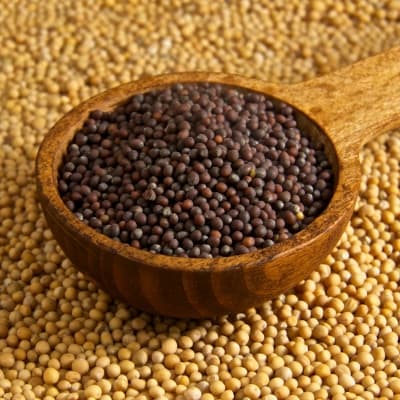
Brassica nigra
Brassica nigra
Safety & Hazards
When eaten in large quantities, the seed and pods have sometimes proved toxic to grazing animals[1].
Cultivation Details
Black mustard is adapted to a wide variety of climatic conditions. It is usually grown in the temperate and subtropical zones, being unsuited to wet tropical lowland areas but is able to be grown as a rainfed crop in tropical areas of low or moderate rainfall[2, 3]. The plant tolerates an annual precipitation of 300 - 1,700mm, an annual average temperature range of 6 to 27°c[2]. An easily grown plant, black mustard is suited to many types of soils except very heavy clays, it grows best on light sandy loams, or deep rich fertile soils[2]. Succeeds in full sun in a well-drained fertile preferably alkaline soil[4]. Prefers a heavy soil in an open position[5]. Another report says that it prefers a light well-drained soil and some shade in the summer[6]. Succeeds in soils with a pH in the range of 4.9 to 8.2[2]. This species is one of four species used to produce mustard.[3] The other three (see their individual records for more information) are:- Brassica carinata. Ethiopian mustard. This is scarcely used outside of the highlands of Kenya and Ethiopia. Brassica juncea. Brown mustard. A major crop, largely replacing Brassica nigra in commercial cultivation and accounting for around 40% of the total market. Sinapis alba. White mustard. The major mustard in cultivation, accounting for almost 60% of the market. The plants are not very winter hardy so the seed is best sown in the spring when grown for its seed whilst it can be sown as late as late summer as a green manure crop. The flowers have a pleasing perfume, though this is only noticed if several flowers are inhaled at the same time[7].
Propagation
Seed - sow in situ from early spring until late summer as a green manure and in order to obtain a succession of crops. The main crop for seed is sown in mid spring. Cite as: Temperate Plants Database, Ken Fern. temperate.theferns.info. 2026-02-20. <temperate.theferns.info/plant/Brassica+nigra>
Pollinators
Bees, Flies
References
- [1]Edible Native Plants of the Rocky Mountains. — Harrington. H. D. · University of New Mexico Press · 1967 · ISBN 0-8623-0343-9 ↩︎A superb book. Very readable, it gives the results of the authors experiments with native edible plants.
- [2]Handbook of Energy Crops — Duke. J. · - · 1983 · https://hort.purdue.edu/newcrop/duke_energy/dukeindex.html · ISBN - ↩︎Published only on the Internet, excellent information on a wide range of both temperate and tropical plants.
- [3]Plant Resources of Southeast Asia — http://proseanet.org/ ↩︎Lots of information on the uses of the plants of SE Asia.
- [4]The New RHS Dictionary of Gardening. 1992. — Huxley. A. · MacMillan Press · 1992 · ISBN 0-333-47494-5 ↩︎Excellent and very comprehensive, though it contains a number of silly mistakes. Readable yet also very detailed.
- [5]New Vegetable Growers Handbook. — Simons. · Penguin · 1977 · ISBN 0-14-046-050-0 ↩︎A good guide to growing vegetables in temperate areas, not entirely organic.
- [6]Salads all the Year Round. — Larkcom. J. · Hamlyn · 1980 ↩︎A good and comprehensive guide to temperate salad plants, with full organic details of cultivation.
- [7]Scented Flora of the World. — Genders. R. · Robert Hale. London. · 1994 · ISBN 0-7090-5440-8 ↩︎An excellent, comprehensive book on scented plants giving a few other plant uses and brief cultivation details. There are no illustrations.
- [8]Flora of China — Missouri Botanical Garden Press; St. Louis. · 1994 · http://flora.huh.harvard.edu/china/ ↩︎An excellent, comprehensive resource in 25 volumes. In addition to the botanical information the flora also gives basic information on habitat and some uses. An on-line version is also available.
- [9]Flora of the British Isles. — Clapham, Tutin and Warburg. · Cambridge University Press · 1962 · ISBN - ↩︎A very comprehensive flora, the standard reference book but it has no pictures.
- [10]A Modern Herbal. — Grieve. · Penguin · 1984 · ISBN 0-14-046-440-9 ↩︎Not so modern (1930's?) but lots of information, mainly temperate plants.
- [11]Food for Free. — Mabey. R. · Collins · 1974 · ISBN 0-00-219060-5 ↩︎Edible wild plants found in Britain. Fairly comprehensive, very few pictures and rather optimistic on the desirability of some of the plants.
- [12]The Vegetable Garden. — Vilmorin. A. · Ten Speed Press · ISBN 0-89815-041-8 ↩︎A reprint of a nineteenth century classic, giving details of vegetable varieties. Not really that informative though.
- [13]The Oxford Book of Food Plants. — Harrison. S. Wallis. M. Masefield. G. · Oxford University Press · 1975 · ISBN - ↩︎Good drawings of some of the more common food plants from around the world. Not much information though.
- [14]Cornucopia - A Source Book of Edible Plants. — Facciola. S. · Kampong Publications · 1990 · ISBN 0-9628087-0-9 ↩︎Excellent. Contains a very wide range of conventional and unconventional food plants (including tropical) and where they can be obtained (mainly N. American nurseries but also research institutes and a lot of other nurseries from around the world.
- [15]Encyclopaedia of Herbs and their Uses. — Bown. D. · Dorling Kindersley, London. · 1995 · ISBN 0-7513-020-31 ↩︎A very well presented and informative book on herbs from around the globe. Plenty in it for both the casual reader and the serious student. Just one main quibble is the silly way of having two separate entries for each plant.
- [16]Sturtevant's Edible Plants of the World. — Hedrick. U. P. · Dover Publications · 1972 · ISBN 0-486-20459-6 ↩︎Lots of entries, quite a lot of information in most entries and references.
- [17]Flowers of Europe - A Field Guide. — Polunin. O. · Oxford University Press · 1969 · ISBN 0192176218 ↩︎An excellent and well illustrated pocket guide for those with very large pockets. Also gives some details on plant uses.
- [18]The Herb Book. — Lust. J. · Bantam books · 1983 · ISBN 0-553-23827-2 ↩︎Lots of information tightly crammed into a fairly small book.
- [19]Economic Botany. — Hill. A. F. · The Maple Press · 1952 · ISBN - ↩︎Not very comprehensive, but it is quite readable and goes into some detail about the plants it does cover.
- [20]Dictionary of Economic Plants. — Uphof. J. C. Th. · Weinheim · 1959 · ISBN - ↩︎An excellent and very comprehensive guide but it only gives very short descriptions of the uses without any details of how to utilize the plants. Not for the casual reader.
- [21]Earth Medicine, Earth Food. — Weiner. M. A. · Ballantine Books · 1980 · ISBN 0-449-90589-6 ↩︎A nice book to read though it is difficult to look up individual plants since the book is divided into separate sections dealing with the different medicinal uses plus a section on edible plants. Common names are used instead of botanical.
- [22]A Field Guide to Medicinal Plants. Eastern and Central N. America. — Foster. S. & Duke. J. A. · Houghton Mifflin Co. · 1990 · ISBN 0395467225 ↩︎A concise book dealing with almost 500 species. A line drawing of each plant is included plus colour photographs of about 100 species. Very good as a field guide, it only gives brief details about the plants medicinal properties.
- [PFAF]Plants for a Future — pfaf.org ↩︎