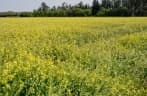
Brassica juncea
Brassica juncea
Safety & Hazards
An oil obtained from the seeds can have a high content of erucic acid. There have been some health concerns over the consumption of high levels of erucic acid n humans, though this is still controversial. At present (2012), several countries only allow cultivars with low erucic acid levels to be used for food.
Cultivation Details
Originating from the central Asian Himalayas to China, Brassica juncea has long been cultivated and many forms have been developed (see separate records). Plants can be grown in the tropical lowlands as well as in much cooler conditions[1]. The plant is reported to tolerate a temperature range of 6 - 37°c and an annual precipitation of 500 - 4,000mm[1]. Succeeds in full sun in most well-drained moisture-retentive fertile soils[2, 3, 4]. Prefers a heavy soil and some shade[2]. Dislikes very hot weather[5]. Plants tolerate high rainfall and, although fairly deep rooted, are not very drought resistant[4]. Tolerates a pH in the range 4.3 to 8.3. This species is one of four species used to produce mustard.[6] The other three (see their individual records for more information) are:- Brassica carinata. Ethiopian mustard. This is scarcely used outside of the highlands of Kenya and Ethiopia. Brassica nigra. Black mustard is only suitable for hand-harvesting and is rapidly losing importance as a commercial crop. Sinapis alba. White mustard. The major mustard in cultivation, accounting for almost 60% of the market. This species has also been cultivated in the Orient for many hundreds of years and a wide diversity of forms has been developed with edible leaves, stems, roots and seeds. These forms have been classified by the botanists as follows and separate entries have been made for each of them. Brassica juncea integrifolia crispifolia. The curled or cutleaf mustards, this group has attractively curled edible leaves. Brassica juncea integrifolia rugosa. Large somewhat cabbage-like edible leaves. Brassica juncea integrifolia strumata. A form with large edible leaf stalks. Brassica juncea integrifolia subintegrifolia. The leaf mustards have quite large smooth-edged edible leaves. Brassica juncea japonica. Rather similar to Brassica juncea crispifolia and combined with that group by some botanists. Brassica juncea napiformis. A form with a swollen edible root. Brassica juncea tsatsai multiceps. The multishoot mustard group. Brassica juncea tsatsai tumida. A form with swollen edible stems. Plants take from 2 - 5 months from sowing to maturity, depending on the season and the cultivar[4]. They prefer a fairly high stable temperature and are well adapted to short day length[3]. Many are best grown in warmer climates than Britain but there are several cultivars that grow well in this country[4]. Plants have a rooting depth of between 90 - 120 cm[7]. A good bee plant[8].
Propagation
Seed - sow in situ from early spring to early autumn in order to obtain a succession of edible leaves. Most varieties of Oriental vegetables belonging to this species are best sown from late early summer to early September otherwise they may bolt[4]. There are about 5,660 - 6,000 per 0.01 kg (1/3 oz)[7]. Cite as: Temperate Plants Database, Ken Fern. temperate.theferns.info. 2026-02-20. <temperate.theferns.info/plant/Brassica+juncea>
Pollinators
Bees
References
- [1]Protabase - Plant Resources of Tropical Africa. — http://www.prota.org ↩︎An excellent on-line database with detailed information on over 3,200 species of useful plants of Africa.
- [2]New Vegetable Growers Handbook. — Simons. · Penguin · 1977 · ISBN 0-14-046-050-0 ↩︎A good guide to growing vegetables in temperate areas, not entirely organic.
- [3]The New RHS Dictionary of Gardening. 1992. — Huxley. A. · MacMillan Press · 1992 · ISBN 0-333-47494-5 ↩︎Excellent and very comprehensive, though it contains a number of silly mistakes. Readable yet also very detailed.
- [4]Oriental Vegetables — Larkcom J. · John Murray · 1991 · ISBN 0-7195-4781-4 ↩︎Well written and very informative.
- [5]Rare Vegetables for Garden and Table. — Organ. J. · Faber · 1960 · ISBN - ↩︎Unusual vegetables that can be grown outdoors in Britain. A good guide.
- [6]Plant Resources of Southeast Asia — http://proseanet.org/ ↩︎Lots of information on the uses of the plants of SE Asia.
- [7]Handbook of Energy Crops — Duke. J. · - · 1983 · https://hort.purdue.edu/newcrop/duke_energy/dukeindex.html · ISBN - ↩︎Published only on the Internet, excellent information on a wide range of both temperate and tropical plants.
- [8]Flora of the USSR. — Komarov. V. L. · Israel Program for Scientific Translation · 1968 · http://www.biodiversitylibrary.org · ISBN - ↩︎An immense (25 or more large volumes) and not yet completed translation of the Russian flora. Full of information on plant uses and habitats but heavy going for casual readers. It can be downloaded from the Internet.
- [9]Flora Europaea — ? · Cambridge University Press · 1964 · ISBN - ↩︎An immense work in 6 volumes (including the index). The standard reference flora for Europe, it is very terse though and with very little extra information. Not for the casual reader.
- [10]Encyclopaedia of Herbs and their Uses. — Bown. D. · Dorling Kindersley, London. · 1995 · ISBN 0-7513-020-31 ↩︎A very well presented and informative book on herbs from around the globe. Plenty in it for both the casual reader and the serious student. Just one main quibble is the silly way of having two separate entries for each plant.
- [11]Pacific Island Ecosystems at Risk — http://www.hear.org/pier/scientificnames/index.html ↩︎A very good website detailing weed species that have been introduced into the Pacific Islands.
- [12]Flora of the British Isles. — Clapham, Tutin and Warburg. · Cambridge University Press · 1962 · ISBN - ↩︎A very comprehensive flora, the standard reference book but it has no pictures.
- [13]Alternative Foods. — Sholto-Douglas. J. ↩︎Not very comprehensive, it seems more or less like a copy of earlier writings with little added.
- [14]Dictionary of Economic Plants. — Uphof. J. C. Th. · Weinheim · 1959 · ISBN - ↩︎An excellent and very comprehensive guide but it only gives very short descriptions of the uses without any details of how to utilize the plants. Not for the casual reader.
- [15]Salads all the Year Round. — Larkcom. J. · Hamlyn · 1980 ↩︎A good and comprehensive guide to temperate salad plants, with full organic details of cultivation.
- [16]A Dictionary of Plants Used by Man. — Usher. G. · Constable · 1974 · ISBN 0094579202 ↩︎Forget the sexist title, this is one of the best books on the subject. Lists a very extensive range of useful plants from around the world with very brief details of the uses. Not for the casual reader.
- [17]Cornucopia - A Source Book of Edible Plants. — Facciola. S. · Kampong Publications · 1990 · ISBN 0-9628087-0-9 ↩︎Excellent. Contains a very wide range of conventional and unconventional food plants (including tropical) and where they can be obtained (mainly N. American nurseries but also research institutes and a lot of other nurseries from around the world.
- [18]Growing from Seed. Volume 1. — Rice. G. (Editor) · Thompson and Morgan. · 1987 · ISBN - ↩︎Very readable magazine with lots of information on propagation.
- [19]RHS Dictionary of Plants plus Supplement. 1956 — F. Chittendon. · Oxford University Press · 1951 · ISBN - ↩︎Comprehensive listing of species and how to grow them. Somewhat outdated, it has been replaced in 1992 by a new dictionary (see [ 200 ]).
- [20]Sturtevant's Edible Plants of the World. — Hedrick. U. P. · Dover Publications · 1972 · ISBN 0-486-20459-6 ↩︎Lots of entries, quite a lot of information in most entries and references.
- [21]Plants for Man. — Schery. R. W. ↩︎Fairly readable but not very comprehensive. Deals with plants from around the world.
- [22]Economic Botany. — Hill. A. F. · The Maple Press · 1952 · ISBN - ↩︎Not very comprehensive, but it is quite readable and goes into some detail about the plants it does cover.