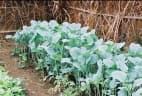
Brassica carinata
Brassica carinata
Safety & Hazards
The oil contained in the seed of this species is rich in erucic acid which is toxic. However, modern cultivars have been selected which are almost free of erucic acid.
Cultivation Details
Brassica carinata is very tolerant of a wide range of climatic conditions and can be grown from the temperate to tropical zones. In cool temperate it is only suitable as a leaf crop, but in other areas it can also be grown for its seed. It grows best in areas where annual daytime temperatures are within the range 10 - 25°c, but can tolerate 5 - 35°c[1]. It prefers a mean annual rainfall in the range 1,000 - 1,500mm, but tolerates 800 - 1,700mm[1]. Succeeds in full sun in a well-drained fertile preferably alkaline soil[2]. Succeeds in any reasonable soil[3]. Prefers a pH in the range 5.5 - 8, tolerating 5 - 8.5[1]. Plants develop an extensive root system, larger than in other Brassica species[4]. There is a difference in first flowering date between oil types and vegetable types; oil types start flowering about 10 weeks after germination, vegetable cultivars after about 12 weeks, depending on cultivar and growing conditions. Flowering of vegetable cultivars is delayed by regular harvesting of the leaves or young shoots[4]. Plants grown in dry regions flower earlier and produce ripe seeds within 4 months from sowing[4]. Vegetable crops grown with adequate moisture produce seeds in 5 - 6 months[4]. An average leaf and shoot yield of 35 tonnes per hectare can be expected, but at research stations leaf yields of 50 - 55 tonnes have been reported[4]. In India and Canada farmers may get seed yields of 1,200 - 1,800 kg per hectare in a good year[4]. Some tall cultivars, when grown with adequate moisture, may develop new shoots after removal of the infructescences and become perennial, normally for one further season, but plants of up to 4 years old have been recorded[4]. This species is one of four species used to produce mustard.[5] The other three (see their individual records for more information) are:- Brassica juncea. Brown mustard. A major crop, largely replacing Brassica nigra in commercial cultivation and accounting for around 40% of the total market. Brassica nigra. Black mustard is only suitable for hand-harvesting and is rapidly losing importance as a commercial crop. Sinapis alba. White mustard. The major mustard in cultivation, accounting for almost 60% of the market. Most Brassica species are cross-pollinating, which contributes to the great diversity within species. Brassica carinata is an exception as it sets seed very efficiently through self-pollination without insects acting as pollinators[4]. The plant does not need low temperatures for flower initiation, and seed production is therefore much easier in Africa than for most Brassica oleracea leaf cabbages except for Portuguese kale[4]. There are some named varieties. 'Texsel' is especially good for temperate climates, it is fast growing even at relatively low temperatures[6, 2]. Research has produced a collection of lines with characteristics suitable for modern agriculture. Varieties are available, including different oil types, such as low erucic (0%) and very high erucic (+ 50%) content[7]. This plant is unknown in the wild. It arose as a natural amphidiploid hybrid of female Brassica nigra and male Brassica oleracea[7].
Propagation
Seed - sow in situ in succession from early spring to early autumn. The seed can also be sown under cloches in late winter when it will yield a crop in late spring. Cite as: Temperate Plants Database, Ken Fern. temperate.theferns.info. 2026-02-20. <temperate.theferns.info/plant/Brassica+carinata>
Pollinators
Bees, Self
References
- [1]Ecocrop — http://ecocrop.fao.org/ecocrop/srv/en/home ↩︎Basic information on a wide range of useful plants, plus details of environmental needs where available.
- [2]The New RHS Dictionary of Gardening. 1992. — Huxley. A. · MacMillan Press · 1992 · ISBN 0-333-47494-5 ↩︎Excellent and very comprehensive, though it contains a number of silly mistakes. Readable yet also very detailed.
- [3]Salads all the Year Round. — Larkcom. J. · Hamlyn · 1980 ↩︎A good and comprehensive guide to temperate salad plants, with full organic details of cultivation.
- [4]Protabase - Plant Resources of Tropical Africa. — http://www.prota.org ↩︎An excellent on-line database with detailed information on over 3,200 species of useful plants of Africa.
- [5]Plant Resources of Southeast Asia — http://proseanet.org/ ↩︎Lots of information on the uses of the plants of SE Asia.
- [6]Alternative Enterprises for Agriculture in the UK. — Carruthers. S. P. (Editor) · Centre for Agricultural Strategy, Univ. of Reading · 1986 · ISBN 0704909820 ↩︎Some suggested alternative commercial crops for Britain. Readable. Produced by a University study group.
- [7]The National Non-Food Crops Centre Crop Database — http://www.nnfcc.co.uk/crops/pd.cfm ↩︎An excellent on-line information source, with information on over 100 species (as of 2006) of plants being investigated as bio-crops.
- [8]Sturtevant's Edible Plants of the World. — Hedrick. U. P. · Dover Publications · 1972 · ISBN 0-486-20459-6 ↩︎Lots of entries, quite a lot of information in most entries and references.
- [9]A Dictionary of Plants Used by Man. — Usher. G. · Constable · 1974 · ISBN 0094579202 ↩︎Forget the sexist title, this is one of the best books on the subject. Lists a very extensive range of useful plants from around the world with very brief details of the uses. Not for the casual reader.
- [10]Cornucopia - A Source Book of Edible Plants. — Facciola. S. · Kampong Publications · 1990 · ISBN 0-9628087-0-9 ↩︎Excellent. Contains a very wide range of conventional and unconventional food plants (including tropical) and where they can be obtained (mainly N. American nurseries but also research institutes and a lot of other nurseries from around the world.
- [PFAF]Plants for a Future — pfaf.org ↩︎