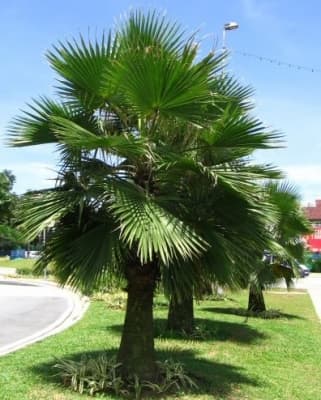
Brahea edulis
Brahea edulis
Safety & Hazards
None known
Cultivation Details
Brahea edulis is a plant of subtropical to tropical areas. Plants grow better in areas of lower rainfall, often growing poorly in areas of higher rainfall[1]. Tolerant of some frost[2]. This species tolerates several degrees of frost if it is growing in a dry sunny climate[3]. Plants grow well in full sun, even when small[1]. Succeeds in most fertile moist but well-drained soils in a sheltered sunny position[4]. Tolerant of poor dry soils[3]. Plants generally grow better in poorer, often alkaline soils, not growing so well in richer, acid soils[1]. Plants are drought and heat tolerant[5]. Plants are tolerant of winds and salty conditions[6]. Palms usually have deep penetrating root systems and generally establish best when planted out at a young stage. However, older plants are substantially more cold tolerant than juvenile plants[4]. In areas at the limit of their cold tolerance, therefore, it is prudent to grow the plants in containers for some years, giving them winter protection, and only planting them into their permanent positions when sheer size dictates[4]. Palms can also often be transplanted even when very large. Although the thick fleshy roots are easily damaged and/or desiccated, new roots are generally freely produced. It is important to stake the plant very firmly to prevent rock, and also to give it plenty of water until re-established - removing many of the leaves can also help[4].
Propagation
Seed - best sown as soon as it is ripe in a warm greenhouse at not less than 24°c[7]. Germination of fresh seed usually takes place in 3 - 4 months at 25°c[8]. Stored seed is very slow to germinate. Pre-soaking the seed for 24 hours in warm water prior to sowing may shorten the germination time. Plants form a long tap-root some time before forming a shoot so it is best to sow 2 - 3 seeds per deep pot. Grow the seedlings on in the greenhouse for at least their first three winters. Plant them out into their permanent positions in late spring or early summer, after the last expected frosts. Cite as: Temperate Plants Database, Ken Fern. temperate.theferns.info. 2026-02-20. <temperate.theferns.info/plant/Brahea+edulis>
Pollinators
Data unavailable
References
- [1]Palms of the World — Blombery. A. & Rodd. T. · Angus and Robertson · 1992 · ISBN 0-207-14848-1 ↩︎An excellent guide, well illustrated, with information on cultivation, uses, habitat etc of almost 200 species of Palms.
- [2]Palm and Cycad Societies of Australia. — http://www.pacsoa.org.au/ ↩︎Contains at least a little information on the majority of palm and cycad species, plus a wealth of photographs. A first class website.
- [3]The New RHS Dictionary of Gardening. 1992. — Huxley. A. · MacMillan Press · 1992 · ISBN 0-333-47494-5 ↩︎Excellent and very comprehensive, though it contains a number of silly mistakes. Readable yet also very detailed.
- [4]Palms for Cooler Climates. — McMillan-Browse. P. · Trebah Enterprises. · 1993 · ISBN 0 9521952 0 8 ↩︎An excellent little booklet on the subject, though it does not mention many plant uses.
- [5]Conservatory and Indoor Plants Volumes 1 & 2 — Phillips. R. & Rix. M. · Pan Books, London. · 1998 · ISBN 0-330-37376-5 ↩︎Excellent photos of over 1,100 species and cultivars with habits and cultivation details plus a few plant uses. Many species are too tender for outdoors in Britain though there are many that can be grown outside.
- [6]Trade Winds Fruit — http://www.tradewindsfruit.com/index.htm ↩︎The on-line catalogue of a company selling seeds. Gives descriptions, photos and uses of a very wide range of fruit and other food-producing plants plus ornamentals.
- [7]The RHS Gardener's Encyclopedia of Plants and Flowers — Brickell. C. · Dorling Kindersley Publishers Ltd. · 1990 · ISBN 0-86318-386-7 ↩︎Excellent range of photographs, some cultivation details but very little information on plant uses.
- [8]Growing from Seed. Volume 3. — Bird. R. (Editor) · Thompson and Morgan. · 1989 · ISBN - ↩︎Very readable magazine with lots of information on propagation.
- [9]Field Guide to the Palms of the Americas — Henderson A.; Galeano G.; Bernal R. · Princeton University Press; Princeton, New Jersey. · 1995 · ISBN 0-691-08537-4 ↩︎An excellent book, giving basic information on all the 550 species of palms native to the Americas that were known in 1995. Comprehensive information on the plants range and habitat, brief description, some uses and almost 250 photos.
- [10]Cornucopia II — Facciola. S. · Kampong Publications, California. · 1998 · ISBN 0-9628087-2-5 ↩︎The second edition of an excellent guide to the edible uses of plants, though it does not give any details of cultivation etc.
- [11]IUCN Red List of Threatened Species — http://www.iucnredlist.org/ ↩︎A list of plants under threat and facing possible extinction, usually with brief details of the threats and information on habitat.
- [12]Dictionary of Economic Plants. — Uphof. J. C. Th. · Weinheim · 1959 · ISBN - ↩︎An excellent and very comprehensive guide but it only gives very short descriptions of the uses without any details of how to utilize the plants. Not for the casual reader.
- [PFAF]Plants for a Future — pfaf.org ↩︎