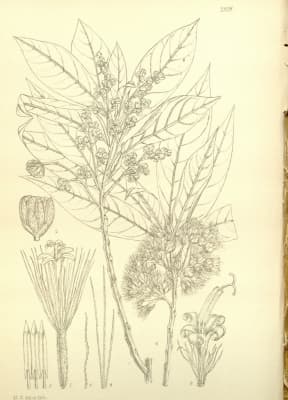
Brachylaena huillensis
Brachylaena huillensis
Safety & Hazards
None known
Cultivation Details
A plant of the tropical and subtropical areas of eastern and southern Africa, where it is found at elevations from 150 - 2,000 metres[1]. It grows best in areas where annual daytime temperatures are within the range 15 - 25°c, but can tolerate 10 - 35°c[2]. It prefers a mean annual rainfall in the range 900 - 1,200mm, but tolerates 700 - 1,400mm[2]. Requires a well drained soil and a position in full sun[3]. Prefers deep, well developed, red, volcanic clayey loams in plateau forests and red soils in the coastal belts[1]. Prefers a pH in the range 5 - 7, tolerating 4.5 - 7.5[2]. A dioecious species, both male and female forms need to be grown if seed is required.
Propagation
Normally propagated by seed[1]. Seeds from fruits collected only 7 days after the maturation of the buds will germinate[1]. Seed storage behaviour is uncertain; viability is lost within 6 months in open storage at room temperature[1]. Cite as: Tropical Plants Database, Ken Fern. tropical.theferns.info. 2026-02-19. <tropical.theferns.info/viewtropical.php?id=Brachylaena+huillensis>
Pollinators
Bees
References
- [1]World Agroforesty Centre — http://www.worldagroforestry.org/ ↩︎An excellent online database of a huge range of trees giving very good information on each plant - its uses, ecology, identity, propagation, pests etc.
- [2]Ecocrop — http://ecocrop.fao.org/ecocrop/srv/en/home ↩︎Basic information on a wide range of useful plants, plus details of environmental needs where available.
- [3]The New RHS Dictionary of Gardening. 1992. — Huxley. A. · MacMillan Press · 1992 · ISBN 0-333-47494-5 ↩︎Excellent and very comprehensive, though it contains a number of silly mistakes. Readable yet also very detailed.
- [4]IUCN Red List of Threatened Species — http://www.iucnredlist.org/ ↩︎A list of plants under threat and facing possible extinction, usually with brief details of the threats and information on habitat.
- [5]Flora Zambesiaca — http://apps.kew.org/efloras/fz/intro.html ↩︎An excellent online flora of plants from the Zambezi River basin. It lists a number of the plant uses as well as the habitats and botanical descriptions of the plants.
- [6]Field Guide to the Moist Forest Trees of Tanzania. — Lovett J.C.; Ruffo C.K.; Gereau R.E.; Taplin J.R.D · Frontier · http://www.york.ac.uk/res/celp/webpages/projects/ecology/tree%20guide/introduction.htm · ISBN 1-873070-33-0 ↩︎A lovely little book giving a basic identification guide to more than 650 species of trees growing in Tanzania. It is also available to view on the internet.
- [7]Dictionary of Economic Plants. — Uphof. J. C. Th. · Weinheim · 1959 · ISBN - ↩︎An excellent and very comprehensive guide but it only gives very short descriptions of the uses without any details of how to utilize the plants. Not for the casual reader.