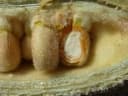
Brachychiton discolor
Brachychiton discolor
Safety & Hazards
The seed capsule contains irritant, glochid-like, hairs and should only be handled when wearing gloves[1].
Cultivation Details
A plant mainly of the subtropics in eastern Australia, just moving into the tropical areas. It is tolerant of some frost[2]. Prefers a sunny position[3]. Grows best in a moist but well-drained, fertile soil[2]. Established plants are drought tolerant[2]. The tree grows rapidly when given good conditions[4]. The tree hybridizes in the wild with Brachychiton acerifolius and Brachychiton bidwillii[2].
Propagation
Seed - it stores well and germinates easily, especially if pre-soaked for 12 - 24 hours in warm water[2]. The seed stores well at room temperatures - 15 year old seed had a 54% germination rate[4]. Cite as: Temperate Plants Database, Ken Fern. temperate.theferns.info. 2026-02-20. <temperate.theferns.info/plant/Brachychiton+discolor>
Pollinators
Data unavailable
References
- [1]Desert Tropicals — http://www.desert-tropicals.com/ ↩︎The main focus of the site is succulent plants, but it also contains information on a wide range of other species. Usually at least one good photograph, plus basic information about the plant and its cultivation.
- [2]Australian Rainforest Plants Volumes 1 - 6 — Nicholson N. & H. · Terania Rainforest Publishing; New South Wales. · 2007 · ISBN 9-78095894-3628 ↩︎Beautiful set of booklets with a terse description of over 600 species and their habitat, often including some of their uses and notes on their cultivation, plus at least one, excellent photograph.
- [3]The New RHS Dictionary of Gardening. 1992. — Huxley. A. · MacMillan Press · 1992 · ISBN 0-333-47494-5 ↩︎Excellent and very comprehensive, though it contains a number of silly mistakes. Readable yet also very detailed.
- [4]Brisbane Rainforest Action and Information Network, — http://www.brisrain.webcentral.com.au ↩︎Information on plants in the Queensland Rainforests.
- [5]The Useful Native Plants of Australia. — Maiden J.H. · Turner & Co.; London. · 1889 · http://www.biodiversitylibrary.org ↩︎Terse details of the uses of many Australian plants and other species naturalised, or at least growing, in Australia. It can be downloaded from the Internet.