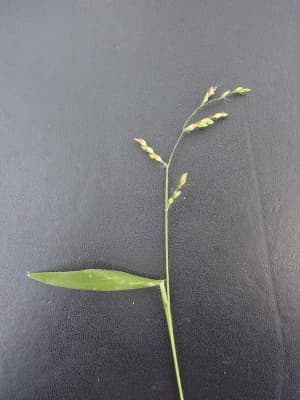
Brachiaria deflexa
Brachiaria deflexa
Safety & Hazards
None known
Cultivation Details
Prefers a slightly shady location[1]. Grows best in a well-drained, fertile soil[1]. Established plants are drought tolerant[2]. The plant is a common weed of cultivation within its native range, being found in arable land, under plantation crops and in flower gardens[2]. Some types mature in as little as 70 - 75 days, but most types take 90 - 130 days to reach maturity[1]. The plant can be considered as one of the ‘kreb’ group of grasses, which includes species such as Echinochloa pyramidalis and Panicum turgidum[2]. These species occur in the Sahel region and are collected for human consumption, especially in times of food shortage[2]. The plant is somewhat similar to another grain crop, Digitaria exilis, though this species grows faster than D. Exilis, but requires a richer soil and better drainage[2]. The wild plant shows some variability, and in the Fouta Djallon area on the Guinea-Mali border a cultivar is grown that is non-shattering[1, 2].
Propagation
Seed - Cite as: Tropical Plants Database, Ken Fern. tropical.theferns.info. 2026-02-19. <tropical.theferns.info/viewtropical.php?id=Brachiaria+deflexa>
Pollinators
Wind
References
- [1]Protabase - Plant Resources of Tropical Africa. — http://www.prota.org ↩︎An excellent on-line database with detailed information on over 3,200 species of useful plants of Africa.
- [2]The Useful Plants of West Tropical Africa. — Burkil. H. M. · Royal Botanic Gardens; Kew. · 1985 - 2004 ↩︎Brief descriptions and details of the uses of over 4,000 plants. A superb, if terse, resource, it is also available electronically on the Web - see http://www.aluka.org/
- [3]Flora Zambesiaca — http://apps.kew.org/efloras/fz/intro.html ↩︎An excellent online flora of plants from the Zambezi River basin. It lists a number of the plant uses as well as the habitats and botanical descriptions of the plants.
- [4]Grassland Species - Profiles — http://www.fao.org/ag/AGP/AGPC/doc/Gbase/Default.htm ↩︎Terse information on over 650 species of plants that grow in grassland, including trees, shrubs and perennial plants as well as grasses. Gives a brief description of the plant, its range and habitat and some of its uses.