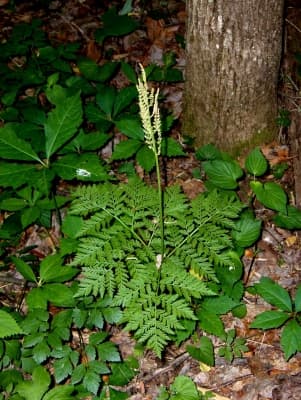
Botrychium virginianum
Botrychium virginianum
Safety & Hazards
Although we have found no reports of toxicity for this species, a number of ferns contain carcinogens so some caution is advisable[1]. Many ferns also contain thiaminase, an enzyme that robs the body of its vitamin B complex. In small quantities this enzyme will do no harm to people eating an adequate diet that is rich in vitamin B, though large quantities can cause severe health problems. The enzyme is destroyed by heat or thorough drying, so cooking the plant will remove the thiaminase[2].
Cultivation Details
Botrychium virginianum is a plant mainly found in the temperate zone, but also found in subtropical and tropical areas through central America to S. America. Prefers a sandy loam with just a small portion of peat[3]. Requires sharp drainage[3]. Best grown in an open position[3]. Plants can be difficult to establish. The prothalli (young plants formed when the spores germinate) of this plant form a symbiotic relationship with a mycorrhizal fungus, similar to the association of orchid seedlings with an invading fungus[1]. Unlike most species of ferns, the fronds of this species grow up straight and not curled inward, crozier fashion[4]. Members of this genus are rarely if ever troubled by browsing deer[5].
Propagation
Spores - best surface sown as soon as they are ripe in a greenhouse and do not allow the compost to dry out. Placing the pot in a plastic bag helps to maintain a humid atmosphere which promotes germination and growth. Prick out small clumps into pots when they are large enough to handle and keep moist until established. Grow on in a greenhouse for at least the first winter and plant out in late spring. Division. It is best not to try and disturb this plant[1]. Cite as: Temperate Plants Database, Ken Fern. temperate.theferns.info. 2026-02-20. <temperate.theferns.info/plant/Botrychium+virginianum>
Pollinators
Data unavailable
References
- [1]The New RHS Dictionary of Gardening. 1992. — Huxley. A. · MacMillan Press · 1992 · ISBN 0-333-47494-5 ↩︎Excellent and very comprehensive, though it contains a number of silly mistakes. Readable yet also very detailed.
- [2]Discovering Wild Plants - Alaska, W. Canada and the Northwest. — Schofield. J. J. · Alaska Northwest Books; Alaska · 2003 · ISBN 0882403699 ↩︎A nice guide to some useful plants in that area.
- [3]RHS Dictionary of Plants plus Supplement. 1956 — F. Chittendon. · Oxford University Press · 1951 · ISBN - ↩︎Comprehensive listing of species and how to grow them. Somewhat outdated, it has been replaced in 1992 by a new dictionary (see [ 200 ]).
- [4]A Modern Herbal. — Grieve. · Penguin · 1984 · ISBN 0-14-046-440-9 ↩︎Not so modern (1930's?) but lots of information, mainly temperate plants.
- [5]Perennial Garden Plants — Thomas. G. S. · J. M. Dent & Sons, London. · 1990 · ISBN 0 460 86048 8 ↩︎A concise guide to a wide range of perennials. Lots of cultivation guides, very little on plant uses.
- [6]Flora of China — Missouri Botanical Garden Press; St. Louis. · 1994 · http://flora.huh.harvard.edu/china/ ↩︎An excellent, comprehensive resource in 25 volumes. In addition to the botanical information the flora also gives basic information on habitat and some uses. An on-line version is also available.
- [7]Ferns and Fern Allies of Guatemala — Field Museum of Natural History · 1981 · http://www.biodiversitylibrary.org ↩︎A flora of the ferns of Guatemala, giving some plant uses. It can be downloaded from the Internet.
- [8]A Field Guide to Medicinal Plants. Eastern and Central N. America. — Foster. S. & Duke. J. A. · Houghton Mifflin Co. · 1990 · ISBN 0395467225 ↩︎A concise book dealing with almost 500 species. A line drawing of each plant is included plus colour photographs of about 100 species. Very good as a field guide, it only gives brief details about the plants medicinal properties.
- [9]Flora of N. America — http://flora.huh.harvard.edu/fna/ ↩︎An on-line version of the flora with an excellent description of the plant including a brief mention of plant uses.
- [10]Sturtevant's Edible Plants of the World. — Hedrick. U. P. · Dover Publications · 1972 · ISBN 0-486-20459-6 ↩︎Lots of entries, quite a lot of information in most entries and references.
- [11]Native American Ethnobotany — Moerman. D. · Timber Press. Oregon. · 1998 · ISBN 0-88192-453-9 ↩︎Very comprehensive but terse guide to the native uses of plants. Excellent bibliography, fully referenced to each plant, giving a pathway to further information. Not for the casual reader.
- [PFAF]Plants for a Future — pfaf.org ↩︎