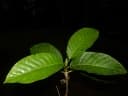
Borojoa patinoi
Borojoa patinoi
Safety & Hazards
None known
Cultivation Details
A plant of warm tropical lowlands usually at elevations up to 700 metres, but sometimes to 1,200 metres[1]. It grows best in areas where annual daytime temperatures fall within the range 20 - 28°c, though it can tolerate 15 - 32°c[1]. Temperatures in its native region may reach up to an absolute maximum of 41°c[1]. It prefers a mean annual rainfall in the range 3,000 - 6,000mm, tolerating 2,500 - 9,000mm[1]. It thrives with high air humidity average up to almost 90%[1]. Succeeds in heavy soils[2]. Prefers a pH in the range 4.5 - 6.5, tolerating 4 - 7[1]. The fruit takes more than one year to ripen after flowering. A dioecious species, both male and female forms need to be grown if fruit and seed are required[1].
Propagation
Seed - Cite as: Tropical Plants Database, Ken Fern. tropical.theferns.info. 2026-02-19. <tropical.theferns.info/viewtropical.php?id=Borojoa+patinoi>
Pollinators
Data unavailable
References
- [1]Ecocrop — http://ecocrop.fao.org/ecocrop/srv/en/home ↩︎Basic information on a wide range of useful plants, plus details of environmental needs where available.
- [2]Perennial Edible Fruits of the Tropics : an Inventory — Martin, F. W.; Campbell, C. W.; Rubertbe, R. M. · U.S. Dept. of Agriculture, Agricultural Research Service · 1987 ↩︎A booklet giving terse details of almost 300 species of edible fruits, plus regional lists of Botanical and Common names for over 2,500 less well-known edible fruits of the tropics.
- [3]Cornucopia II — Facciola. S. · Kampong Publications, California. · 1998 · ISBN 0-9628087-2-5 ↩︎The second edition of an excellent guide to the edible uses of plants, though it does not give any details of cultivation etc.
- [4]Mansfeld's Database of Agricultural and Horticultural Plants — http://mansfeld.ipk-gatersleben.de/pls/htmldb_pgrc/f?p=185:3:4292127278597336 ↩︎Terse details of a huge range of useful plants.
- [PFAF]Plants for a Future — pfaf.org ↩︎