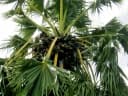
Borassus flabellifer
Borassus flabellifer
Safety & Hazards
None known
Cultivation Details
The palmyra is a very adaptable palm that can succeed in a wide range of conditions in dry to moist tropical and subtropical climates[1]. It grows best at elevations below 800 metres[1]. It can survive with as little as 250mm of rain a year, and one month or more where rainfall is below 25mm[2], cropping satisfactorily with 500 - 900mm per year[1]. It will also grow and crop well with rainfall as high as 5,000mm per year[1]. It grows best where temperatures never fall below 10°c[2], with an optimum mean annual temperature around 30°c, but it withstands extreme temperatures as high as 45°c and as low as 0°c[1]. Plants grow well in full sun, even when small[2]. Prefers a sandy soil[1], but plants are able to succeed under a wide range of conditions[3]. Established plants are quite drought resistant and also survive waterlogging quite well[1]. It is difficult to determinie the original habitat of the plant since its distribution is so heavily influenced by human activity. It occurs between sea level and 800 metres, though it is more abundant at low elevations and is particularly common in coastal areas with sandy or alluvial soils and in areas with permanent soil moisture such as flood plains and river valleys. It is commonly grown along the margins of rice paddies[4]. The palm starts flowering and fruiting 12 - 20 years after germination, usually in the dry season[1]. A dioecious species, both male and female forms need to be grown if fruit and seed are required[3].
Propagation
Seed - pre-soak for 24 hours in warm water and sow in containers or in situ. The seed is difficult to germinate, often taking 12 months or more[2]. Scarifying it prior to soaking may reduce germination time. When germination occurs, the massive cotyledon grows several metres down into the ground before the roots and leaves appear[2]. Seeds should thus be planted in deep containers or into a permanent position in the ground as soon as growth begins to appear[2]. Cite as: Tropical Plants Database, Ken Fern. tropical.theferns.info. 2026-02-19. <tropical.theferns.info/viewtropical.php?id=Borassus+flabellifer>
Pollinators
Bees
References
- [1]World Agroforesty Centre — http://www.worldagroforestry.org/ ↩︎An excellent online database of a huge range of trees giving very good information on each plant - its uses, ecology, identity, propagation, pests etc.
- [2]Palms of the World — Blombery. A. & Rodd. T. · Angus and Robertson · 1992 · ISBN 0-207-14848-1 ↩︎An excellent guide, well illustrated, with information on cultivation, uses, habitat etc of almost 200 species of Palms.
- [3]Digital Compendium of Forestry Species of Cambodia — www.digitalspecies.blogspot.com; Phnom Penh · 2008 · http://www.digitalspecies.blogspot.com ↩︎A very detailed booklet, produced in PDF format on the internet, giving information on around 100 species of trees.
- [4]A Revision of Borassus L. (Arecaceae) — Bayton R.P. · 2007 · http://www.jstor.org/stable/20443389 ↩︎
- [5]Trees Commonly Cultivated in SE Asia — Jensen. M. · FAO Regional Office, Bangkok. · 1999 · ISBN 974-89377-5-5 ↩︎
- [6]Cornucopia II — Facciola. S. · Kampong Publications, California. · 1998 · ISBN 0-9628087-2-5 ↩︎The second edition of an excellent guide to the edible uses of plants, though it does not give any details of cultivation etc.
- [7]Perennial Edible Fruits of the Tropics : an Inventory — Martin, F. W.; Campbell, C. W.; Rubertbe, R. M. · U.S. Dept. of Agriculture, Agricultural Research Service · 1987 ↩︎A booklet giving terse details of almost 300 species of edible fruits, plus regional lists of Botanical and Common names for over 2,500 less well-known edible fruits of the tropics.
- [8]Dictionary of Economic Plants. — Uphof. J. C. Th. · Weinheim · 1959 · ISBN - ↩︎An excellent and very comprehensive guide but it only gives very short descriptions of the uses without any details of how to utilize the plants. Not for the casual reader.
- [9]Useful Fiber Plants of the World — Dodge C.R. · USDA; Washington. · 1897 · http://www.biodiversitylibrary.org/ ↩︎A rather dated, but very comprehensive catalogue of fibre plants from around the world. The book can be downloaded from the Internet.
- [PFAF]Plants for a Future — pfaf.org ↩︎