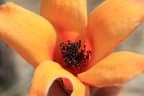
Bombax costatum
Bombax costatum
Safety & Hazards
None known
Cultivation Details
Prefers a humus-rich, loamy soil and a position in full sun[1]. Grows well on stony soils[2]. The tuberous roots act as water and/or sugar storage facilities during long drought periods[2]. Trees have a thick, corky bark and are very resistant to fire[2, 3, 4]. Plants begin flowering and fruiting, according to site and conditions, from the sixth year on, but very irregularly[2]. They usually flower in the dry season[5]. Unfortunately many trees are unproductive of seedfloss owing to fire-damage at the critical time of flowering in the dry season[3]. A mature tree bears up to 1,500 fruits each year with a total yield of 5 - 8 kg of kapok. Under favourable conditions, 3 - 5 kg kapok per tree can be obtained from the 10th year onwards[2]. An important bee forage species[2].
Propagation
Direct seeding is a preferred propagation mode, however wildlings may also be used[2]. The seedlings are difficult to plant in spite of their vigorous rooting ability. Natural regeneration is easy and abundant when the plants are sufficiently protected against fire and livestock[2]. Cuttings root easily[4]. Cite as: Tropical Plants Database, Ken Fern. tropical.theferns.info. 2026-02-19. <tropical.theferns.info/viewtropical.php?id=Bombax+costatum>
Pollinators
Data unavailable
References
- [1]The New RHS Dictionary of Gardening. 1992. — Huxley. A. · MacMillan Press · 1992 · ISBN 0-333-47494-5 ↩︎Excellent and very comprehensive, though it contains a number of silly mistakes. Readable yet also very detailed.
- [2]World Agroforesty Centre — http://www.worldagroforestry.org/ ↩︎An excellent online database of a huge range of trees giving very good information on each plant - its uses, ecology, identity, propagation, pests etc.
- [3]The Useful Plants of West Tropical Africa. — Burkil. H. M. · Royal Botanic Gardens; Kew. · 1985 - 2004 ↩︎Brief descriptions and details of the uses of over 4,000 plants. A superb, if terse, resource, it is also available electronically on the Web - see http://www.aluka.org/
- [4]Trees and Shrubs of the Sahel. Their Characteristics and Uses. — von Maydell H. · Deutsche Gesellschaft fur Technische Zusammenarbeit; Germany · 1990 · ISBN 3-8236-1198-4 ↩︎A well-researched book, usually with more than one photograph of each species and good information on the plant and its uses.
- [5]Traditional Vegetables in Benin — Achigan-Dako E. Et al · Darwin Initiative; International Foundation for Science · 2009 ↩︎Issued as a PDF on the Internet, it contains basic information on over 250 species of plants used for food in Benin.
- [6]Dictionary of Economic Plants. — Uphof. J. C. Th. · Weinheim · 1959 · ISBN - ↩︎An excellent and very comprehensive guide but it only gives very short descriptions of the uses without any details of how to utilize the plants. Not for the casual reader.
- [7]CosIng — http://ec.europa.eu/growth/tools-databases/cosing/ ↩︎CosIng is the European Commission database for information on cosmetic substances and ingredients.