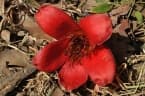
Bombax ceiba
Bombax ceiba
Safety & Hazards
None known
Cultivation Details
A plant of the tropical, humid lowlands[1]. It grows best in areas where annual daytime temperatures are within the range 28 - 42°c, though it can tolerate 5 - 49°c[2]. It can resist occasional light frosts, with new growth being killed at -1°c, but dormant growth being tolerant down to -3°c[2, 3]. It prefers a mean annual rainfall of 750 - 4,000mm, tolerating 500 - 5,000mm and preferring a distinct dry season[2]. Grows best in a sunny position[4]. Prefers a deep, rich, well-drained soil, but tolerating a wide range of conditions[4, 5]. Established plants are drought tolerant[4], and can also withstand occasional inundation of the soil[5]. Prefers a pH in the range 5.5 - 6.5, tolerating 4.9 - 7.2[2]. A fast-growing plant, especially when young[5]. The plant can commence flowering when around 8 - 10 years old from seed[5]. The plant produces suckers, especially when young, though they often die after 2 - 3 years, especially as the tree grows older[5]. Young trees can be coppiced, but older trees will often fail to grow back after being cut down[5]. The tree has a thick bark which acts as an insulation and allows it to recover from fires[5, 3].
Propagation
Seed - sown fresh, without pre-treatment, they have a high germination rate[5]. Some reports suggest germination rates can be improved by pre-soaking the seeds for 12 hours prior to sowing[5], this is likely to refer to seeds that have dried somewhat[PFAF]. Seeds can be sown in a sunny position, either in situ or in nursery beds. Sprouting takes place in 10 - 25 days[5]. Transplant 5cm tall seedlings to individual containers and plant out 12 months later[5]. Cuttings of half-ripe wood. Cite as: Tropical Plants Database, Ken Fern. tropical.theferns.info. 2026-02-19. <tropical.theferns.info/viewtropical.php?id=Bombax+ceiba>
Pollinators
Birds, Bees
References
- [1]Trees Commonly Cultivated in SE Asia — Jensen. M. · FAO Regional Office, Bangkok. · 1999 · ISBN 974-89377-5-5 ↩︎
- [2]Ecocrop — http://ecocrop.fao.org/ecocrop/srv/en/home ↩︎Basic information on a wide range of useful plants, plus details of environmental needs where available.
- [3]Trees of Laos and Vietnam - A Field Guide to 100 species. — Hoang Van Sam; Khamseng Nanthavong; Kessler P.J.A. · Blumea · 2004 ↩︎A detailed guide, with excellent line-drawings, to 100 of the more important trees of Laos and Vietnam. A very good work, giving lots of information about each plant. Originally published in the journal Blumea, it is available as a PDF on the Interne
- [4]Tropical and Subtropical Trees - A Worldwide Encyclopaedic Guide. — Barwick. M. · Thames & Hudson, London · 2004 · ISBN 0-500-51181-0 ↩︎A superb book, very concise and well written, giving a wealth of information on 400 or more species including descriptions, habitat, cultivation details and plant uses. A wealth of colour photographs bring each plant vividly to life.
- [5]Digital Compendium of Forestry Species of Cambodia — www.digitalspecies.blogspot.com; Phnom Penh · 2008 · http://www.digitalspecies.blogspot.com ↩︎A very detailed booklet, produced in PDF format on the internet, giving information on around 100 species of trees.
- [6]Mansfeld's Database of Agricultural and Horticultural Plants — http://mansfeld.ipk-gatersleben.de/pls/htmldb_pgrc/f?p=185:3:4292127278597336 ↩︎Terse details of a huge range of useful plants.
- [7]Flora of China — Missouri Botanical Garden Press; St. Louis. · 1994 · http://flora.huh.harvard.edu/china/ ↩︎An excellent, comprehensive resource in 25 volumes. In addition to the botanical information the flora also gives basic information on habitat and some uses. An on-line version is also available.
- [8]Cornucopia II — Facciola. S. · Kampong Publications, California. · 1998 · ISBN 0-9628087-2-5 ↩︎The second edition of an excellent guide to the edible uses of plants, though it does not give any details of cultivation etc.
- [9]Plant Resources of Southeast Asia — http://proseanet.org/ ↩︎Lots of information on the uses of the plants of SE Asia.
- [10]Useful Fiber Plants of the World — Dodge C.R. · USDA; Washington. · 1897 · http://www.biodiversitylibrary.org/ ↩︎A rather dated, but very comprehensive catalogue of fibre plants from around the world. The book can be downloaded from the Internet.
- [11]CosIng — http://ec.europa.eu/growth/tools-databases/cosing/ ↩︎CosIng is the European Commission database for information on cosmetic substances and ingredients.
- [12]Dictionary of Economic Plants. — Uphof. J. C. Th. · Weinheim · 1959 · ISBN - ↩︎An excellent and very comprehensive guide but it only gives very short descriptions of the uses without any details of how to utilize the plants. Not for the casual reader.
- [13]Larvicidal activity of Dregea volubilis and Bombax malabaricum leaf extracts against the filarial vector Culex quinq — Emdad Hossain; Anjali Rawani; Goutam Chandra; Subhash C. Man · 2011 ↩︎
- [PFAF]Plants for a Future — pfaf.org ↩︎