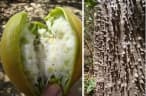
Bombacopsis quinata
Bombacopsis quinata
Safety & Hazards
None known
Cultivation Details
Red ceiba is found in the dry to wet tropical forests of northern S. America, where it succeeds at elevations from sea level to around 900 metres[1]. It grows best where the mean annual temperature is in the range 21 - 27°c, and the mean annual rainfall is 800 - 3,000mm[1]. It can thrive in areas with a 5 - 6 months dry season[2]. Prefers a humus-rich loamy soil[3]. It grows in a wide variety of situations, ranging from well-drained upland soils to imperfectly drained Vertisols, on low, flattened sites. Soil reactions at most locations are within pH 6 - 8[1]. A fast-growing tree[2]. Trees coppice readily[4]. Trees are sometimes allowed to remain when clearing forest, in order to provide shelter for coffee plantations[1].
Propagation
Seeds do not require pregermination treatment and initiate root radicles within 8 days of sowing[1]. Seed storage behaviour is orthodox; seeds tolerate desiccation to 7.2% mc with 90% germination; 77% germination is achieved after 1 year subsequent storage at 5c.[1] Seeds lose viability rapidly if the capsules are collected too early, but seed collected from capsules harvested at full maturity keep well for at least 2 - 3 years[1]. B. quinata is relatively easy to propagate vegetatively. Large diameter cuttings from semi-mature trees root well. They have been used successfully to establish clonal seed orchards in Colombia, Costa Rica and Venezuela. Best rooting is obtained from cuttings from shoots, which develop following felling of young trees, or from cuttings from stem material of young nursery stock. Sprouting is enhanced when trees are felled at the end of the dry season before leaf flush[1]. Cite as: Tropical Plants Database, Ken Fern. tropical.theferns.info. 2026-02-19. <tropical.theferns.info/viewtropical.php?id=Bombacopsis+quinata>
Pollinators
Bats, Moths
References
- [1]World Agroforesty Centre — http://www.worldagroforestry.org/ ↩︎An excellent online database of a huge range of trees giving very good information on each plant - its uses, ecology, identity, propagation, pests etc.
- [2]Timber Trees of Meso America. — UNEP · 2005 · http://www.unep-wcmc.org/forest/timber/workshops/reports/MA2005/Annex%202.pdf ↩︎A PDF document, published on the internet. Detailed reports on about 30 species of timber trees from Central America.
- [3]The New RHS Dictionary of Gardening. 1992. — Huxley. A. · MacMillan Press · 1992 · ISBN 0-333-47494-5 ↩︎Excellent and very comprehensive, though it contains a number of silly mistakes. Readable yet also very detailed.
- [4]Global Tree Campaign - 40 Species in Trade — http://www.unep-wcmc.org/trees/trade/40_species_in_trade.htm ↩︎Information on the habitats, uses and some cultivation notes for 40 species of timber trees.
- [5]Tropical Timbers of the World. Ag. Handbook No. 607. — Chudnoff. Martin. · USDA Forest Service. Wisconsin. · 1984 ↩︎Terse details on the properties of the wood of almost 400 species of trees from the Tropics.
- [6]Contributions from the United States National Herbarium Vol. 18 — Smithsonian Institute; Washington. · 1917 · http://www.biodiversitylibrary.org ↩︎Includes a treatment of the Annona. It can be downloaded from the Internet.
- [7]IUCN Red List of Threatened Species — http://www.iucnredlist.org/ ↩︎A list of plants under threat and facing possible extinction, usually with brief details of the threats and information on habitat.
- [8]South American Timbers: the Properties, Uses and Characteristics of 190 Species. — Bolza. E. & Christensen. F.J. · Commonwealth Scientific and Industrial Research Organization · 1979 · ISBN 0 643 02582 0 ↩︎A very useful guide.
- [9]Dictionary of Economic Plants. — Uphof. J. C. Th. · Weinheim · 1959 · ISBN - ↩︎An excellent and very comprehensive guide but it only gives very short descriptions of the uses without any details of how to utilize the plants. Not for the casual reader.