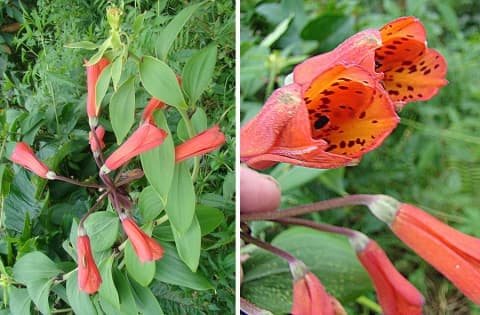
Bomarea acutifolia
Bomarea acutifolia
Safety & Hazards
The fresh sap of this plant can cause skin rashes in some people. The plant contains small quantities (up to 0.2%) of the compound tuliposide A, which probably hydrolizes on the skin to form the allergenic lactone tulipalin A. People who are allergic to the sap of tulips are very likely to also be sensitive to the sap of this plant[1, 2].
Cultivation Details
Bomarea acutifolia is native to the subtropics and tropics of central America where it grows at moderate to high elevations. It is not very cold tolerant, but can succeed outdoors in areas of the temperate zone where winters are short and mild, with occasional short-lived temperatures falling no more than a few degrees below zero. Plants can be given extra protection by mulching the roots in winter or by digging up the tubers and replanting in the spring. Plants prefer a minimum night temperature of 10°c[3]. Requires a warm sunny position and a well-drained slightly acid soil[4, 5]. Keep the plants almost dry in winter[3] and apply a good thick organic mulch to the roots[5]. The mulch should be removed as growth commences in the spring because the young shoots are very susceptible to slug damage[PFAF]. This genus is closely related to Alstroemeria species[5]. The plant is closely related to B. Shuttleworthi[5].
Propagation
Seed - best sown as soon as it is ripe in a warm greenhouse, it will germinate in a few weeks[4]. Stratify stored seed for 3 weeks at 20°c, then 3 weeks at 5°c[3]. It usually germinates in 1 - 2 months at 20°c[3]. Prick out the seedlings into individual pots when they are large enough to handle and grow them on in the greenhouse for at least their first winter. Plant them out into their permanent positions in early summer. Division in spring, with care since the roots are brittle. Each portion must have some roots and a growth bud[4]. Pot up the divisions, grow them on in the greenhouse until they are well established and then plant them out into their permanent positions in the summer or late spring of the following year. Cite as: Temperate Plants Database, Ken Fern. temperate.theferns.info. 2026-02-20. <temperate.theferns.info/plant/Bomarea+acutifolia>
Pollinators
Bees
References
- [1]A Colour Atlas of Poisonous Plants. — Frohne. D. and Pfänder. J. · Wolfe · 1984 · ISBN 0723408394 ↩︎Brilliant. Goes into technical details but in a very readable way. The best work on the subject that I've come across so far.
- [2]BoDD (Botanical Dermatology Database) — http://bodd.cf.ac.uk/ ↩︎Brief notes on a very wide range of plants that have reports of causing harm to the skin.
- [3]Growing from Seed. Volume 3. — Bird. R. (Editor) · Thompson and Morgan. · 1989 · ISBN - ↩︎Very readable magazine with lots of information on propagation.
- [4]RHS Dictionary of Plants plus Supplement. 1956 — F. Chittendon. · Oxford University Press · 1951 · ISBN - ↩︎Comprehensive listing of species and how to grow them. Somewhat outdated, it has been replaced in 1992 by a new dictionary (see [ 200 ]).
- [5]The New RHS Dictionary of Gardening. 1992. — Huxley. A. · MacMillan Press · 1992 · ISBN 0-333-47494-5 ↩︎Excellent and very comprehensive, though it contains a number of silly mistakes. Readable yet also very detailed.
- [6]Flora of Guatemala — Standley P.C. & J. A. Steyermark · 1946 - 1976 · http://www.archive.org/ ↩︎A superb reference, though somewhat dated. Gives lots of plant uses as well as information on plant habit and habitat. The entire flora (13 volumes) can now be downloaded from http://www.archive.org/
- [7]Meet Flora Mexicana. — Pesman. M. W. · Dale S. King. Arizona. · 1962 · ISBN - ↩︎Very readable flora but rather lacking botanically. A few notes on useful plants.
- [8]A Dictionary of Plants Used by Man. — Usher. G. · Constable · 1974 · ISBN 0094579202 ↩︎Forget the sexist title, this is one of the best books on the subject. Lists a very extensive range of useful plants from around the world with very brief details of the uses. Not for the casual reader.
- [9]Tanaka's Cyclopedia of Edible Plants of the World. — Tanaka. T. & Nakao S. · Keigaku Publishing; Tokyo · 1976 · ISBN - ↩︎The most comprehensive list of edible plants I've come across. Only the briefest entry for each species, though, and some of the entries are more than a little dubious. Not for the casual reader.
- [10]Economic Botany. — Hill. A. F. · The Maple Press · 1952 · ISBN - ↩︎Not very comprehensive, but it is quite readable and goes into some detail about the plants it does cover.
- [11]Dictionary of Economic Plants. — Uphof. J. C. Th. · Weinheim · 1959 · ISBN - ↩︎An excellent and very comprehensive guide but it only gives very short descriptions of the uses without any details of how to utilize the plants. Not for the casual reader.
- [PFAF]Plants for a Future — pfaf.org ↩︎