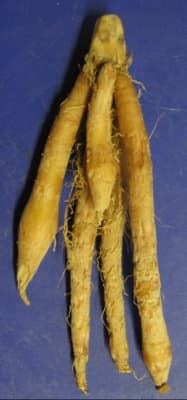
Boesenbergia rotunda
Boesenbergia rotunda
Safety & Hazards
None known
Cultivation Details
A plant of the hot, humid, tropical and subtropical lowlands, where it is found at elevations up to 1,000 metres. It grows best in areas where annual daytime temperatures are within the range 18 0 30°c, but can tolerate 12 - 35°c[1]. Mature plants can be killed by temperatures of -12°c or lower, although new growth can be severely damaged at temperatures of -1°c[1]. It prefers a mean annual rainfall in the range 1,200 - 3,000mm, but tolerates 1,000 - 5,000mm[1]. An easily grown plant, it succeeds in full sun or light shade in a moist soil[2]. Prefers a well-drained loam rich in organic matter[3]. Succeeds in almost all types of soil but grows best in sandy soils[1]. Prefers a pH in the range 6 - 7, tolerating 5.5 - 7.5[1]. During its growth, the mother tuber emits long, straight, swollen carrot-like roots resembling Chinese keys[3]. Plants grown in shady locations lose their cineole content much faster than those grown in sunny places[3]. When grown for the rhizome and roots as a spice, the life cycle of a plant is about 5 months[3]. Plants can produce young shoots for vegetable use and rhizome and roots for medicinal use for several years[3]. If left undisturbed a plant can spread by its roots and may develop into a gregarious community[3]. Young shoots to be used as a vegetable can be harvested as soon as 1 - 2 months after planting[3]. The whole plants can be pulled up 4 - 5 months after planting for use as cooking spice and traditional medicine[3]. If not harvested within 5 months after planting, the rhizomes will become woody and their quality as a spice will decrease[3]. Specific parts of the plant, e.g. The enlarged roots for external use as medicine, can be selectively harvested later than 6 months after planting, without disturbing the growth of the plant[3]. The average yield of fresh rhizomes and roots is about 10 - 30 t/ha at 4 - 6 months after planting[3]. Being mainly a crop of smallholders for domestic use only, yield data are scarce[3].
Propagation
Seed - needs to be sown as soon as it is ripe in containers at a temperature of 20c[4]. Division. A rhizome cutting planted in the open produces 4 - 5 leaves in about 1 month after planting; under shade, only 2 leaves are produced[3]. Cite as: Tropical Plants Database, Ken Fern. tropical.theferns.info. 2026-02-19. <tropical.theferns.info/viewtropical.php?id=Boesenbergia+rotunda>
Pollinators
Data unavailable
References
- [1]Ecocrop — http://ecocrop.fao.org/ecocrop/srv/en/home ↩︎Basic information on a wide range of useful plants, plus details of environmental needs where available.
- [2]Tropical Food Gardens — Norrington. L. · Bloomings Books (Melbourne) · 2001 · ISBN 1-876473-41-x ↩︎Excellent little book giving some basic information on a range of plants.
- [3]Plant Resources of Southeast Asia — http://proseanet.org/ ↩︎Lots of information on the uses of the plants of SE Asia.
- [4]The New RHS Dictionary of Gardening. 1992. — Huxley. A. · MacMillan Press · 1992 · ISBN 0-333-47494-5 ↩︎Excellent and very comprehensive, though it contains a number of silly mistakes. Readable yet also very detailed.
- [5]Flora of China — Missouri Botanical Garden Press; St. Louis. · 1994 · http://flora.huh.harvard.edu/china/ ↩︎An excellent, comprehensive resource in 25 volumes. In addition to the botanical information the flora also gives basic information on habitat and some uses. An on-line version is also available.
- [6]Mansfeld's Database of Agricultural and Horticultural Plants — http://mansfeld.ipk-gatersleben.de/pls/htmldb_pgrc/f?p=185:3:4292127278597336 ↩︎Terse details of a huge range of useful plants.
- [7]Cornucopia II — Facciola. S. · Kampong Publications, California. · 1998 · ISBN 0-9628087-2-5 ↩︎The second edition of an excellent guide to the edible uses of plants, though it does not give any details of cultivation etc.
- [8]Dictionary of Economic Plants. — Uphof. J. C. Th. · Weinheim · 1959 · ISBN - ↩︎An excellent and very comprehensive guide but it only gives very short descriptions of the uses without any details of how to utilize the plants. Not for the casual reader.