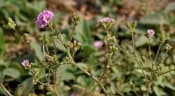
Boerhavia diffusa
Boerhavia diffusa
Safety & Hazards
The very viscid perianth tube containing the fruit readily adheres to other objects and detaches itself from the plant. Small insects are caught by the secretion, and young chickens and turkeys sometimes die in consequence of their eyes becoming sealed up by the sticky fruits[1].
Cultivation Details
Boerhavia diffusa is widespread through much of the tropics and the subtropics and has also become naturalized in parts of the temperate zone Prefers a sunny position and a sandy, well-drained soil[2, 3]. The plant grows wild in a range of soil types[3]. Prefers a pH in the range 6.6 - 7.8[3]. Plants can commence flowering when only 4 weeks old from seed. The plant can flower and produce fruit all year round if sufficient water is available[2].
Propagation
Seed - we have no information on this species but suggest sowing the seed in a greenhouse in the spring. When they are large enough to handle, prick the seedlings out into individual pots and grow them on in the greenhouse for at least their first winter. Plant them out into their permanent positions in late spring or early summer, after the last expected frosts. Cuttings Cite as: Temperate Plants Database, Ken Fern. temperate.theferns.info. 2026-02-20. <temperate.theferns.info/plant/Boerhavia+diffusa>
Pollinators
Data unavailable
References
- [1]The Useful Plants of the Island of Guam — Safford W.E. · Smithsonian Institute; Washington. · 1905 · http://www.biodiversitylibrary.org/ ↩︎A very comprehensive, if rather dated, guide to the plants of Guam. It can be downloaded from the Internet.
- [2]Protabase - Plant Resources of Tropical Africa. — http://www.prota.org ↩︎An excellent on-line database with detailed information on over 3,200 species of useful plants of Africa.
- [3]Invasive Species Compendium — http://www.cabi.org ↩︎An immense resource - in depth information on over 900 species of invasive plants (it also has information on animals, fungi etc).
- [4]Flora of China — Missouri Botanical Garden Press; St. Louis. · 1994 · http://flora.huh.harvard.edu/china/ ↩︎An excellent, comprehensive resource in 25 volumes. In addition to the botanical information the flora also gives basic information on habitat and some uses. An on-line version is also available.
- [5]Handbook of Ayurvedic Medicinal Plants — Kapoor. L. D. · CRC Press, Florida. · 2001 · ISBN 0-8493-2929-9 ↩︎A very detailed book on some of the key Ayurvedic herbs, giving both technical and non-technical information on each plant. The whole is very well referenced.
- [6]Dictionary of Economic Plants. — Uphof. J. C. Th. · Weinheim · 1959 · ISBN - ↩︎An excellent and very comprehensive guide but it only gives very short descriptions of the uses without any details of how to utilize the plants. Not for the casual reader.
- [7]Medicinal Plants of the Guianas — DeFilipps, R. A.; Maina, S. L.; & Crepin, J. · Smithsonian Museum · http://botany.si.edu/bdg/medicinal/index.html ↩︎A down-loadable PDF document of a book in pre-publication awaiting illustration. An excellent, if rather terse, guide to the traditional medicinal uses of the plants of the region
- [8]Traditional Vegetables in Benin — Achigan-Dako E. Et al · Darwin Initiative; International Foundation for Science · 2009 ↩︎Issued as a PDF on the Internet, it contains basic information on over 250 species of plants used for food in Benin.