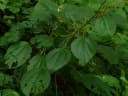
Boehmeria virgata macrophylla
Boehmeria virgata macrophylla
Safety & Hazards
Although members of the nettle family, plants in this genus do not have stinging hairs[1].
Cultivation Details
Boehmeria virgata macrophylla has a very wide range from the tropics of Africa, through southern Asia (where it can be found at elevations up to 3,000 metres in the Himalayas and experiences both snow and frost) and through to southeast Asia. Species in this genus generally succeed in a warm sandy soil[2] that is very well-drained[3]. This species is found in a wide range of habitats, including wet and soils, open positions and deep shade[4]. A variable species, several sub-species are recognised[5]. Plants in this species are usually dioecious, though monoecious forms also occur.[5].
Propagation
Seed - sow spring in a warm greenhouse and only just cover the seed. When they are large enough to handle, prick the seedlings out into individual pots and grow them on in the greenhouse for at least their first winter. Plant them out into their permanent positions in late spring or early summer, after the last expected frosts. Division in spring. Very easy, larger divisions can be planted straight into their permanent positions whilst smaller clumps are best potted up and kept in a cold frame until they are growing away well. Layering. Basal cuttings in late spring. Harvest the shoots when they are about 10 - 15cm long with plenty of underground stem. Pot them up into individual pots and keep them in light shade in a cold frame or greenhouse until they are rooting well. Grow them on for their first winter in the cold frame and then plant them out in the summer. Cite as: Temperate Plants Database, Ken Fern. temperate.theferns.info. 2026-02-20. <temperate.theferns.info/plant/Boehmeria+virgata+macrophylla>
Pollinators
Data unavailable
References
- [1]An Illustrated Flora of the Northern United States and Canada — Britton. N. L. Brown. A. · Dover Publications. New York. · 1970 · ISBN 0-486-22642-5 ↩︎Reprint of a 1913 Flora, but still a very useful book.
- [2]RHS Dictionary of Plants plus Supplement. 1956 — F. Chittendon. · Oxford University Press · 1951 · ISBN - ↩︎Comprehensive listing of species and how to grow them. Somewhat outdated, it has been replaced in 1992 by a new dictionary (see [ 200 ]).
- [3]The New RHS Dictionary of Gardening. 1992. — Huxley. A. · MacMillan Press · 1992 · ISBN 0-333-47494-5 ↩︎Excellent and very comprehensive, though it contains a number of silly mistakes. Readable yet also very detailed.
- [4]The Old World species of Boehmeria (Urticaceae, tribus Boehmerieae). A taxonomic revision — Wilmot-Dear C.M. & Friis I. · 2013 · http://www.ingentaconnect.com/content/nhn/blumea ↩︎A comprehensive revision of the genus.
- [5]Flora of China — Missouri Botanical Garden Press; St. Louis. · 1994 · http://flora.huh.harvard.edu/china/ ↩︎An excellent, comprehensive resource in 25 volumes. In addition to the botanical information the flora also gives basic information on habitat and some uses. An on-line version is also available.
- [6]A Manual of Indian Timbers. — Gamble. J. S. · Bishen Singh Mahendra Pal Singh · 1972 · ISBN - ↩︎First written in the 19th century, but still a classic, giving a lot of information on the uses and habitats of Indian trees. Not for the casual reader.
- [7]Useful Fiber Plants of the World — Dodge C.R. · USDA; Washington. · 1897 · http://www.biodiversitylibrary.org/ ↩︎A rather dated, but very comprehensive catalogue of fibre plants from around the world. The book can be downloaded from the Internet.
- [8]A Dictionary of Plants Used by Man. — Usher. G. · Constable · 1974 · ISBN 0094579202 ↩︎Forget the sexist title, this is one of the best books on the subject. Lists a very extensive range of useful plants from around the world with very brief details of the uses. Not for the casual reader.
- [9]Forest Flora of Chakrata, Dehra Dun and Saharanpur. — Gupta. B. L. · Forest Research Institute Press · 1945 · ISBN - ↩︎A good flora for the middle Himalayan forests, sparsly illustrated. Not really for the casual reader.
- [10]Plants and People of Nepal — Manandhar. N. P. · Timber Press. Oregon. · 2002 · ISBN 0-88192-527-6 ↩︎Excellent book, covering over 1,500 species of useful plants from Nepal together with information on the geography and peoples of Nepal. Good descriptions of the plants with terse notes on their uses.