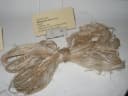
Boehmeria nivea
Boehmeria nivea
Safety & Hazards
Although members of the nettle family, plants in this genus do not have stinging hairs[1].
Cultivation Details
A plant of the sub-tropics to the tropics, also succeeding in warm temperate areas. The plant can be grown between latitudes 6 - 45°N and 9 - 38°S. It is adapted to a relative air humidity about 80%. Both excessive rainfall and drought affects the quality of the fibre. Relatively flat areas, not subject to flooding as well as gentle sloping lands, not subject to erosion are suitable for ramie production. It is found at elevations up to 1,300 metres. It grows best in areas where annual daytime temperatures are within the range 17 - 27°c, but can tolerate 10 - 34°c[2]. It prefers a mean annual rainfall in the range 1,500 - 2,500mm, but tolerates 1,000 - 4,000mm[2]. Requires a rich warm sandy soil that is very well drained[3, 4, 5, 6]. Succeeds in a wide range of soils so long as they are fertile[2]. Intolerant of wet soils[6]. This is a very greedy plant that can soon impoverish a soil, it requires a lot of feeding if it is to perform well[5]. All plant remains, after the fibre has been removed, should be returned to the soil[5]. Prefers a pH in the range 5.4 - 6.5, tolerating 4.8 - 7.5[2]. Boehmeria nivea is an extremely variable species that is widespread over large areas of subtropical and tropical Asia. Its complex species includes several forms that have sometimes been given specific or subspecific rank, though they are now considered to be a part of one highly variable species[7]. The form formerly known as Boehmeria nivea tenacissima (Gaud.) Miq., which produces the fibre 'Rhea' is found in Malaysia and is not hardy in the temperate zone[6]. Yields are from 375 to 900 kilos of fibre (per acre?)[5]. Two to four harvests per year are possible depending upon the climate, it is harvested as the stems turn brown[5]. Yields of green plants may in temperate regions vary between 15 - 20 tonnes/ha and in tropical areas 8 - 10 tonnes/ha. Yields of about 1400 kg fibre/ha have been reported[2]. There are an increase in yields in the 2nd and 3rd year[2]. Stems can be harvested 2 - 3 times per year in temperate areas, 4 - 5 times in subtropical areas and in the tropics up to 6 crops can be produced annually[2]. The crop is normally replanted after 7 - 10 years, but may persist for 20 years[2]. The plant tends to take up whatever minerals are present in the soil. This could cause problems for example high uptake of molybdenum can lead to conditioned copper deficiency[8].
Propagation
Seed - sow spring in a warm greenhouse and only just cover the seed. When they are large enough to handle, prick the seedlings out into individual pots and grow them on in the greenhouse for at least their first winter. Plant them out into their permanent positions in late spring or early summer, after the last expected frosts. Division in spring. Very easy, larger divisions can be planted straight into their permanent positions whilst smaller clumps are best potted up and kept in a cold frame until they are growing away well. Layering. Basal cuttings in late spring. Harvest the shoots when they are about 10 - 15cm long with plenty of underground stem. Pot them up into individual pots and keep them in light shade in a cold frame or greenhouse until they are rooting well. Grow them on for their first winter in the cold frame and then plant them out in the summer. Cite as: Temperate Plants Database, Ken Fern. temperate.theferns.info. 2026-02-20. <temperate.theferns.info/plant/Boehmeria+nivea>
Pollinators
Data unavailable
References
- [1]An Illustrated Flora of the Northern United States and Canada — Britton. N. L. Brown. A. · Dover Publications. New York. · 1970 · ISBN 0-486-22642-5 ↩︎Reprint of a 1913 Flora, but still a very useful book.
- [2]Ecocrop — http://ecocrop.fao.org/ecocrop/srv/en/home ↩︎Basic information on a wide range of useful plants, plus details of environmental needs where available.
- [3]RHS Dictionary of Plants plus Supplement. 1956 — F. Chittendon. · Oxford University Press · 1951 · ISBN - ↩︎Comprehensive listing of species and how to grow them. Somewhat outdated, it has been replaced in 1992 by a new dictionary (see [ 200 ]).
- [4]Plants for Man. — Schery. R. W. ↩︎Fairly readable but not very comprehensive. Deals with plants from around the world.
- [5]Encyclopaedia Britannica. 15th edition. — ? ↩︎It contains a few things of interest to the plant project.
- [6]The New RHS Dictionary of Gardening. 1992. — Huxley. A. · MacMillan Press · 1992 · ISBN 0-333-47494-5 ↩︎Excellent and very comprehensive, though it contains a number of silly mistakes. Readable yet also very detailed.
- [7]The Old World species of Boehmeria (Urticaceae, tribus Boehmerieae). A taxonomic revision — Wilmot-Dear C.M. & Friis I. · 2013 · http://www.ingentaconnect.com/content/nhn/blumea ↩︎A comprehensive revision of the genus.
- [8]The National Non-Food Crops Centre Crop Database — http://www.nnfcc.co.uk/crops/pd.cfm ↩︎An excellent on-line information source, with information on over 100 species (as of 2006) of plants being investigated as bio-crops.
- [9]Flora of China — Missouri Botanical Garden Press; St. Louis. · 1994 · http://flora.huh.harvard.edu/china/ ↩︎An excellent, comprehensive resource in 25 volumes. In addition to the botanical information the flora also gives basic information on habitat and some uses. An on-line version is also available.
- [10]Flora Europaea — ? · Cambridge University Press · 1964 · ISBN - ↩︎An immense work in 6 volumes (including the index). The standard reference flora for Europe, it is very terse though and with very little extra information. Not for the casual reader.
- [11]Famine Foods listed in the Chiu-Huang Pen-ts'ao. — Reid. B. E. · Southern Materials Centre; Taipei · 1977 · ISBN - ↩︎A translation of an ancient Chinese book on edible wild foods. Fascinating.
- [12]Plants for Human Consumption. — Kunkel. G. · Koeltz Scientific Books · 1984 · ISBN 3874292169 ↩︎An excellent book for the dedicated. A comprehensive listing of Latin names with a brief list of edible parts.
- [13]Medicinal Plants in Vietnam — Nguyen Van Dan & Doan Thi Nhu · World Health Organisation · 1989 · ISBN 92 9061 101 4 ↩︎An excellent book, giving information on over 200 plants, their medicinal compounds and applications.
- [14]A Barefoot Doctors Manual. — ? · Running Press; Philadelphica. · 1977 · ISBN 0-914294-92-X ↩︎A very readable herbal from China, combining some modern methods with traditional chinese methods.
- [15]Chinese Materia Medica. — Stuart. Rev. G. A. · Taipei. Southern Materials Centre · 1911 · ISBN - ↩︎A translation of an ancient Chinese herbal. Fascinating.
- [16]Medicinal Plants of China — Duke. J. A. and Ayensu. E. S. · Reference Publications, Inc. · 1985 · ISBN 0-917256-20-4 ↩︎Details of over 1,200 medicinal plants of China and brief details of their uses. Often includes an analysis, or at least a list of constituents. Heavy going if you are not into the subject.
- [17]Glossary of Indian Medicinal Plants (Including the Supplement). — Chopra. R. N., Nayar. S. L. and Chopra. I. C. · Council of Scientific and Industrial Research, New Delhi. · 1986 · ISBN - ↩︎Very terse details of medicinal uses of plants with a wide range of references and details of research into the plants chemistry. Not for the casual reader.
- [18]Dictionary of Economic Plants. — Uphof. J. C. Th. · Weinheim · 1959 · ISBN - ↩︎An excellent and very comprehensive guide but it only gives very short descriptions of the uses without any details of how to utilize the plants. Not for the casual reader.
- [19]A Dictionary of Plants Used by Man. — Usher. G. · Constable · 1974 · ISBN 0094579202 ↩︎Forget the sexist title, this is one of the best books on the subject. Lists a very extensive range of useful plants from around the world with very brief details of the uses. Not for the casual reader.
- [20]Flora of the USSR. — Komarov. V. L. · Israel Program for Scientific Translation · 1968 · http://www.biodiversitylibrary.org · ISBN - ↩︎An immense (25 or more large volumes) and not yet completed translation of the Russian flora. Full of information on plant uses and habitats but heavy going for casual readers. It can be downloaded from the Internet.
- [21]Economic Botany. — Hill. A. F. · The Maple Press · 1952 · ISBN - ↩︎Not very comprehensive, but it is quite readable and goes into some detail about the plants it does cover.
- [22]A Weavers Garden — Buchanan. R. · McGraw-Hill Contemporary · 1987 · ISBN 0934026289 ↩︎Covers all aspects of growing your own clothes, from fibre plants to dyes.
- [23]Plant Fibres for Papermaking. — Bell. L. A. · Liliaceae Press · 1988 · ISBN - ↩︎A good practical section on how to make paper on a small scale plus details of about 75 species (quite a few of them tropical) that can be used.
- [PFAF]Plants for a Future — pfaf.org ↩︎