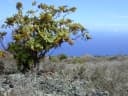
Bocconia frutescens
Bocconia frutescens
Safety & Hazards
None known
Cultivation Details
A plant of the tropics and subtropics, it is intolerant of much winter cold[1]. Prefers a well-drained soil on the light side and a position in full sun[1]. The plant produces large numbers of seeds with a red fleshy aril at the base that attracts birds, which disperse the seed over long distances[2]. Because it is able to flourish in a broad range of environmental conditions and along a large elevational gradient within its home range, it appears to have the potential to invade native and non-native habitats in dry and mesic environments in areas such as Hawaii. Given its potential to reach tree-sized stature and its ability to form thick stands, it is expected to be a serious competitor with native or other desirable species. In the Wood Valley area of Hawaii, it quickly spread from one landscape planting near to occupy in excess of 3,500 acres of abandoned cane land[2].
Propagation
Seed - germinates best at a temperature of 20 - 25c[1]. Cite as: Tropical Plants Database, Ken Fern. tropical.theferns.info. 2026-02-19. <tropical.theferns.info/viewtropical.php?id=Bocconia+frutescens>
Pollinators
Data unavailable
References
- [1]The New RHS Dictionary of Gardening. 1992. — Huxley. A. · MacMillan Press · 1992 · ISBN 0-333-47494-5 ↩︎Excellent and very comprehensive, though it contains a number of silly mistakes. Readable yet also very detailed.
- [2]Pacific Island Ecosystems at Risk — http://www.hear.org/pier/scientificnames/index.html ↩︎A very good website detailing weed species that have been introduced into the Pacific Islands.
- [3]Flora of Guatemala — Standley P.C. & J. A. Steyermark · 1946 - 1976 · http://www.archive.org/ ↩︎A superb reference, though somewhat dated. Gives lots of plant uses as well as information on plant habit and habitat. The entire flora (13 volumes) can now be downloaded from http://www.archive.org/
- [4]Dictionary of Economic Plants. — Uphof. J. C. Th. · Weinheim · 1959 · ISBN - ↩︎An excellent and very comprehensive guide but it only gives very short descriptions of the uses without any details of how to utilize the plants. Not for the casual reader.
- [5]Botanical Museum Leaflets Vol 28 — Harvard University; Cambridge, Mass. · 1981 · http://www.biodiversitylibrary.org ↩︎An article on the Ethnopharmacological uses of plants in northwestern S. America, amongst many other articles. It can be downloaded from the Internet.