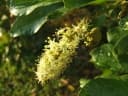
Blighia sapida
Blighia sapida
Safety & Hazards
Great care should be exercised if eating this fruit. It must only be eaten when fully ripe since both before and after that stage it is considered to be poisonous[1]. A toxic peptide, hypoglycine A, is contained in the unripe aril[2]. The pink raphe that attaches the aril to its seed is deadly toxic and must be carefully and completely removed[2]. The pounded fruit is used as fish poison[3].
Cultivation Details
A plant of the drier to very wet lowland tropics and subtropics, where it is found at elevations up to 900 metres. It grows best in areas where annual daytime temperatures are within the range 24 - 27°c, but can tolerate 20 - 34°c[4]. Mature plants can be killed by temperatures of -3°c or lower, but young plants are intolerant of any frost[4]. It prefers a mean annual rainfall in the range 2,000 - 4,000mm, but tolerates 700 - 6,000mm[4]. Grows best in a sunny position[2]. Prefers a moist, loamy, fertile, well-drained soil[1, 2]. Plants can succeed in a range of soils, including infertile, rocky soils[5]. Prefers a pH in the range 5.5 - 6.5, tolerating 4.3 - 8[4]. Established plants are drought tolerant[2]. Initial growth is fast on moderately fertile soils. Seedlings grow best in gaps in the forest canopy, with a mean annual height increment of 70cm[3]. Plants can commence cropping when 3 - 4 years old from seed[5]. The plant has been known to escape from cultivation when grown in sandy soils[2]. Plants flower intermittently throughout the year[2]. A dioecious species, both male and female forms need to be grown if fruit and seed are required[3].
Propagation
Seed - they are sensitive to desiccation and are considered short-lived. It is recommended to sow them within a few days after extraction from the fruit. However, seeds can be kept for 3 months in moist storage at 21°c. Germination starts after 2 - 4 weeks, with a germination rate of 80%[3]. Greenwood cuttings. Air layering Grafting Cite as: Tropical Plants Database, Ken Fern. tropical.theferns.info. 2026-02-19. <tropical.theferns.info/viewtropical.php?id=Blighia+sapida>
Pollinators
Bees
References
- [1]The New RHS Dictionary of Gardening. 1992. — Huxley. A. · MacMillan Press · 1992 · ISBN 0-333-47494-5 ↩︎Excellent and very comprehensive, though it contains a number of silly mistakes. Readable yet also very detailed.
- [2]Tropical and Subtropical Trees - A Worldwide Encyclopaedic Guide. — Barwick. M. · Thames & Hudson, London · 2004 · ISBN 0-500-51181-0 ↩︎A superb book, very concise and well written, giving a wealth of information on 400 or more species including descriptions, habitat, cultivation details and plant uses. A wealth of colour photographs bring each plant vividly to life.
- [3]Protabase - Plant Resources of Tropical Africa. — http://www.prota.org ↩︎An excellent on-line database with detailed information on over 3,200 species of useful plants of Africa.
- [4]Ecocrop — http://ecocrop.fao.org/ecocrop/srv/en/home ↩︎Basic information on a wide range of useful plants, plus details of environmental needs where available.
- [5]Perennial Edible Fruits of the Tropics : an Inventory — Martin, F. W.; Campbell, C. W.; Rubertbe, R. M. · U.S. Dept. of Agriculture, Agricultural Research Service · 1987 ↩︎A booklet giving terse details of almost 300 species of edible fruits, plus regional lists of Botanical and Common names for over 2,500 less well-known edible fruits of the tropics.
- [6]Brazilian Fruits and Cultivated Exotics — Lorenzi. H.; Bacher. L.; Lacerda. M.; Sartori. S. · Instituto Plantarum De Estudos Da Flora LTDA; Brazil. · 2000 · ISBN 85-867174-24-0 ↩︎A superb book, giving information on several hundred fruit species. Each entry has a brief description of the plant and its uses, accompanied by one to many excellent quality photographs of the fruits.
- [7]The Useful Plants of West Tropical Africa. — Burkil. H. M. · Royal Botanic Gardens; Kew. · 1985 - 2004 ↩︎Brief descriptions and details of the uses of over 4,000 plants. A superb, if terse, resource, it is also available electronically on the Web - see http://www.aluka.org/
- [8]Cornucopia II — Facciola. S. · Kampong Publications, California. · 1998 · ISBN 0-9628087-2-5 ↩︎The second edition of an excellent guide to the edible uses of plants, though it does not give any details of cultivation etc.
- [9]Mansfeld's Database of Agricultural and Horticultural Plants — http://mansfeld.ipk-gatersleben.de/pls/htmldb_pgrc/f?p=185:3:4292127278597336 ↩︎Terse details of a huge range of useful plants.
- [10]Dictionary of Economic Plants. — Uphof. J. C. Th. · Weinheim · 1959 · ISBN - ↩︎An excellent and very comprehensive guide but it only gives very short descriptions of the uses without any details of how to utilize the plants. Not for the casual reader.
- [11]Traditional Vegetables in Benin — Achigan-Dako E. Et al · Darwin Initiative; International Foundation for Science · 2009 ↩︎Issued as a PDF on the Internet, it contains basic information on over 250 species of plants used for food in Benin.