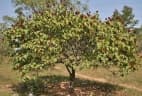
Bixa orellana
Bixa orellana
Safety & Hazards
None known
Cultivation Details
Annatto requires a frost-free, warm, humid climate. It can grow at elevations from sea level up to 2,200 metres in tropical to subtropical climates where a mean annual rainfall of 2,500 - 5,000mm is distributed throughout the year[1]. It can withstand droughts of up to 4 months, but thrives best with well distributed rainfall and a dry season for seed ripening[2]. It prefers a mean annual temperature in the range 28 - 32°c, with a mean maximum temperature of 22 - 27°c and a mean minimum temperature of 18 - 26°c[1]. An easily grown plant, it succeeds on almost all soil types, preferring a moist, but well-drained neutral or slightly alkaline soil in a sunny position[3, 1]. Prefers a slightly acid soil according to another report[4]. Prefers a pH in the range 5.5 - 7.5, tolerating 4.5 - 8.5[2]. It grows into a larger tree when planted in deeper and more fertile soil, rich in organic matte[1]. Plants commence fruiting when quite young[5]. Trees can commence bearing fruit when only 2 years old[6, 2]. Seed-grown plants take longer to flower than vegetatively propagated ones, and do so sparingly. Under favourable conditions, fruiting commences 18 months from planting or earlier, and full crops of seeds are obtained after 3 - 4 years[1]. Seed yields reach their peak when the trees are 4 - 5 years of age, usually a decline become evident around 12 years, but productivity can continue for up to 20 years[2]. Seed yields from 0.5 - 5 tonnes/ha per year have been reported, but usually yields are between 800 - 1,500 kg/ha[2]. 20 - 50g of dye can be obtained from 1 kilo of seed[2]. In Puerto Rico and the Virgin Islands, flowering occurs mainly in spring and fruiting chiefly in the summer[1]. In some areas the tree can produce flushes of fruits at several times through the year[6].
Propagation
Seed - the plant is usually grown from seed taken from freshly gathered ripe pods, which germinate better than dry ones[1]. Mature seeds, taken directly from fresh fruits, germinate readily in 7 - 10 days under moist conditions[7]. Seed is sown directly in the field, 2 - 5 seeds per hole in well-prepared soil, usually at the beginning of the rainy season. After germination only one seedling per hole is retained[7]. Seedlings may also be raised in planting trays; they are transferred to 1 kg bags containing a soil mixture and kept in the nursery for 3 - 4 months before they are transplanted into the field[7]. Cleaned, sun-dried seeds retain viability for over one year, but their germination rate falls to 12% in 3 years[7] Cuttings in sand. Hardwood cuttings of 8mm or more in diameter readily root when a root hormone suitable for hardwood cuttings is applied. Roots are produced in abundance in 7 - 9 weeks. Rooted cuttings are first transferred into pots or bags and kept in a nursery and can be transplanted to the field after 3 months[7]. Propagating by cuttings allows selection of high-yielding, rapidly growing cultivars that flower early and profusely and bear fruit within 2 years[1]. Air layering Budding Cite as: Tropical Plants Database, Ken Fern. tropical.theferns.info. 2026-02-19. <tropical.theferns.info/viewtropical.php?id=Bixa+orellana>
Pollinators
Bees
References
- [1]World Agroforesty Centre — http://www.worldagroforestry.org/ ↩︎An excellent online database of a huge range of trees giving very good information on each plant - its uses, ecology, identity, propagation, pests etc.
- [2]Ecocrop — http://ecocrop.fao.org/ecocrop/srv/en/home ↩︎Basic information on a wide range of useful plants, plus details of environmental needs where available.
- [3]Cornucopia II — Facciola. S. · Kampong Publications, California. · 1998 · ISBN 0-9628087-2-5 ↩︎The second edition of an excellent guide to the edible uses of plants, though it does not give any details of cultivation etc.
- [4]Tropical and Subtropical Trees - A Worldwide Encyclopaedic Guide. — Barwick. M. · Thames & Hudson, London · 2004 · ISBN 0-500-51181-0 ↩︎A superb book, very concise and well written, giving a wealth of information on 400 or more species including descriptions, habitat, cultivation details and plant uses. A wealth of colour photographs bring each plant vividly to life.
- [5]The New RHS Dictionary of Gardening. 1992. — Huxley. A. · MacMillan Press · 1992 · ISBN 0-333-47494-5 ↩︎Excellent and very comprehensive, though it contains a number of silly mistakes. Readable yet also very detailed.
- [6]Trade Winds Fruit — http://www.tradewindsfruit.com/index.htm ↩︎The on-line catalogue of a company selling seeds. Gives descriptions, photos and uses of a very wide range of fruit and other food-producing plants plus ornamentals.
- [7]Protabase - Plant Resources of Tropical Africa. — http://www.prota.org ↩︎An excellent on-line database with detailed information on over 3,200 species of useful plants of Africa.
- [8]Plant Resources of Southeast Asia — http://proseanet.org/ ↩︎Lots of information on the uses of the plants of SE Asia.
- [9]Trees Commonly Cultivated in SE Asia — Jensen. M. · FAO Regional Office, Bangkok. · 1999 · ISBN 974-89377-5-5 ↩︎
- [10]Encyclopaedia of Herbs and their Uses. — Bown. D. · Dorling Kindersley, London. · 1995 · ISBN 0-7513-020-31 ↩︎A very well presented and informative book on herbs from around the globe. Plenty in it for both the casual reader and the serious student. Just one main quibble is the silly way of having two separate entries for each plant.
- [11]Tropical Ornamentals; A Guide — Whistler. W. Arthur. · Timber Press Inc. Oregon. · 2000 · ISBN 0-88192-448-2 ↩︎An excellent little guide to some of the more commonly cultivated ornamental plants of the Tropics, often giving some information on the plants other uses.
- [12]The Encyclopedia of Medicinal Plants — Chevallier. A. · Dorling Kindersley. London · 1996 · ISBN 9-780751-303148 ↩︎An excellent guide to over 500 of the more well known medicinal herbs from around the world.
- [13]Medicinal Plants of the Guianas — DeFilipps, R. A.; Maina, S. L.; & Crepin, J. · Smithsonian Museum · http://botany.si.edu/bdg/medicinal/index.html ↩︎A down-loadable PDF document of a book in pre-publication awaiting illustration. An excellent, if rather terse, guide to the traditional medicinal uses of the plants of the region
- [14]Medicinal Plants of Brazil — Mors W.B.; Rizzini C.T.; Pereira N.A. · Reference Publications; Michigan. · 2000 · ISBN 0-917256-42-5 ↩︎An extremely concise book, listing approximately 1,500 species and varieties of plants with their botanical name, common name in Brazil, regions in Brazil where the plant is found, a brief list of uses and any medically active compounds in the plant.
- [15]Levantamento etnobotânico de plantas popularmente utilizadas como antiúlceras e antiinflamatórias pela comunidade de — De Jesus, N.Z.T. et al · 2009 · ISBN 0102-695X ↩︎
- [16]Useful Fiber Plants of the World — Dodge C.R. · USDA; Washington. · 1897 · http://www.biodiversitylibrary.org/ ↩︎A rather dated, but very comprehensive catalogue of fibre plants from around the world. The book can be downloaded from the Internet.