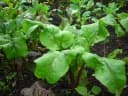
Beta vulgaris
Beta vulgaris
Safety & Hazards
None known
Cultivation Details
Beta vulgaris is originally a native of the warm temperate zone, though it has spread further north to the cold temperate zone. It grows best in areas where annual daytime temperatures are within the range 15 - 25°c, but can tolerate 4 - 35°c[1]. When dormant, the plant can survive temperatures down to about -6°c, but young growth can be severely damaged at 0°c[1]. It prefers a mean annual rainfall in the range 600 - 1,500mm, but tolerates 500 - 2,500mm[1]. A very easily grown plant, it succeeds in sun or light shade in moist soils but prefers a rich well-drained light neutral to alkaline soil[2, 3]. Beets grow well in a variety of soils, growing best in a deep, friable well-drained soil abundant with organic matter, but doing poorly on clay. They prefer an open position and a light well-drained soil[4]. The optimum pH is 6.0 - 6.8, but the plant can tolerate 5 - 8.3[1]. Some salinity may be tolerated after the seedling stage. Beets are notable for their tolerance to manganese toxicity[5]. Plants are tolerant of saline soils and respond positively if salt is added to non-saline soils at a rate of about 30g per square metre[6]. As currently recognized (2016), this species includes four different cultivated groups. Each group has its own record in the database, but below is a brief description:- Garden Beet Group. Probably better known as the beetroot, it is grown mainly for its edible root, though the leaves can also be eaten. There are two basic forms, those with rounded roots and those with elongated roots with many named varieties of each form. Leaf Beet Group. This includes spinach beet with its edible leaves that are used like spinach. It also includes the various forms of chard which, in addition to their edible leaves, also have enlarged leaf stalks that can be eaten. Neither form produce an edible root. Sugar Beet Group. Grown mainly for their large roots, which are very rich in sugars. Both the root and the young leaves can be eaten, but the plant is usually only grown as a commercial crop for the extraction of sugar from the roots.. Fodder Beet Group. The fodder beets produce large roots and lots of leaves. They are grown primarily as a food crop for domestic farm animals, though both roots and leaves are edible. Most beetroot seed is actually a cluster of several seeds, though monogerm varieties have been produced that only have one seed - these monogerm varieties are less likely to require thinning once they have germinated[6].
Propagation
Seed - sow in situ. Cite as: Temperate Plants Database, Ken Fern. temperate.theferns.info. 2026-02-20. <temperate.theferns.info/plant/Beta+vulgaris>
Pollinators
Wind, Thrips
References
- [1]Ecocrop — http://ecocrop.fao.org/ecocrop/srv/en/home ↩︎Basic information on a wide range of useful plants, plus details of environmental needs where available.
- [2]Rare Vegetables for Garden and Table. — Organ. J. · Faber · 1960 · ISBN - ↩︎Unusual vegetables that can be grown outdoors in Britain. A good guide.
- [3]The Gardener's Assistant. — Thompson. B. · Blackie and Son. · 1878 · ISBN - ↩︎Excellent general but extensive guide to gardening practices in the 19th century. A very good section on fruits and vegetables with many little known species.
- [4]Salads all the Year Round. — Larkcom. J. · Hamlyn · 1980 ↩︎A good and comprehensive guide to temperate salad plants, with full organic details of cultivation.
- [5]Handbook of Energy Crops — Duke. J. · - · 1983 · https://hort.purdue.edu/newcrop/duke_energy/dukeindex.html · ISBN - ↩︎Published only on the Internet, excellent information on a wide range of both temperate and tropical plants.
- [6]Vegetables — Phillips. R. & Rix. M. · Macmillan Reference Books, London. · 1995 · ISBN 0 333 62640 0 ↩︎Excellent and easily read book with good information and an excellent collection of photos of vegetables from around the world, including many unusual species.
- [7]Protabase - Plant Resources of Tropical Africa. — http://www.prota.org ↩︎An excellent on-line database with detailed information on over 3,200 species of useful plants of Africa.
- [8]Sturtevant's Edible Plants of the World. — Hedrick. U. P. · Dover Publications · 1972 · ISBN 0-486-20459-6 ↩︎Lots of entries, quite a lot of information in most entries and references.
- [9]New Vegetable Growers Handbook. — Simons. · Penguin · 1977 · ISBN 0-14-046-050-0 ↩︎A good guide to growing vegetables in temperate areas, not entirely organic.
- [10]The Vegetable Garden. — Vilmorin. A. · Ten Speed Press · ISBN 0-89815-041-8 ↩︎A reprint of a nineteenth century classic, giving details of vegetable varieties. Not really that informative though.
- [11]Fruits of the Earth. — Bianchini. F., Corbetta. F. and Pistoia. M. ↩︎Lovely pictures, a very readable book.
- [12]Lilies - Their Culture and Management. — Woodcock. and Coutts. · Country Life · 1935 · ISBN - ↩︎A classic, but dated. Deals with the genus Lilium.
- [13]Medicinal Plants of China — Duke. J. A. and Ayensu. E. S. · Reference Publications, Inc. · 1985 · ISBN 0-917256-20-4 ↩︎Details of over 1,200 medicinal plants of China and brief details of their uses. Often includes an analysis, or at least a list of constituents. Heavy going if you are not into the subject.
- [14]The Encyclopedia of Medicinal Plants — Chevallier. A. · Dorling Kindersley. London · 1996 · ISBN 9-780751-303148 ↩︎An excellent guide to over 500 of the more well known medicinal herbs from around the world.
- [PFAF]Plants for a Future — pfaf.org ↩︎