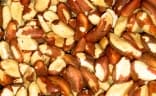
Bertholletia excelsa
Bertholletia excelsa
Safety & Hazards
Nuts from trees growing on barium-rich soils can accumulate up to 0.29% barium and should be avoided due to danger of barium toxicity[1].
Cultivation Details
A plant of the lowland, tropical rain forests, where it is found at elevations up to 200 metres[2, 3]. It grows best in areas where annual daytime temperatures are within the range 20 - 36°c, but can tolerate 12 - 40°c[3]. It prefers a mean annual rainfall in the range 2,400 - 2,800mm, but tolerates 1,400 - 3,500mm[3]. In eastern Amazonia, in the lower limits of its climatic range, there can be 2 - 7 months where the monthly rainfall is less than 100 mm[1]. A pronounced dry season is necessary for good fruit set[2]. Requires a deep, well-drained but moisture retentive fertile, medium to heavy soil[4, 3]. Mature trees grow best in a sunny position[4], but young trees require shade for their first 5 - 7 years[3]. Well adapted to heavy clay and low-fertility Oxisols but is not tolerant to waterlogging[2]. Prefers a pH in the range 5.5 - 7, tolerating 4.5 - 8[3]. Trees commence flowering when about 5 - 6 years old[3]. Fruiting starts at 12 - 16 years in the forest and as early as 8 years if trees are well managed in the open[2, 3]. Mature nuts are produced approximately 15 months after fertilization[5, 2]. The seeds are borne in a large spherical wooden 'fruit' that is up to 15cm in diameter and can weight up to 2 kilos[5]. Between 12 and 24 seeds are contained in each fruit and this falls intact from the tree when it is ripe[5]. Since the fruits are only formed on the upper branches, and these can be 30 metres or more above ground level, this can make collecting the seeds a rather hazardous occupation[5]. The nuts are normally extracted in situ from the 'fruits' and then shipped out of the jungle to be sold[5]. Trees 16 years old produce 30 - 50 fruits, mature trees usually 200 - 400, and a yield of 1,000 fruits has been reported[2]. Yields of up to 450 kilos of nuts can be obtained from the best trees[5].
Propagation
Seed - fresh seed germinates rapidly, often within 2 - 3 weeks, so long as a portion of the hard shell is cracked or carefully removed first in order to allow the entry of moisture[5]. Otherwise seed can take 2 years to germinate[5]. Seedlings probably need good light to grow away well[2]. Seedling trees have borne a first crop at an age of 14 - 20 years[5]. If the conditions are right, some of the seeds buried by rodents may germinate. Trees appear to depend on natural or artificial disturbance to reproduce. For example, they will be found in clearings in the forest created by humans, forest gaps created by tree fall, or sprouting from damaged mother roots. Trees take about 10 years to start reproducing; grafted material may begin to bear nuts within 4 years. Other than using a single clone, several selections are cloned and grafted onto stock to encourage cross-fertilization, which increases yield[2]. Cite as: Tropical Plants Database, Ken Fern. tropical.theferns.info. 2026-02-19. <tropical.theferns.info/viewtropical.php?id=Bertholletia+excelsa>
Pollinators
Bees
References
- [1]Edible Nuts. — Wickens G.E. · FAO, Rome. · 1995 · http://www.fao.org/docrep/ · ISBN 92-5-103748-5 ↩︎Detailed information on 20 of the most valuable nut crops, plus more basic information on a wide range of other nut-producing plants. It can be downloaded from the Internet.
- [2]World Agroforesty Centre — http://www.worldagroforestry.org/ ↩︎An excellent online database of a huge range of trees giving very good information on each plant - its uses, ecology, identity, propagation, pests etc.
- [3]Ecocrop — http://ecocrop.fao.org/ecocrop/srv/en/home ↩︎Basic information on a wide range of useful plants, plus details of environmental needs where available.
- [4]Tropical and Subtropical Trees - A Worldwide Encyclopaedic Guide. — Barwick. M. · Thames & Hudson, London · 2004 · ISBN 0-500-51181-0 ↩︎A superb book, very concise and well written, giving a wealth of information on 400 or more species including descriptions, habitat, cultivation details and plant uses. A wealth of colour photographs bring each plant vividly to life.
- [5]Nuts. — Howes. F. N. · Faber · 1948 · ISBN - ↩︎Rather old but still a masterpiece. Has sections on tropical and temperate plants with edible nuts plus a section on nut plants in Britain. Very readable.
- [6]The New RHS Dictionary of Gardening. 1992. — Huxley. A. · MacMillan Press · 1992 · ISBN 0-333-47494-5 ↩︎Excellent and very comprehensive, though it contains a number of silly mistakes. Readable yet also very detailed.
- [7]Useful Fiber Plants of the World — Dodge C.R. · USDA; Washington. · 1897 · http://www.biodiversitylibrary.org/ ↩︎A rather dated, but very comprehensive catalogue of fibre plants from around the world. The book can be downloaded from the Internet.
- [8]Cornucopia II — Facciola. S. · Kampong Publications, California. · 1998 · ISBN 0-9628087-2-5 ↩︎The second edition of an excellent guide to the edible uses of plants, though it does not give any details of cultivation etc.
- [9]Medicinal Plants of the Guianas — DeFilipps, R. A.; Maina, S. L.; & Crepin, J. · Smithsonian Museum · http://botany.si.edu/bdg/medicinal/index.html ↩︎A down-loadable PDF document of a book in pre-publication awaiting illustration. An excellent, if rather terse, guide to the traditional medicinal uses of the plants of the region
- [10]Medicinal Plants of Brazil — Mors W.B.; Rizzini C.T.; Pereira N.A. · Reference Publications; Michigan. · 2000 · ISBN 0-917256-42-5 ↩︎An extremely concise book, listing approximately 1,500 species and varieties of plants with their botanical name, common name in Brazil, regions in Brazil where the plant is found, a brief list of uses and any medically active compounds in the plant.
- [11]Dictionary of Economic Plants. — Uphof. J. C. Th. · Weinheim · 1959 · ISBN - ↩︎An excellent and very comprehensive guide but it only gives very short descriptions of the uses without any details of how to utilize the plants. Not for the casual reader.
- [12]Technical Information on 134 Species of Bolivian Woods — USDA Forest Service -- Forest Products Lab · USDA Forest Service · http://www2.fpl.fs.fed.us/publications/ ↩︎A PDF file, available for download. Exactly what the title says, brief and to the point.
- [13]Brazilian Trees. Volume 1. 4th Edition. — Lorenzi. H. · Instituto Plantarum De Estudos Da Flora; Brazil. · 2002 · ISBN 85-86714-17-8 ↩︎Information on 350 species of Brazilian trees. Stunning photographs of each species, brief details on the plant, its uses and how to grow it from seed. A superb work, with the minor irritation that the translation from Portuguese is not of the best.
- [14]Tropix 7 — CIRAD · http://tropix.cirad.fr/en ↩︎An on-line guide to the timbers of 245 species of trees.