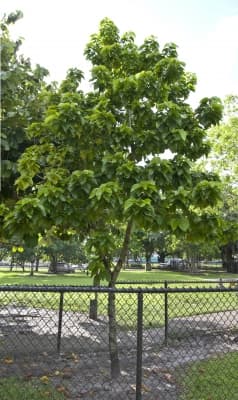
Berrya cordifolia
Berrya cordifolia
Safety & Hazards
The seeds have stiff hairs which may penetrate the skin and cause painful itching[1].
Cultivation Details
A plant of the humid, lowland tropics, where it is found at elevations up to 300 metres. It grows best in areas where annual daytime temperatures are within the range 26 - 32°c, but can tolerate 20 - 34°c[2]. It prefers a mean annual rainfall in the range 2,700 - 3,300mm, but tolerates 2,500 - 3,500mm and a distinct dry season[2]. Grows best in a sunny position or in light shade in a fertile, medium to heavy soil[2]. The tree requires partial shade, especially in the seedling stage; solitary trees in full sun grow poorly[1]. Dislikes clay soils[1]. Prefers a pH in the range 6 - 7, tolerating 5.5 - 8[2]. Tolerant of poor drainage, but it is not resistant to drought[1]. Whilst seedling growth is slow, later on the tree grows fairly fast with an average annual bole diameter increase of 1cm for at least the first 30 years[1]. The tree coppices well and produces root suckers[1].
Propagation
Seed - about 30% of the seeds germinate in 14 - 33 days, but a germination percentage of 20% has also been recorded[1]. Seedlings 8 - 10 months old are used as bare-rooted planting stock. Stumps prepared from 1.5 - 2-year-old stock with a diameter of 2cm can also be used; the shoot is trimmed to 3 - 4cm and the roots to 20cm. Planting of stumps resulted in 70 - 75% survival[1]. Cite as: Tropical Plants Database, Ken Fern. tropical.theferns.info. 2026-02-19. <tropical.theferns.info/viewtropical.php?id=Berrya+cordifolia>
Pollinators
Data unavailable
References
- [1]Protabase - Plant Resources of Tropical Africa. — http://www.prota.org ↩︎An excellent on-line database with detailed information on over 3,200 species of useful plants of Africa.
- [2]Ecocrop — http://ecocrop.fao.org/ecocrop/srv/en/home ↩︎Basic information on a wide range of useful plants, plus details of environmental needs where available.
- [3]Flora of China — Missouri Botanical Garden Press; St. Louis. · 1994 · http://flora.huh.harvard.edu/china/ ↩︎An excellent, comprehensive resource in 25 volumes. In addition to the botanical information the flora also gives basic information on habitat and some uses. An on-line version is also available.
- [4]Flora Vitiensis Nova — Smith. A.C. · Pacific Tropical Botanical Garden; Hawaii · 1979 · http://www.biodiversitylibrary.org ↩︎A comprehensive flora of Fiji, often showing plant uses. It can be downloaded from the Internet.
- [5]Thai Forest Bulletin (Botany) No. 16 — The Forest Herbarium; Bangkok. · 1986 · ISBN 0495-3843 ↩︎A botanical journal, publishing papers on taxonomy (especially vascular plants), nomenclature, phylogeny, systematics, plant geography, and floristics; also morphology, palynology, cytotaxonomy, chemotaxonomy, anatomy and other relevant disciplines.
- [6]A Manual of Indian Timbers. — Gamble. J. S. · Bishen Singh Mahendra Pal Singh · 1972 · ISBN - ↩︎First written in the 19th century, but still a classic, giving a lot of information on the uses and habitats of Indian trees. Not for the casual reader.
- [7]Dictionary of Economic Plants. — Uphof. J. C. Th. · Weinheim · 1959 · ISBN - ↩︎An excellent and very comprehensive guide but it only gives very short descriptions of the uses without any details of how to utilize the plants. Not for the casual reader.