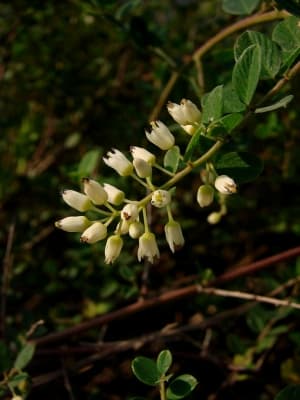
Berchemia lineata
Berchemia lineata
Safety & Hazards
None known
Cultivation Details
Berberis lineata is not hardy in the colder areas of the temperate zone, it tolerates temperatures down to between -5 and -10°c[1]. Requires a good moist well-drained loam, succeeding in full sun if the soil does not dry out otherwise it is best in light shade[2, 1]. Suitable for growing along fences, against walls with wire supports or for growing through other shrubs[1]. Plants climb by means of twining around supports[3]. Closely related to Berchemia edgeworthii[3].
Propagation
Seed - sow spring or autumn in a cold frame[1]. When they are large enough to handle, prick the seedlings out into individual pots and grow them on in the greenhouse for at least their first winter. Plant them out into their permanent positions in late spring or early summer, after the last expected frosts. Cuttings of half-ripe wood, mid summer in a frame[1]. Cuttings of mature wood of the current season's growth, late autumn to January in a frame. Root cuttings in winter[1]. Layering of young stems in winter[1]. Cite as: Temperate Plants Database, Ken Fern. temperate.theferns.info. 2026-02-20. <temperate.theferns.info/plant/Berchemia+lineata>
Pollinators
Data unavailable
References
- [1]The New RHS Dictionary of Gardening. 1992. — Huxley. A. · MacMillan Press · 1992 · ISBN 0-333-47494-5 ↩︎Excellent and very comprehensive, though it contains a number of silly mistakes. Readable yet also very detailed.
- [2]Trees and Shrubs Hardy in Great Britain. Vol 1 - 4 and Supplement. — Bean. W. · Murray · 1981 · ISBN - ↩︎A classic with a wealth of information on the plants, but poor on pictures.
- [3]Ornamental Shrubs, Climbers and Bamboos. — Thomas. G. S. · Murray · 1992 · ISBN 0-7195-5043-2 ↩︎Contains a wide range of plants with a brief description, mainly of their ornamental value but also usually of cultivation details and varieties.
- [4]Flora of China — Missouri Botanical Garden Press; St. Louis. · 1994 · http://flora.huh.harvard.edu/china/ ↩︎An excellent, comprehensive resource in 25 volumes. In addition to the botanical information the flora also gives basic information on habitat and some uses. An on-line version is also available.
- [5]Flora of Japan — http://www.foj.info ↩︎An on-line version of the flora - an excellent resource.
- [6]Plants for Human Consumption. — Kunkel. G. · Koeltz Scientific Books · 1984 · ISBN 3874292169 ↩︎An excellent book for the dedicated. A comprehensive listing of Latin names with a brief list of edible parts.
- [7]Plants and People of Nepal — Manandhar. N. P. · Timber Press. Oregon. · 2002 · ISBN 0-88192-527-6 ↩︎Excellent book, covering over 1,500 species of useful plants from Nepal together with information on the geography and peoples of Nepal. Good descriptions of the plants with terse notes on their uses.
- [8]Tanaka's Cyclopedia of Edible Plants of the World. — Tanaka. T. & Nakao S. · Keigaku Publishing; Tokyo · 1976 · ISBN - ↩︎The most comprehensive list of edible plants I've come across. Only the briefest entry for each species, though, and some of the entries are more than a little dubious. Not for the casual reader.
- [9]RHS Dictionary of Plants plus Supplement. 1956 — F. Chittendon. · Oxford University Press · 1951 · ISBN - ↩︎Comprehensive listing of species and how to grow them. Somewhat outdated, it has been replaced in 1992 by a new dictionary (see [ 200 ]).
- [10]Glossary of Indian Medicinal Plants (Including the Supplement). — Chopra. R. N., Nayar. S. L. and Chopra. I. C. · Council of Scientific and Industrial Research, New Delhi. · 1986 · ISBN - ↩︎Very terse details of medicinal uses of plants with a wide range of references and details of research into the plants chemistry. Not for the casual reader.
- [11]An Illustrated Dictionary of Medicine, Biology and Allied Sciences. — Gould G.M. · P. Blakiston's Son & Co.; Philadelphia. · 1907 · http://www.biodiversitylibrary.org ↩︎A major work at the time, though very dated now. Contains quite a lot of information about medicinal plant uses.
- [12]Medicinal Plants of Vietnam, Cambodia and Laos. — Nguyen Van Duong · Mekong Printing; Vietnam (Printers) · 1993 · ISBN 0-9837303-1-2 ↩︎Published by the author, this is an excellent book on the medicinal attributes of plants growing in the area that used to be called Indo-China.