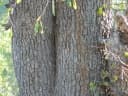
Berchemia discolor
Berchemia discolor
Safety & Hazards
None known
Cultivation Details
A plant of the tropics and subtropics, growing naturally in various climates, from semi-arid areas to areas receiving rainfall in 4 years out of 5, where it is found at elevations up to 1,900 metres. It grows best in areas where annual daytime temperatures are within the range 14 - 30°c, but can tolerate 10 - 38°c[1]. It can be killed by frosts[1]. It prefers a mean annual rainfall in the range 400 - 1,000mm, but tolerates 200 - 1,400mm[1]. Prefers a position in full sun, tolerating light shade[1]. Succeeds in most well-drained soils of moderate to high fertility[1]. Prefers a pH in the range 5 - 7, tolerating 4.5 - 7.5[1]. Established plants are drought tolerant[1]. The growth rate is relatively fast, 600 - 800 mm/year[2]. A good tree to plant at or near watering points, as its roots are not aggressive[2]. The tree responds well to coppicing and pollarding[2].
Propagation
Seed - germination takes some time due to the hard seed coat, it can be sped up by scarifying the seed or immersing it in hot water and then allowing the water to cool for 12 hours[3]. Root suckers. Cite as: Tropical Plants Database, Ken Fern. tropical.theferns.info. 2026-02-19. <tropical.theferns.info/viewtropical.php?id=Berchemia+discolor>
Pollinators
Bees
References
- [1]Ecocrop — http://ecocrop.fao.org/ecocrop/srv/en/home ↩︎Basic information on a wide range of useful plants, plus details of environmental needs where available.
- [2]World Agroforesty Centre — http://www.worldagroforestry.org/ ↩︎An excellent online database of a huge range of trees giving very good information on each plant - its uses, ecology, identity, propagation, pests etc.
- [3]Indigenous multipurpose trees of Tanzania. — Hines. D.A. & Eckman. K. · 1993 · ISBN 0-9697075-0-9 ↩︎A simple handbook with information on over 50 species of trees found in Tanzania giving details of environmental requirements, cultivation needs, uses etc. It can be downloaded from the Internet.
- [4]Edible Wild Plants of Tanzania — Ruffo, C.K.: Birnie, A. & Tengnas, B. · Regional Land Management Unit; Nairobi. · 2002 · ISBN 9966-896-60-0 ↩︎A very well presented, simple guide to growing and utilizing wild food plants in Tanzania, with line drawings of each plant, a description, habitat and range, non-food as well as food uses, plus basic information on growing the plants.
- [5]Field Guide to the Moist Forest Trees of Tanzania. — Lovett J.C.; Ruffo C.K.; Gereau R.E.; Taplin J.R.D · Frontier · http://www.york.ac.uk/res/celp/webpages/projects/ecology/tree%20guide/introduction.htm · ISBN 1-873070-33-0 ↩︎A lovely little book giving a basic identification guide to more than 650 species of trees growing in Tanzania. It is also available to view on the internet.