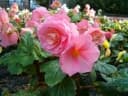
Begonia ×tuberhybrida
Begonia ×tuberhybrida
Safety & Hazards
The plant contains relatively high levels of oxalic acid[1]. Perfectly alright (and tasty) in small quantities, it is best not to eat large amounts of this plant since oxalic acid can bind up the body's supply of calcium leading to nutritional deficiency. It is oxalic acid that gives foods such as rhubarb their acid flavour. Cooking greatly reduces the oxalic acid content. People with a tendency to rheumatism, arthritis, gout, kidney stones or hyperacidity should take especial caution if including this plant in their diet since it can aggravate their condition[2].
Cultivation Details
Grows best in bright, filtered light[3]. Three flower buds are produced from each leaf axil - the two outer of these are female and the inner one male. The male flower is larger and more showy and so many growers remove the females before they flower[3].
Propagation
Seed - Cite as: Tropical Plants Database, Ken Fern. tropical.theferns.info. 2026-02-19. <tropical.theferns.info/viewtropical.php?id=Begonia+%C3%97tuberhybrida>
Pollinators
Data unavailable
References
- [1]Cornucopia II — Facciola. S. · Kampong Publications, California. · 1998 · ISBN 0-9628087-2-5 ↩︎The second edition of an excellent guide to the edible uses of plants, though it does not give any details of cultivation etc.
- [2]Encyclopaedia of Herbs and their Uses. — Bown. D. · Dorling Kindersley, London. · 1995 · ISBN 0-7513-020-31 ↩︎A very well presented and informative book on herbs from around the globe. Plenty in it for both the casual reader and the serious student. Just one main quibble is the silly way of having two separate entries for each plant.
- [3]The New RHS Dictionary of Gardening. 1992. — Huxley. A. · MacMillan Press · 1992 · ISBN 0-333-47494-5 ↩︎Excellent and very comprehensive, though it contains a number of silly mistakes. Readable yet also very detailed.