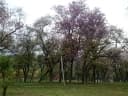
Bauhinia variegata
Bauhinia variegata
Safety & Hazards
None known
Cultivation Details
Mountain ebony is a plant of tropical and subtropical climates with hot, dry summers and mild winters. It grows best at an altitude up to 1,800 metres with a mean maximum temperature in the range 30 - 42°c and a mean minimum temperature in the range 7 - 14°c[1]. Plants can experience occasional temperatures down to -2°c in their native range[2]. The mean annual rainfall should be in the range 500 - 2,550mm[1]. Prefers a fertile, moisture-retentive but well-drained soil, requiring a position in full sun[3, 4, 1]. The tree is fairly resistant to drought but susceptible to fires[1] Some care should be taken before introducing the plant into new areas because it can become invasive[5]. A fast-growing tree - under ideal conditions one year old seedlings can attain a height of more than 2 metres[2]. The tree starts flowering at a very early age of 2 - 3 years[1]. The tree coppices well and can stand heavy lopping fairly well[1]. There are some named varieties[3]. Although many species within the family Fabaceae have a symbiotic relationship with soil bacteria, this species is said to be devoid of such a relationship and therefore does not fix atmospheric nitrogen[6].
Propagation
Seed - pre-soak for 24 hours in warm water then sow in situ[1]. This is more successful than growing in a nursery bed and planting out when one year old[1]. If sowing in a nursery seedbed, then the plants should be placed in their final positions whilst they are still small - they can attain a height of 1 metre within 1 month of germinating, with roots 50cm long[2]. The seed germinates readily within 4 - 10 days, showing a high degree of fertility even after 12 months storage[2]. Cuttings of half-ripe wood, with the leaves removed, in moist sand July/August in a frame[3]. Gentle bottom heat is usually required. Cuttings root only with difficulty[1]. Layering. Cite as: Tropical Plants Database, Ken Fern. tropical.theferns.info. 2026-02-19. <tropical.theferns.info/viewtropical.php?id=Bauhinia+variegata>
Pollinators
Bees
References
- [1]World Agroforesty Centre — http://www.worldagroforestry.org/ ↩︎An excellent online database of a huge range of trees giving very good information on each plant - its uses, ecology, identity, propagation, pests etc.
- [2]The Silviculture of Indian Trees — Troup. R.S. · Oxford, at the Clarendon Press · 1921 · http://www.biodiversitylibrary.org ↩︎An excellent treatment.
- [3]The New RHS Dictionary of Gardening. 1992. — Huxley. A. · MacMillan Press · 1992 · ISBN 0-333-47494-5 ↩︎Excellent and very comprehensive, though it contains a number of silly mistakes. Readable yet also very detailed.
- [4]Conservatory and Indoor Plants Volumes 1 & 2 — Phillips. R. & Rix. M. · Pan Books, London. · 1998 · ISBN 0-330-37376-5 ↩︎Excellent photos of over 1,100 species and cultivars with habits and cultivation details plus a few plant uses. Many species are too tender for outdoors in Britain though there are many that can be grown outside.
- [5]Tropical and Subtropical Trees - A Worldwide Encyclopaedic Guide. — Barwick. M. · Thames & Hudson, London · 2004 · ISBN 0-500-51181-0 ↩︎A superb book, very concise and well written, giving a wealth of information on 400 or more species including descriptions, habitat, cultivation details and plant uses. A wealth of colour photographs bring each plant vividly to life.
- [6]Nodulation Plants in GRIN Taxonomy — United States Department of Agriculture · http://www.ars-grin.gov/~sbmljw/cgi-bin/taxnodul.pl?language=en ↩︎An online database listing plants that have either positive or negative reports on root and stem nodulation with nitrogen-fixing bacteria.
- [7]Dominica Botanic Gardens — http://www.da-academy.org/trees_shrubs.html ↩︎An on-line resource, providing top quality pictures and some basic information on various plants being grown at the Botanic Gardens, often including uses and habitat.
- [8]Mansfeld's Database of Agricultural and Horticultural Plants — http://mansfeld.ipk-gatersleben.de/pls/htmldb_pgrc/f?p=185:3:4292127278597336 ↩︎Terse details of a huge range of useful plants.
- [9]IUCN Red List of Threatened Species — http://www.iucnredlist.org/ ↩︎A list of plants under threat and facing possible extinction, usually with brief details of the threats and information on habitat.
- [10]Plants and People of Nepal — Manandhar. N. P. · Timber Press. Oregon. · 2002 · ISBN 0-88192-527-6 ↩︎Excellent book, covering over 1,500 species of useful plants from Nepal together with information on the geography and peoples of Nepal. Good descriptions of the plants with terse notes on their uses.
- [11]Dictionary of Economic Plants. — Uphof. J. C. Th. · Weinheim · 1959 · ISBN - ↩︎An excellent and very comprehensive guide but it only gives very short descriptions of the uses without any details of how to utilize the plants. Not for the casual reader.
- [12]Cornucopia II — Facciola. S. · Kampong Publications, California. · 1998 · ISBN 0-9628087-2-5 ↩︎The second edition of an excellent guide to the edible uses of plants, though it does not give any details of cultivation etc.
- [13]Medicinal Plants of Nepal — Dept. of Medicinal Plants. Nepal. · 1993 · ISBN - ↩︎Terse details of the medicinal properties of Nepalese plants, including cultivated species and a few imported herbs.
- [14]Ethnobotanical Studies of Useful Trees of District Kotli, Azad Jammu and Kashmir — Muhammad Ajaib & Zaheer-Ud-Din Khan · 2014 · ISBN 2313-206X ↩︎