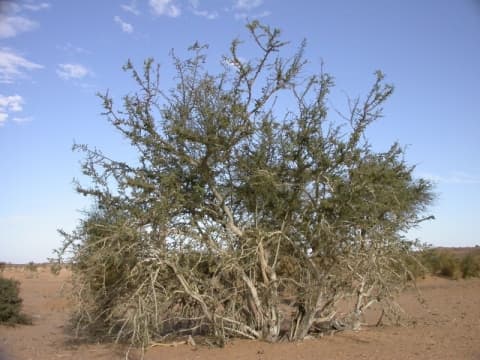
Bauhinia rufescens
Bauhinia rufescens
Safety & Hazards
None known
Cultivation Details
A plant of the drier tropics, where it is found at elevations up to 800 metres. It grows best in areas where annual daytime temperatures are within the range 30 - 40°c, but can tolerate 20 - 46°c[1]. It prefers a mean annual rainfall in the range 400 - 1,000mm, but tolerates 250 - 1,200mm[1]. Prefers a fertile, moisture-retentive but well-drained soil and a position in full sun[2]. Tolerant of dry, sandy soils as well as stony, clayey and lateritic soils[3]. Prefers a pH in the range 5.5 - 7.5, tolerating 5 - 8[1]. Growth of young plants in their native environment is fairly slow, with a height of 1 metre expected after 2 years where the annual rainfall is 500 mm[4]. The plant regenerates quickly and abundantly after browsing[4]. This species is very similar to the Asian species B. Racemosa[2]. Bees are attracted to the flowers[5]. Although many species within the family Fabaceae have a symbiotic relationship with soil bacteria, this species is said to be devoid of such a relationship and therefore does not fix atmospheric nitrogen[6].
Propagation
Seed - it has a hard seedcoat and needs scarification before sowing to speed up germination. This can usually be done by pouring a small amount of nearly boiling water on the seeds (being careful not to cook them!) and then soaking them for 12 - 24 hours in warm water. By this time they should have imbibed moisture and swollen - if they have not, then carefully make a nick in the seedcoat (being careful not to damage the embryo) and soak for a further 12 hours. Trees are normally ready for planting out 4 - 6 months after germination[4]. Cuttings of half-ripe wood, with the leaves removed, placed in moist sand[2]. Good rooting has been observed on cuttings, with 85% producing roots in 2 weeks. The cuttings rooted better in a sand or a sand-gravel mixture, and upper nodes rooted better than basal nodes[4]. Cite as: Tropical Plants Database, Ken Fern. tropical.theferns.info. 2026-02-19. <tropical.theferns.info/viewtropical.php?id=Bauhinia+rufescens>
Pollinators
Bees
References
- [1]Ecocrop — http://ecocrop.fao.org/ecocrop/srv/en/home ↩︎Basic information on a wide range of useful plants, plus details of environmental needs where available.
- [2]The New RHS Dictionary of Gardening. 1992. — Huxley. A. · MacMillan Press · 1992 · ISBN 0-333-47494-5 ↩︎Excellent and very comprehensive, though it contains a number of silly mistakes. Readable yet also very detailed.
- [3]Trees and Shrubs of the Sahel. Their Characteristics and Uses. — von Maydell H. · Deutsche Gesellschaft fur Technische Zusammenarbeit; Germany · 1990 · ISBN 3-8236-1198-4 ↩︎A well-researched book, usually with more than one photograph of each species and good information on the plant and its uses.
- [4]World Agroforesty Centre — http://www.worldagroforestry.org/ ↩︎An excellent online database of a huge range of trees giving very good information on each plant - its uses, ecology, identity, propagation, pests etc.
- [5]Tropical and Subtropical Trees - A Worldwide Encyclopaedic Guide. — Barwick. M. · Thames & Hudson, London · 2004 · ISBN 0-500-51181-0 ↩︎A superb book, very concise and well written, giving a wealth of information on 400 or more species including descriptions, habitat, cultivation details and plant uses. A wealth of colour photographs bring each plant vividly to life.
- [6]Nodulation Plants in GRIN Taxonomy — United States Department of Agriculture · http://www.ars-grin.gov/~sbmljw/cgi-bin/taxnodul.pl?language=en ↩︎An online database listing plants that have either positive or negative reports on root and stem nodulation with nitrogen-fixing bacteria.
- [7]African Flowering Plants Database — Conservatoire et Jardin Botaniques. · http://www.ville-ge.ch/musinfo/bd/cjb/africa/recherche.php ↩︎Contains information on over 150,000 plant names (including synonyms) giving a description and habitat, plus a distribution map.
- [8]The Useful Plants of West Tropical Africa. — Burkil. H. M. · Royal Botanic Gardens; Kew. · 1985 - 2004 ↩︎Brief descriptions and details of the uses of over 4,000 plants. A superb, if terse, resource, it is also available electronically on the Web - see http://www.aluka.org/
- [9]Dictionary of Economic Plants. — Uphof. J. C. Th. · Weinheim · 1959 · ISBN - ↩︎An excellent and very comprehensive guide but it only gives very short descriptions of the uses without any details of how to utilize the plants. Not for the casual reader.